 Add to Chrome
 Add to Firefox
 Add to Edge
Physics-Aligned Self-Supervised Learning for Scientific Imaging
Jul 30, 2026
Data augmentations define the invariances learned by self-supervised learning (SSL). Standard augmentation pipelines were designed for natural images, yet scientific imaging modalities are governed by physical measurement processes with distinct symmetry and acquisition constraints. Enforcing invariances that contradict these constraints can distort learned representations and limit downstream performance, but practitioners moving from machine learning into a new scientific modality currently have little guidance beyond transferring natural-image pipelines unexamined. We address this gap with a principled, reproducible procedure for augmentation design in scientific SSL: we formalise the physics-aligned augmentation set as a union of measurement-consistent symmetries and acquisition-driven perturbations, and we give a concrete, largely label-free workflow---enumerate candidates, label each by the measurement operator, validate with representation-geometry diagnostics, and confirm by single-factor ablation---for selecting them. We instantiate the procedure for real-space electron microscopy and reciprocal-space 4D-STEM diffraction, and evaluate it across five SSL paradigms (DINOv2, SimCLR, MAE, VICRegL, I-JEPA) on classification and crystal-orientation regression. Physics-aligned augmentations substantially improve downstream performance for objectives relying on cross-view consistency, reduce geodesic error and improve robustness under realistic acquisition variability (detector gain, resolution loss), and systematically reshape representation geometry. While our experiments use electron microscopy, the procedure is modality-agnostic and applies to other measurement-driven domains such as medical and remote-sensing imaging. These results position augmentation design as a primary, and controllable, source of inductive bias in scientific self-supervised learning.

MatBind: A Shared Embedding Space for Multimodal Materials Characterization
Jul 09, 2026Fully characterizing a crystalline material requires integrating heterogeneous data sources -- atomic structures, diffraction patterns, electronic density of states, and natural language -- each of which captures a different facet of the same physical object. In practice, however, these modalities are stored and analyzed in isolation, making it difficult to relate or query materials across representational boundaries. We present MatBind, a contrastive learning framework that aligns four materials modalities -- crystal structure, powder X-ray diffraction (pXRD) simulated from structures, density of states (DOS), and text -- into a unified embedding space using crystal structure as the central physical anchor. The framework induces alignment between modalities never explicitly paired during training, enabling emergent zero-shot cross-modal retrieval as a direct consequence of the shared representation. The learned embedding space organizes materials according to physically meaningful properties without explicit supervision, and retrieval performance improves systematically when modalities are combined at query time. These results demonstrate that treating heterogeneous materials data as complementary projections of a single physical reality, rather than as isolated data sources, is not a practical choice but is consistent with the underlying physics.
Ontology-based knowledge graph infrastructure for interoperable atomistic simulation data
Mar 31, 2026The reuse of atomistic simulation data is often limited by heterogeneous formats, incomplete metadata, and a lack of standardized representations of workflows and provenance. Here we present an ontology-based infrastructure for representing and integrating atomistic simulation data as a knowledge graph. The approach combines domain ontologies with a software framework that enables data capture both from existing datasets and directly from simulation workflows at the point of generation. Heterogeneous data from multiple sources are normalized into a common, ontology-aligned representation, enabling consistent querying and analysis across datasets. We demonstrate these capabilities through the integration of grain boundary data, cross-dataset analysis of material properties, and extraction of derived thermodynamic quantities from existing simulations. In addition, workflows are represented in a machine-readable form, enabling both forward provenance tracking and partial reconstruction of computational procedures. The resulting knowledge graph contains over 750,000 triples describing nearly 8,000 computational samples. This work provides a practical framework for improving the findability, interoperability, and reuse of atomistic simulation data.
Towards knowledge-based workflows: a semantic approach to atomistic simulations for mechanical and thermodynamic properties
Feb 01, 2026Mechanical and thermodynamic properties, including the influence of crystal defects, are critical for evaluating materials in engineering applications. Molecular dynamics simulations provide valuable insight into these mechanisms at the atomic scale. However, current practice often relies on fragmented scripts with inconsistent metadata and limited provenance, which hinders reproducibility, interoperability, and reuse. FAIR data principles and workflow-based approaches offer a path to address these limitations. We present reusable atomistic workflows that incorporate metadata annotation aligned with application ontologies, enabling automatic provenance capture and FAIR-compliant data outputs. The workflows cover key mechanical and thermodynamic quantities, including equation of state, elastic tensors, mechanical loading, thermal properties, defect formation energies, and nanoindentation. We demonstrate validation of structure-property relations such as the Hall-Petch effect and show that the workflows can be reused across different interatomic potentials and materials within a coherent semantic framework. The approach provides AI-ready simulation data, supports emerging agentic AI workflows, and establishes a generalizable blueprint for knowledge-based mechanical and thermodynamic simulations.
Ontology-aligned structuring and reuse of multimodal materials data and workflows towards automatic reproduction
Jan 18, 2026Reproducibility of computational results remains a challenge in materials science, as simulation workflows and parameters are often reported only in unstructured text and tables. While literature data are valuable for validation and reuse, the lack of machine-readable workflow descriptions prevents large-scale curation and systematic comparison. Existing text-mining approaches are insufficient to extract complete computational workflows with their associated parameters. An ontology-driven, large language model (LLM)-assisted framework is introduced for the automated extraction and structuring of computational workflows from the literature. The approach focuses on density functional theory-based stacking fault energy (SFE) calculations in hexagonal close-packed magnesium and its binary alloys, and uses a multi-stage filtering strategy together with prompt-engineered LLM extraction applied to method sections and tables. Extracted information is unified into a canonical schema and aligned with established materials ontologies (CMSO, ASMO, and PLDO), enabling the construction of a knowledge graph using atomRDF. The resulting knowledge graph enables systematic comparison of reported SFE values and supports the structured reuse of computational protocols. While full computational reproducibility is still constrained by missing or implicit metadata, the framework provides a foundation for organizing and contextualizing published results in a semantically interoperable form, thereby improving transparency and reusability of computational materials data.
Out-of-distribution generalization of deep-learning surrogates for 2D PDE-generated dynamics in the small-data regime
Jan 13, 2026Partial differential equations (PDEs) are a central tool for modeling the dynamics of physical, engineering, and materials systems, but high-fidelity simulations are often computationally expensive. At the same time, many scientific applications can be viewed as the evolution of spatially distributed fields, making data-driven forecasting of such fields a core task in scientific machine learning. In this work we study autoregressive deep-learning surrogates for two-dimensional PDE dynamics on periodic domains, focusing on generalization to out-of-distribution initial conditions within a fixed PDE and parameter regime and on strict small-data settings with at most $\mathcal{O}(10^2)$ simulated trajectories per system. We introduce a multi-channel U-Net [...], evaluate it on five qualitatively different PDE families and compare it to ViT, AFNO, PDE-Transformer, and KAN-UNet under a common training setup. Across all datasets, me-UNet matches or outperforms these more complex architectures in terms of field-space error, spectral similarity, and physics-based metrics for in-distribution rollouts, while requiring substantially less training time. It also generalizes qualitatively to unseen initial conditions with as few as $\approx 20$ training simulations. A data-efficiency study and Grad-CAM analysis further suggest that, in small-data periodic 2D PDE settings, convolutional architectures with inductive biases aligned to locality and periodic boundary conditions remain strong contenders for accurate and moderately out-of-distribution-robust surrogate modeling.
Self-Supervised Learning in Electron Microscopy: Towards a Foundation Model for Advanced Image Analysis
Feb 28, 2024
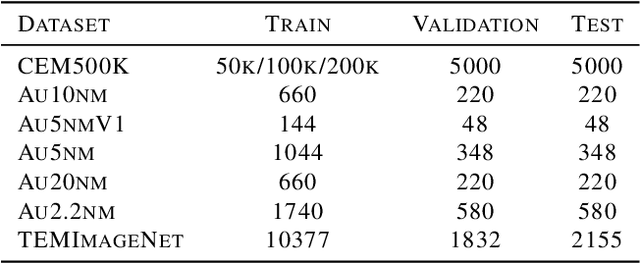
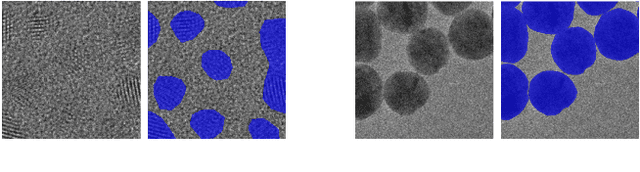

In this work, we explore the potential of self-supervised learning from unlabeled electron microscopy datasets, taking a step toward building a foundation model in this field. We show how self-supervised pretraining facilitates efficient fine-tuning for a spectrum of downstream tasks, including semantic segmentation, denoising, noise & background removal, and super-resolution. Experimentation with varying model complexities and receptive field sizes reveals the remarkable phenomenon that fine-tuned models of lower complexity consistently outperform more complex models with random weight initialization. We demonstrate the versatility of self-supervised pretraining across various downstream tasks in the context of electron microscopy, allowing faster convergence and better performance. We conclude that self-supervised pretraining serves as a powerful catalyst, being especially advantageous when limited annotated data are available and efficient scaling of computational cost are important.
Combining unsupervised and supervised learning in microscopy enables defect analysis of a full 4H-SiC wafer
Feb 20, 2024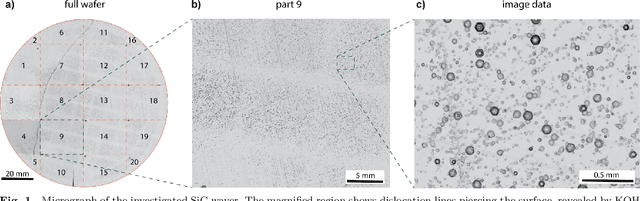
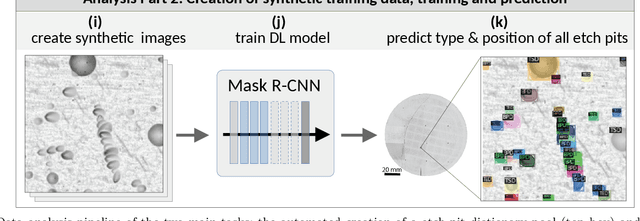
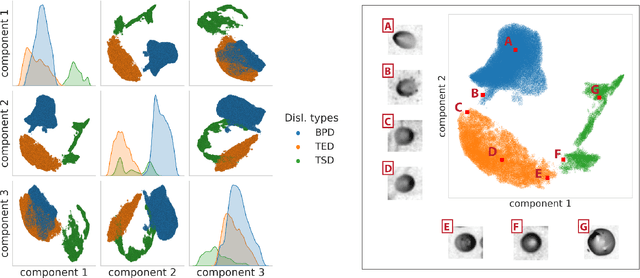
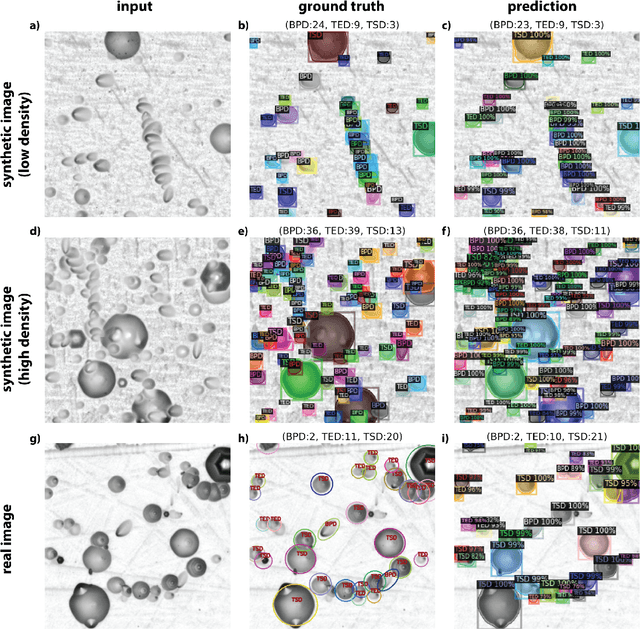
Detecting and analyzing various defect types in semiconductor materials is an important prerequisite for understanding the underlying mechanisms as well as tailoring the production processes. Analysis of microscopy images that reveal defects typically requires image analysis tasks such as segmentation and object detection. With the permanently increasing amount of data that is produced by experiments, handling these tasks manually becomes more and more impossible. In this work, we combine various image analysis and data mining techniques for creating a robust and accurate, automated image analysis pipeline. This allows for extracting the type and position of all defects in a microscopy image of a KOH-etched 4H-SiC wafer that was stitched together from approximately 40,000 individual images.
DISO: A Domain Ontology for Modeling Dislocations in Crystalline Materials
Jan 04, 2024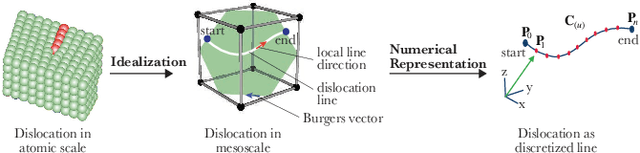
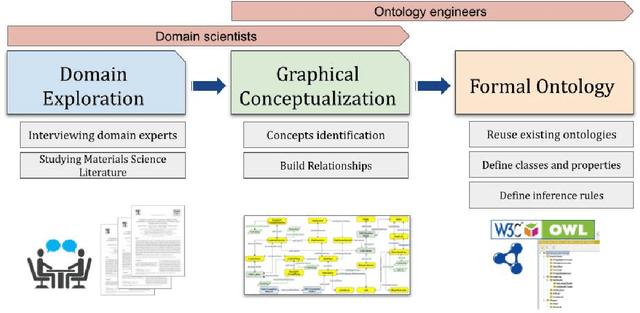
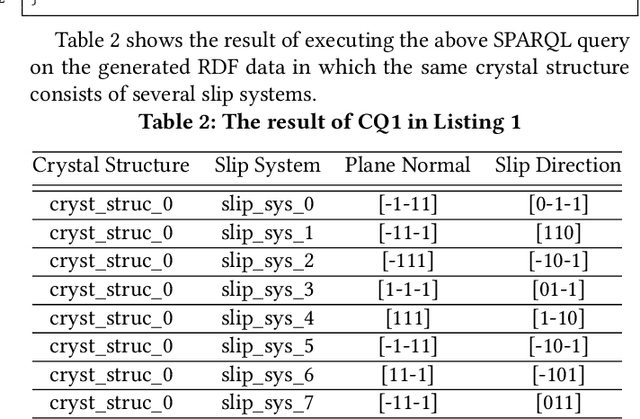
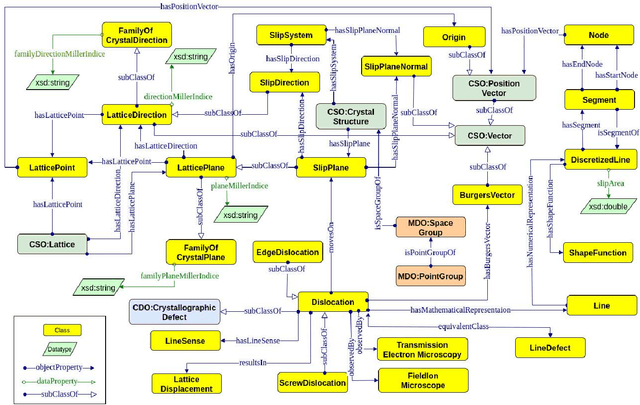
Crystalline materials, such as metals and semiconductors, nearly always contain a special defect type called dislocation. This defect decisively determines many important material properties, e.g., strength, fracture toughness, or ductility. Over the past years, significant effort has been put into understanding dislocation behavior across different length scales via experimental characterization techniques and simulations. This paper introduces the dislocation ontology (DISO), which defines the concepts and relationships related to linear defects in crystalline materials. We developed DISO using a top-down approach in which we start defining the most general concepts in the dislocation domain and subsequent specialization of them. DISO is published through a persistent URL following W3C best practices for publishing Linked Data. Two potential use cases for DISO are presented to illustrate its usefulness in the dislocation dynamics domain. The evaluation of the ontology is performed in two directions, evaluating the success of the ontology in modeling a real-world domain and the richness of the ontology.
Machine learning for structure-guided materials and process design
Dec 22, 2023
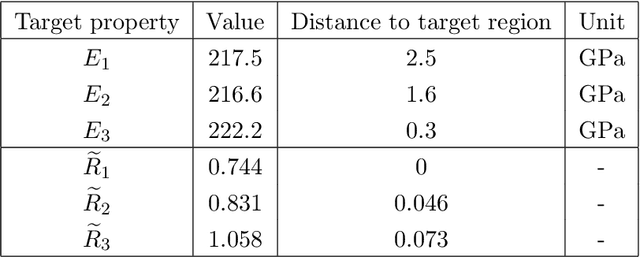
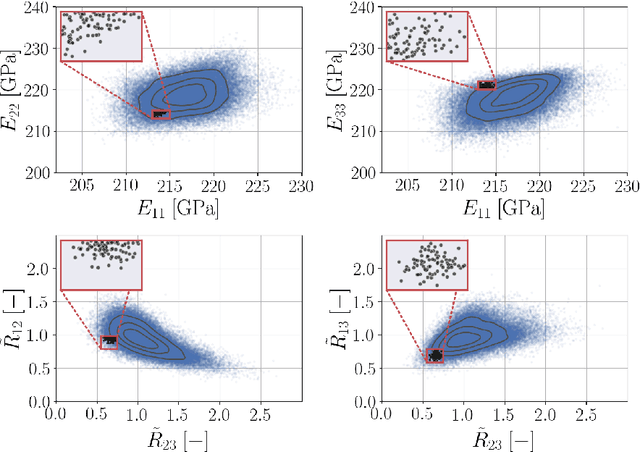

In recent years, there has been a growing interest in accelerated materials innovation in both, research and industry. However, to truly add value to the development of new advanced materials, it is inevitable to take into account manufacturing processes and thereby tailor materials design approaches to support downstream process design approaches. As a major step into this direction, we present a holistic optimization approach that covers the entire materials process-structure-property chain. Our approach specifically employs machine learning techniques to address two critical identification problems. The first is to solve a materials design problem, which involves identifying near-optimal material structures that exhibit desired macroscopic properties. The second is to solve a process design problem that is to find an optimal processing path to manufacture these material structures. Both identification problems are typically ill-posed, which presents a significant challenge for solution approaches. However, the non-unique nature of these problems also offers an important advantage for processing: By having several target structures that perform similarly well, the corresponding processes can be efficiently guided towards manufacturing the best reachable structure. In particular, we apply deep reinforcement learning for process design in combination with a multi-task learning-based optimization approach for materials design. The functionality of the approach will be demonstrated by using it to manufacture crystallographic textures with desired properties in a metal forming process.