 Add to Chrome
 Add to Firefox
 Add to Edge
Physics-Aligned Self-Supervised Learning for Scientific Imaging
Jul 30, 2026
Data augmentations define the invariances learned by self-supervised learning (SSL). Standard augmentation pipelines were designed for natural images, yet scientific imaging modalities are governed by physical measurement processes with distinct symmetry and acquisition constraints. Enforcing invariances that contradict these constraints can distort learned representations and limit downstream performance, but practitioners moving from machine learning into a new scientific modality currently have little guidance beyond transferring natural-image pipelines unexamined. We address this gap with a principled, reproducible procedure for augmentation design in scientific SSL: we formalise the physics-aligned augmentation set as a union of measurement-consistent symmetries and acquisition-driven perturbations, and we give a concrete, largely label-free workflow---enumerate candidates, label each by the measurement operator, validate with representation-geometry diagnostics, and confirm by single-factor ablation---for selecting them. We instantiate the procedure for real-space electron microscopy and reciprocal-space 4D-STEM diffraction, and evaluate it across five SSL paradigms (DINOv2, SimCLR, MAE, VICRegL, I-JEPA) on classification and crystal-orientation regression. Physics-aligned augmentations substantially improve downstream performance for objectives relying on cross-view consistency, reduce geodesic error and improve robustness under realistic acquisition variability (detector gain, resolution loss), and systematically reshape representation geometry. While our experiments use electron microscopy, the procedure is modality-agnostic and applies to other measurement-driven domains such as medical and remote-sensing imaging. These results position augmentation design as a primary, and controllable, source of inductive bias in scientific self-supervised learning.

MatBind: A Shared Embedding Space for Multimodal Materials Characterization
Jul 09, 2026Fully characterizing a crystalline material requires integrating heterogeneous data sources -- atomic structures, diffraction patterns, electronic density of states, and natural language -- each of which captures a different facet of the same physical object. In practice, however, these modalities are stored and analyzed in isolation, making it difficult to relate or query materials across representational boundaries. We present MatBind, a contrastive learning framework that aligns four materials modalities -- crystal structure, powder X-ray diffraction (pXRD) simulated from structures, density of states (DOS), and text -- into a unified embedding space using crystal structure as the central physical anchor. The framework induces alignment between modalities never explicitly paired during training, enabling emergent zero-shot cross-modal retrieval as a direct consequence of the shared representation. The learned embedding space organizes materials according to physically meaningful properties without explicit supervision, and retrieval performance improves systematically when modalities are combined at query time. These results demonstrate that treating heterogeneous materials data as complementary projections of a single physical reality, rather than as isolated data sources, is not a practical choice but is consistent with the underlying physics.
Self-Supervised Learning in Electron Microscopy: Towards a Foundation Model for Advanced Image Analysis
Feb 28, 2024
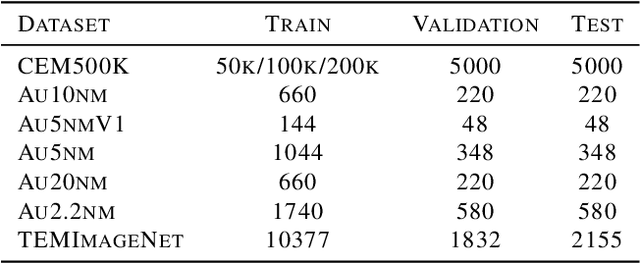
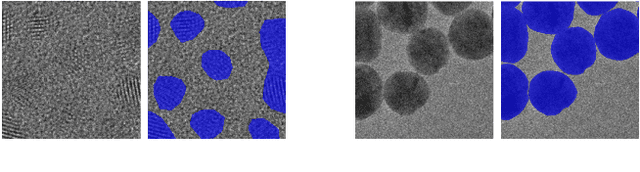

In this work, we explore the potential of self-supervised learning from unlabeled electron microscopy datasets, taking a step toward building a foundation model in this field. We show how self-supervised pretraining facilitates efficient fine-tuning for a spectrum of downstream tasks, including semantic segmentation, denoising, noise & background removal, and super-resolution. Experimentation with varying model complexities and receptive field sizes reveals the remarkable phenomenon that fine-tuned models of lower complexity consistently outperform more complex models with random weight initialization. We demonstrate the versatility of self-supervised pretraining across various downstream tasks in the context of electron microscopy, allowing faster convergence and better performance. We conclude that self-supervised pretraining serves as a powerful catalyst, being especially advantageous when limited annotated data are available and efficient scaling of computational cost are important.