 Add to Chrome
 Add to Firefox
 Add to Edge
Crystal structure prediction using graph neural combinatorial optimization
Apr 27, 2026
Crystalline materials are widely used in technological applications, yet their discovery remains a significant challenge. As their properties are driven by structure, crystal structure prediction (CSP) methods play a central role in computational approaches aiming to accelerate this process. Previously, CSP has been approached from a combinatorial optimization perspective, with the core challenge of allocating atoms on a fine grid of predefined discrete positions within a unit cell while minimizing their interaction energy. Exact mathematical optimization methods provide guaranteed solutions, but they become computationally expensive for large-scale instances, where the atomic configuration space grows rapidly, particularly in the absence of additional symmetry constraints. In this work, we introduce a neural combinatorial optimization approach to the atom allocation challenge and, subsequently, CSP, based on graph neural networks (GNNs), which can effectively sample from the distribution of feasible structures in an unsupervised manner. We leverage expander graphs to construct computational graphs over discrete positions that capture both short- and long-range interactions between atoms, and employ the Gumbel-Sinkhorn approach to enforce the desired stoichiometry of the generated structures. We demonstrate that our method outperforms classical heuristic approaches and is competitive with a commercial optimization solver across a range of chemical compositions. This enables the use of ever-expanding GPU infrastructure to tackle the inherent combinatorial challenges of CSP, paving the way for scaling beyond current capabilities.

On Background Bias of Post-Hoc Concept Embeddings in Computer Vision DNNs
Apr 11, 2025The thriving research field of concept-based explainable artificial intelligence (C-XAI) investigates how human-interpretable semantic concepts embed in the latent spaces of deep neural networks (DNNs). Post-hoc approaches therein use a set of examples to specify a concept, and determine its embeddings in DNN latent space using data driven techniques. This proved useful to uncover biases between different target (foreground or concept) classes. However, given that the background is mostly uncontrolled during training, an important question has been left unattended so far: Are/to what extent are state-of-the-art, data-driven post-hoc C-XAI approaches themselves prone to biases with respect to their backgrounds? E.g., wild animals mostly occur against vegetation backgrounds, and they seldom appear on roads. Even simple and robust C-XAI methods might abuse this shortcut for enhanced performance. A dangerous performance degradation of the concept-corner cases of animals on the road could thus remain undiscovered. This work validates and thoroughly confirms that established Net2Vec-based concept segmentation techniques frequently capture background biases, including alarming ones, such as underperformance on road scenes. For the analysis, we compare 3 established techniques from the domain of background randomization on >50 concepts from 2 datasets, and 7 diverse DNN architectures. Our results indicate that even low-cost setups can provide both valuable insight and improved background robustness.
Cluster Exploration using Informative Manifold Projections
Sep 26, 2023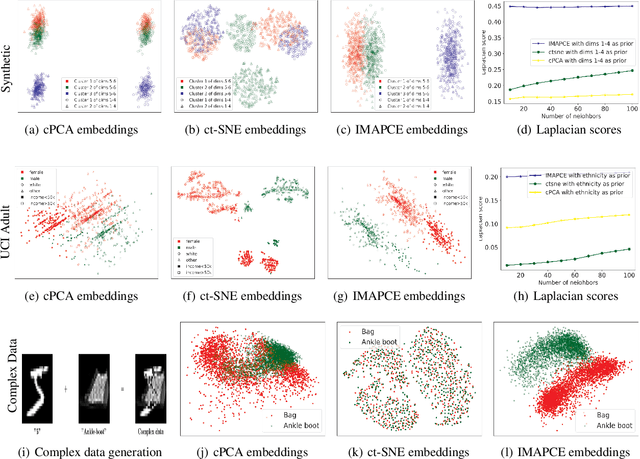
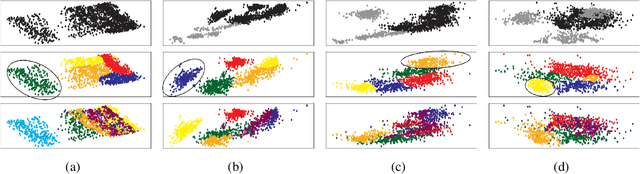
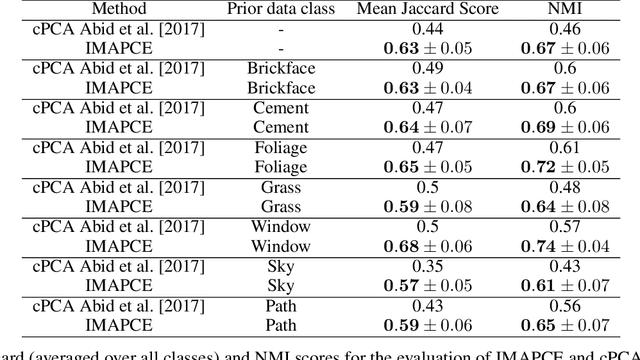
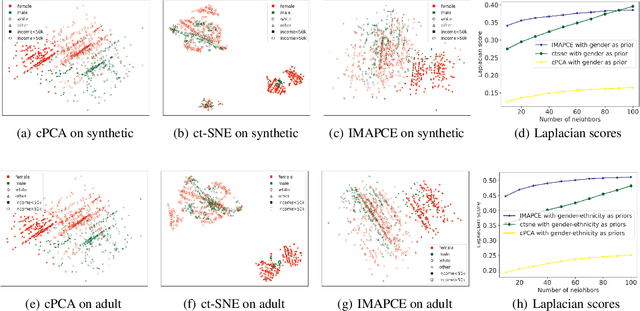
Dimensionality reduction (DR) is one of the key tools for the visual exploration of high-dimensional data and uncovering its cluster structure in two- or three-dimensional spaces. The vast majority of DR methods in the literature do not take into account any prior knowledge a practitioner may have regarding the dataset under consideration. We propose a novel method to generate informative embeddings which not only factor out the structure associated with different kinds of prior knowledge but also aim to reveal any remaining underlying structure. To achieve this, we employ a linear combination of two objectives: firstly, contrastive PCA that discounts the structure associated with the prior information, and secondly, kurtosis projection pursuit which ensures meaningful data separation in the obtained embeddings. We formulate this task as a manifold optimization problem and validate it empirically across a variety of datasets considering three distinct types of prior knowledge. Lastly, we provide an automated framework to perform iterative visual exploration of high-dimensional data.
SHREC 2021: Classification in cryo-electron tomograms
Mar 18, 2022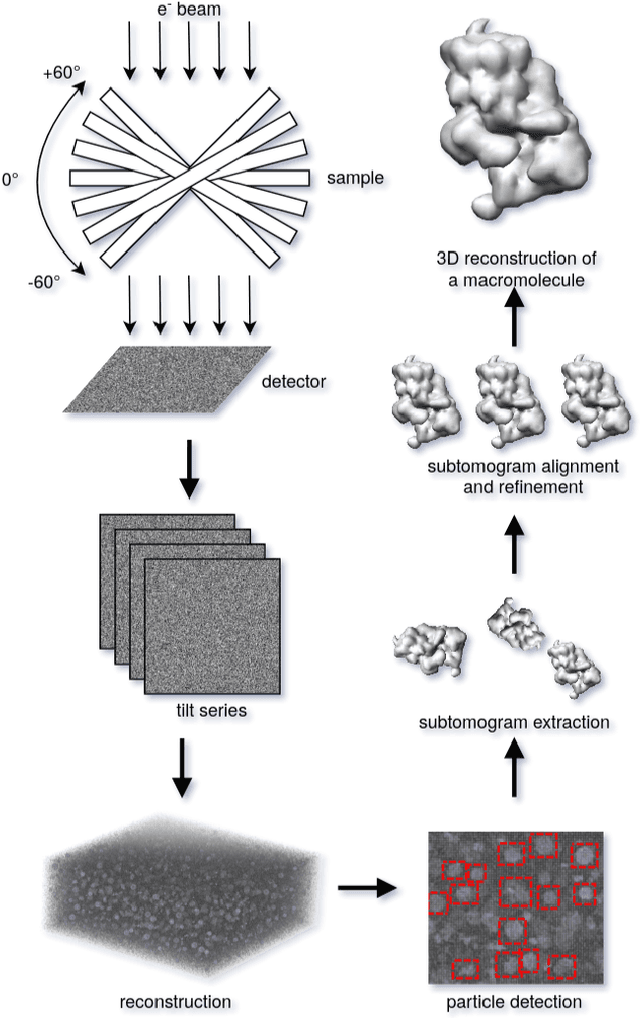
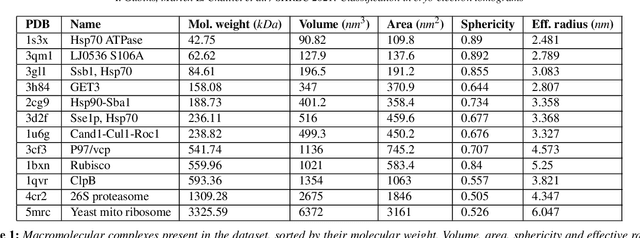
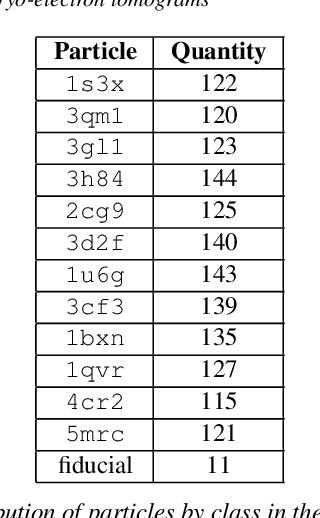
Cryo-electron tomography (cryo-ET) is an imaging technique that allows three-dimensional visualization of macro-molecular assemblies under near-native conditions. Cryo-ET comes with a number of challenges, mainly low signal-to-noise and inability to obtain images from all angles. Computational methods are key to analyze cryo-electron tomograms. To promote innovation in computational methods, we generate a novel simulated dataset to benchmark different methods of localization and classification of biological macromolecules in tomograms. Our publicly available dataset contains ten tomographic reconstructions of simulated cell-like volumes. Each volume contains twelve different types of complexes, varying in size, function and structure. In this paper, we have evaluated seven different methods of finding and classifying proteins. Seven research groups present results obtained with learning-based methods and trained on the simulated dataset, as well as a baseline template matching (TM), a traditional method widely used in cryo-ET research. We show that learning-based approaches can achieve notably better localization and classification performance than TM. We also experimentally confirm that there is a negative relationship between particle size and performance for all methods.