 Add to Chrome
 Add to Firefox
 Add to Edge
Measuring LLM Trust Allocation Across Conflicting Software Artifacts
Apr 03, 2026
LLM-based software engineering assistants fail not only by producing incorrect outputs, but also by allocating trust to the wrong artifact when code, documentation, and tests disagree. Existing evaluations focus mainly on downstream outcomes and therefore cannot reveal whether a model recognized degraded evidence, identified the unreliable source, or calibrated its trust across artifacts. We present TRACE (Trust Reasoning over Artifacts for Calibrated Evaluation), a framework that elicits structured artifact-level trust traces over Javadoc, method signatures, implementations, and test prefixes under blind perturbations. Using 22,339 valid traces from seven models on 456 curated Java method bundles, we evaluate per-artifact quality assessment, inconsistency detection, affected artifact attribution, and source prioritization. Across all models, quality penalties are largely localized to the perturbed artifact and increase with severity, but sensitivity is asymmetric across artifact types: documentation bugs induce a substantially larger heavy-to-subtle gap than implementation faults (0.152-0.253 vs. 0.049-0.123). Models detect explicit documentation bugs well (67-94%) and Javadoc and implementation contradictions at 50-91%, yet show a systematic blind spot when only the implementation drifts while the documentation remains plausible, with detection dropping by 7-42 percentage points. Confidence is poorly calibrated for six of seven models. These findings suggest that current LLMs are better at auditing natural-language specifications than at detecting subtle code-level drift, motivating explicit artifact-level trust reasoning before correctness-critical downstream use.

Training LLMs to Better Self-Debug and Explain Code
May 28, 2024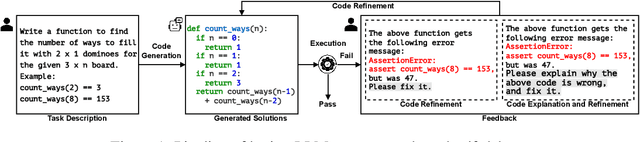


In the domain of code generation, self-debugging is crucial. It allows LLMs to refine their generated code based on execution feedback. This is particularly important because generating correct solutions in one attempt proves challenging for complex tasks. Prior works on self-debugging mostly focus on prompting methods by providing LLMs with few-shot examples, which work poorly on small open-sourced LLMs. In this work, we propose a training framework that significantly improves self-debugging capability of LLMs. Intuitively, we observe that a chain of explanations on the wrong code followed by code refinement helps LLMs better analyze the wrong code and do refinement. We thus propose an automated pipeline to collect a high-quality dataset for code explanation and refinement by generating a number of explanations and refinement trajectories and filtering via execution verification. We perform supervised fine-tuning (SFT) and further reinforcement learning (RL) on both success and failure trajectories with a novel reward design considering code explanation and refinement quality. SFT improves the pass@1 by up to 15.92% and pass@10 by 9.30% over four benchmarks. RL training brings additional up to 3.54% improvement on pass@1 and 2.55% improvement on pass@10. The trained LLMs show iterative refinement ability, and can keep refining code continuously. Lastly, our human evaluation shows that the LLMs trained with our framework generate more useful code explanations and help developers better understand bugs in source code.