 Add to Chrome
 Add to Firefox
 Add to Edge
Studying quantization trade-offs for efficient inference deployment in machine translation
Jul 31, 2026
Deploying large language models in realistic server environments poses challenges, as the system needs to provide high-quality responses with low latency. Quantization is a common approach to reduce the memory footprint and improve inference efficiency, yet its impact on latency and throughput is rarely evaluated under controlled, orchestration-level workloads. In this work we study the quantization trade-offs of two translation model families, EuroLLM \citep{martins2025eurollm} and Hy-MT2 \citep{zheng2026hy} across five models ranging from 1.7B to 22B for efficient deployment on a single A100 or H100 GPU. We demonstrate that combining a document-chunking strategy with W4A8 or W8A8 quantization improves the latency-throughput Pareto-curve under a wide range of workloads. Furthermore, since standard machine translation (MT) benchmarks rely on isolated sentences and fail to capture long-context dynamics, we introduce a document-level evaluation from WMT24++ to assess how text chunking strategies affect translation quality under quantization. Our results reveal that standard segment-level evaluation can fail to predict the interaction between quantization and long-context document translation. While Hy-MT2 remains robust under quantization, EuroLLM shows strong sensitivity and translation quality collapses rapidly for all considered quantization formats. Overall, our experiments show that the trade-off between inference efficiency and translation quality depends not only on the quantization format, but also on the choice of text chunking strategy.

The Price of Robustness: Stable Classifiers Need Overparameterization
Mar 03, 2026The relationship between overparameterization, stability, and generalization remains incompletely understood in the setting of discontinuous classifiers. We address this gap by establishing a generalization bound for finite function classes that improves inversely with class stability, defined as the expected distance to the decision boundary in the input domain (margin). Interpreting class stability as a quantifiable notion of robustness, we derive as a corollary a law of robustness for classification that extends the results of Bubeck and Sellke beyond smoothness assumptions to discontinuous functions. In particular, any interpolating model with $p \approx n$ parameters on $n$ data points must be unstable, implying that substantial overparameterization is necessary to achieve high stability. We obtain analogous results for parameterized infinite function classes by analyzing a stronger robustness measure derived from the margin in the codomain, which we refer to as the normalized co-stability. Experiments support our theory: stability increases with model size and correlates with test performance, while traditional norm-based measures remain largely uninformative.
* 29 pages, 9 figures. Accepted at ICLR 2026
1-Bit Wonder: Improving QAT Performance in the Low-Bit Regime through K-Means Quantization
Feb 17, 2026Quantization-aware training (QAT) is an effective method to drastically reduce the memory footprint of LLMs while keeping performance degradation at an acceptable level. However, the optimal choice of quantization format and bit-width presents a challenge in practice. The full design space of quantization is not fully explored in the context of QAT, and the precise trade-off between quantization and downstream performance is poorly understood, as comparisons often rely solely on perplexity-based evaluations. In this work, we address these shortcomings with an empirical study of QAT in the low-bit regime. We show that k-means based weight quantization outperforms integer formats and can be implemented efficiently on standard hardware. Furthermore, we find that, under a fixed inference memory budget, the best performance on generative downstream tasks is achieved with $1$-bit quantized weights.
Graph Representational Learning: When Does More Expressivity Hurt Generalization?
May 16, 2025Graph Neural Networks (GNNs) are powerful tools for learning on structured data, yet the relationship between their expressivity and predictive performance remains unclear. We introduce a family of premetrics that capture different degrees of structural similarity between graphs and relate these similarities to generalization, and consequently, the performance of expressive GNNs. By considering a setting where graph labels are correlated with structural features, we derive generalization bounds that depend on the distance between training and test graphs, model complexity, and training set size. These bounds reveal that more expressive GNNs may generalize worse unless their increased complexity is balanced by a sufficiently large training set or reduced distance between training and test graphs. Our findings relate expressivity and generalization, offering theoretical insights supported by empirical results.
Graph Neural Networks for Enhancing Ensemble Forecasts of Extreme Rainfall
Apr 07, 2025Climate change is increasing the occurrence of extreme precipitation events, threatening infrastructure, agriculture, and public safety. Ensemble prediction systems provide probabilistic forecasts but exhibit biases and difficulties in capturing extreme weather. While post-processing techniques aim to enhance forecast accuracy, they rarely focus on precipitation, which exhibits complex spatial dependencies and tail behavior. Our novel framework leverages graph neural networks to post-process ensemble forecasts, specifically modeling the extremes of the underlying distribution. This allows to capture spatial dependencies and improves forecast accuracy for extreme events, thus leading to more reliable forecasts and mitigating risks of extreme precipitation and flooding.
Generalization Bounds for Message Passing Networks on Mixture of Graphons
Apr 04, 2024
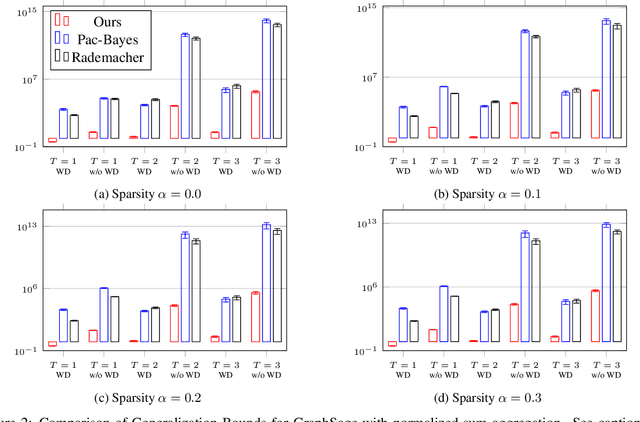
We study the generalization capabilities of Message Passing Neural Networks (MPNNs), a prevalent class of Graph Neural Networks (GNN). We derive generalization bounds specifically for MPNNs with normalized sum aggregation and mean aggregation. Our analysis is based on a data generation model incorporating a finite set of template graphons. Each graph within this framework is generated by sampling from one of the graphons with a certain degree of perturbation. In particular, we extend previous MPNN generalization results to a more realistic setting, which includes the following modifications: 1) we analyze simple random graphs with Bernoulli-distributed edges instead of weighted graphs; 2) we sample both graphs and graph signals from perturbed graphons instead of clean graphons; and 3) we analyze sparse graphs instead of dense graphs. In this more realistic and challenging scenario, we provide a generalization bound that decreases as the average number of nodes in the graphs increases. Our results imply that MPNNs with higher complexity than the size of the training set can still generalize effectively, as long as the graphs are sufficiently large.
Weisfeiler and Leman Go Loopy: A New Hierarchy for Graph Representational Learning
Mar 20, 2024We introduce $r$-loopy Weisfeiler-Leman ($r$-$\ell{}$WL), a novel hierarchy of graph isomorphism tests and a corresponding GNN framework, $r$-$\ell{}$MPNN, that can count cycles up to length $r + 2$. Most notably, we show that $r$-$\ell{}$WL can count homomorphisms of cactus graphs. This strictly extends classical 1-WL, which can only count homomorphisms of trees and, in fact, is incomparable to $k$-WL for any fixed $k$. We empirically validate the expressive and counting power of the proposed $r$-$\ell{}$MPNN on several synthetic datasets and present state-of-the-art predictive performance on various real-world datasets. The code is available at https://github.com/RPaolino/loopy
A Fractional Graph Laplacian Approach to Oversmoothing
May 22, 2023
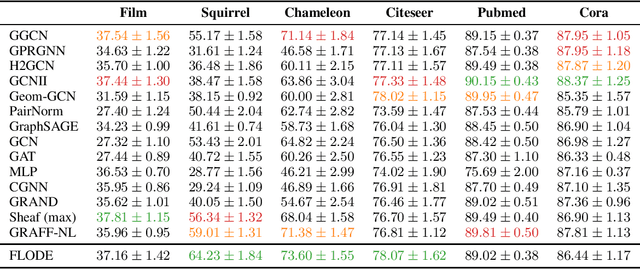

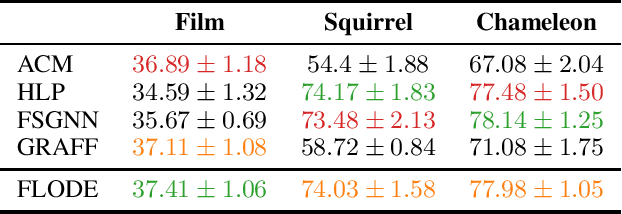
Graph neural networks (GNNs) have shown state-of-the-art performances in various applications. However, GNNs often struggle to capture long-range dependencies in graphs due to oversmoothing. In this paper, we generalize the concept of oversmoothing from undirected to directed graphs. To this aim, we extend the notion of Dirichlet energy by considering a directed symmetrically normalized Laplacian. As vanilla graph convolutional networks are prone to oversmooth, we adopt a neural graph ODE framework. Specifically, we propose fractional graph Laplacian neural ODEs, which describe non-local dynamics. We prove that our approach allows propagating information between distant nodes while maintaining a low probability of long-distance jumps. Moreover, we show that our method is more flexible with respect to the convergence of the graph's Dirichlet energy, thereby mitigating oversmoothing. We conduct extensive experiments on synthetic and real-world graphs, both directed and undirected, demonstrating our method's versatility across diverse graph homophily levels. Our code is available at https://github.com/RPaolino/fLode .
Generalized Laplacian Positional Encoding for Graph Representation Learning
Nov 10, 2022

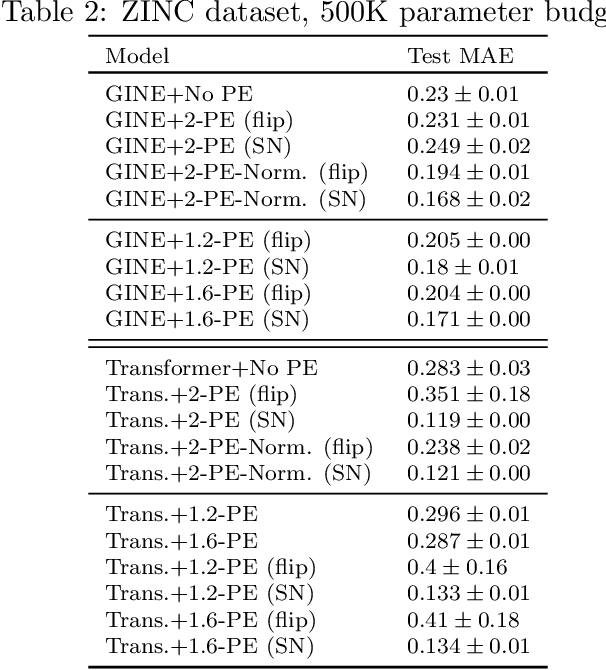

Graph neural networks (GNNs) are the primary tool for processing graph-structured data. Unfortunately, the most commonly used GNNs, called Message Passing Neural Networks (MPNNs) suffer from several fundamental limitations. To overcome these limitations, recent works have adapted the idea of positional encodings to graph data. This paper draws inspiration from the recent success of Laplacian-based positional encoding and defines a novel family of positional encoding schemes for graphs. We accomplish this by generalizing the optimization problem that defines the Laplace embedding to more general dissimilarity functions rather than the 2-norm used in the original formulation. This family of positional encodings is then instantiated by considering p-norms. We discuss a method for calculating these positional encoding schemes, implement it in PyTorch and demonstrate how the resulting positional encoding captures different properties of the graph. Furthermore, we demonstrate that this novel family of positional encodings can improve the expressive power of MPNNs. Lastly, we present preliminary experimental results.
Stability and Generalization Capabilities of Message Passing Graph Neural Networks
Feb 04, 2022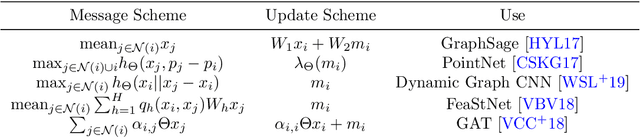
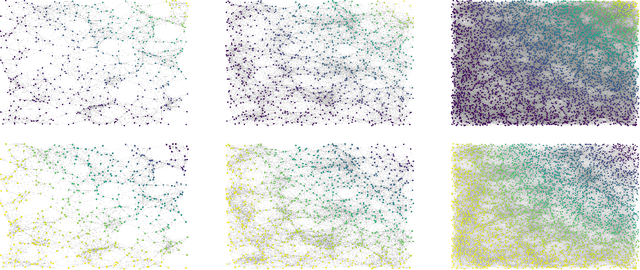
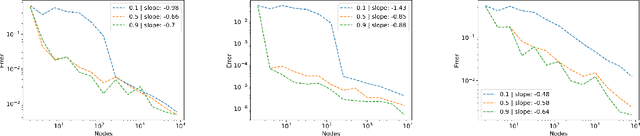
Message passing neural networks (MPNN) have seen a steep rise in popularity since their introduction as generalizations of convolutional neural networks to graph structured data, and are now considered state-of-the-art tools for solving a large variety of graph-focused problems. We study the generalization capabilities of MPNNs in graph classification. We assume that graphs of different classes are sampled from different random graph models. Based on this data distribution, we derive a non-asymptotic bound on the generalization gap between the empirical and statistical loss, that decreases to zero as the graphs become larger. This is proven by showing that a MPNN, applied on a graph, approximates the MPNN applied on the geometric model that the graph discretizes.