 Add to Chrome
 Add to Firefox
 Add to Edge
Model-Adaptive Tool Necessity Reveals the Knowing-Doing Gap in LLM Tool Use
May 13, 2026
Large language models (LLMs) increasingly act as autonomous agents that must decide when to answer directly vs. when to invoke external tools. Prior work studying adaptive tool use has largely treated tool necessity as a model-agnostic property, annotated by human or LLM judge, and mostly cover cases where the answer is obvious (e.g., fetching the weather vs. paraphrasing text). However, tool necessity in the wild is more nuanced due to the divergence of capability boundaries across models: a problem solvable by a strong model on its own may still require tools for a weaker one. In this work, we introduce a model-adaptive definition of tool-necessity, grounded in each model's empirical performance. Following this definition, we compare the necessity against observed tool-call behavior across four models on arithmetic and factual QA dataset, and find substantial mismatches of 26.5-54.0% and 30.8-41.8%, respectively. To diagnose the failure, we decompose tool use into two stages: an internal cognition stage that reflects whether a model believes a tool is necessary, and an execution stage that determines whether the model actually makes a tool-call action. By probing the LLM hidden states, we find that both signals are often linearly decodable, yet their probe directions become nearly orthogonal in the late-layer, last-token regime that drives the next-token action. By tracing the trajectory of samples in the two-stage process, we further discover that the majority of mismatch is concentrated in the cognition-to-action transition, not in cognition itself. These results reveal a knowing-doing gap in LLM tool-use: improving tool-use reliability requires not only better recognition of when tools are needed, but also better translation of that recognition into action.

Data-Centric Debugging: mitigating model failures via targeted data collection
Nov 17, 2022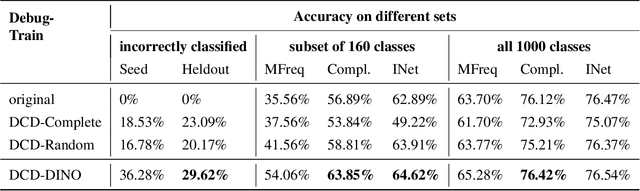
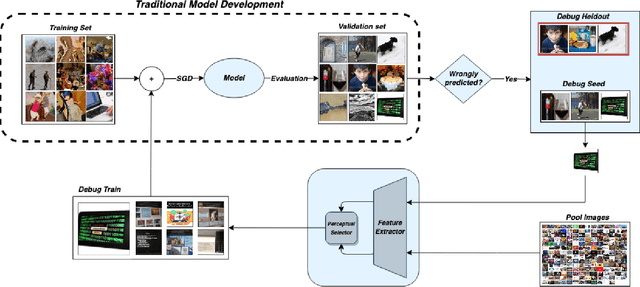
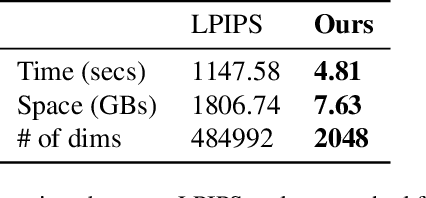
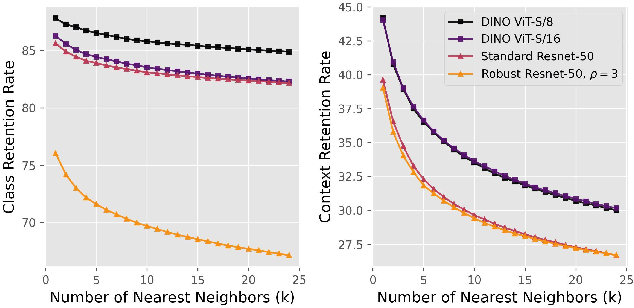
Deep neural networks can be unreliable in the real world when the training set does not adequately cover all the settings where they are deployed. Focusing on image classification, we consider the setting where we have an error distribution $\mathcal{E}$ representing a deployment scenario where the model fails. We have access to a small set of samples $\mathcal{E}_{sample}$ from $\mathcal{E}$ and it can be expensive to obtain additional samples. In the traditional model development framework, mitigating failures of the model in $\mathcal{E}$ can be challenging and is often done in an ad hoc manner. In this paper, we propose a general methodology for model debugging that can systemically improve model performance on $\mathcal{E}$ while maintaining its performance on the original test set. Our key assumption is that we have access to a large pool of weakly (noisily) labeled data $\mathcal{F}$. However, naively adding $\mathcal{F}$ to the training would hurt model performance due to the large extent of label noise. Our Data-Centric Debugging (DCD) framework carefully creates a debug-train set by selecting images from $\mathcal{F}$ that are perceptually similar to the images in $\mathcal{E}_{sample}$. To do this, we use the $\ell_2$ distance in the feature space (penultimate layer activations) of various models including ResNet, Robust ResNet and DINO where we observe DINO ViTs are significantly better at discovering similar images compared to Resnets. Compared to LPIPS, we find that our method reduces compute and storage requirements by 99.58\%. Compared to the baselines that maintain model performance on the test set, we achieve significantly (+9.45\%) improved results on the debug-heldout sets.