 Add to Chrome
 Add to Firefox
 Add to Edge
What Understanding Means in AI-Laden Astronomy
Jan 15, 2026
Artificial intelligence is rapidly transforming astronomical research, yet the scientific community has largely treated this transformation as an engineering challenge rather than an epistemological one. This perspective article argues that philosophy of science offers essential tools for navigating AI's integration into astronomy--conceptual clarity about what "understanding" means, critical examination of assumptions about data and discovery, and frameworks for evaluating AI's roles across different research contexts. Drawing on an interdisciplinary workshop convening astronomers, philosophers, and computer scientists, we identify several tensions. First, the narrative that AI will "derive fundamental physics" from data misconstrues contemporary astronomy as equation-derivation rather than the observation-driven enterprise it is. Second, scientific understanding involves more than prediction--it requires narrative construction, contextual judgment, and communicative achievement that current AI architectures struggle to provide. Third, because narrative and judgment matter, human peer review remains essential--yet AI-generated content flooding the literature threatens our capacity to identify genuine insight. Fourth, while AI excels at well-defined problem-solving, the ill-defined problem-finding that drives breakthroughs appears to require capacities beyond pattern recognition. Fifth, as AI accelerates what is feasible, pursuitworthiness criteria risk shifting toward what AI makes easy rather than what is genuinely important. We propose "pragmatic understanding" as a framework for integration--recognizing AI as a tool that extends human cognition while requiring new norms for validation and epistemic evaluation. Engaging with these questions now may help the community shape the transformation rather than merely react to it.

Joint Embedding Learning of Educational Knowledge Graphs
Dec 23, 2019
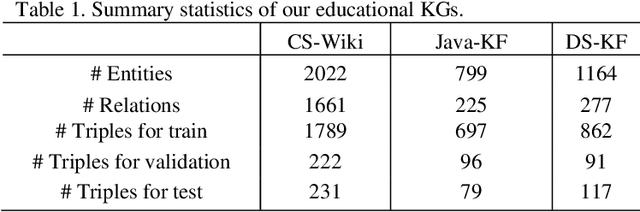


As an efficient model for knowledge organization, the knowledge graph has been widely adopted in several fields, e.g., biomedicine, sociology, and education. And there is a steady trend of learning embedding representations of knowledge graphs to facilitate knowledge graph construction and downstream tasks. In general, knowledge graph embedding techniques aim to learn vectorized representations which preserve the structural information of the graph. And conventional embedding learning models rely on structural relationships among entities and relations. However, in educational knowledge graphs, structural relationships are not the focus. Instead, rich literals of the graphs are more valuable. In this paper, we focus on this problem and propose a novel model for embedding learning of educational knowledge graphs. Our model considers both structural and literal information and jointly learns embedding representations. Three experimental graphs were constructed based on an educational knowledge graph which has been applied in real-world teaching. We conducted two experiments on the three graphs and other common benchmark graphs. The experimental results proved the effectiveness of our model and its superiority over other baselines when processing educational knowledge graphs.