 Add to Chrome
 Add to Firefox
 Add to Edge
Location Not Found: Exposing Implicit Local and Global Biases in Multilingual LLMs
Apr 21, 2026
Multilingual large language models (LLMs) have minimized the fluency gap between languages. This advancement, however, exposes models to the risk of biased behavior, as knowledge and norms may propagate across languages. In this work, we aim to quantify models' inter- and intra-lingual biases, via their ability to answer locale-ambiguous questions. To this end, we present LocQA, a test set containing 2,156 questions in 12 languages, referring to various locale-dependent facts such as laws, dates, and measurements. The questions do not contain indications of the locales they relate to, other than the querying language itself. LLMs' responses to LocQA locale-ambiguous questions thus reveal models' implicit priors. We used LocQA to evaluate 32 models, and detected two types of structural biases. Inter-lingually, we show a global bias towards answers relevant to the US-locale, even when models are asked in languages other than English. Moreover, we discovered that this global bias is exacerbated in models that underwent instruction tuning, compared to their base counterparts. Intra-lingually, we show that when multiple locales are relevant for the same language, models act as demographic probability engines, prioritizing locales with larger populations. Taken together, insights from LocQA may help in shaping LLMs' desired local behavior, and in quantifying the impact of various training phases on different kinds of biases.

Gemma 3 Technical Report
Mar 25, 2025We introduce Gemma 3, a multimodal addition to the Gemma family of lightweight open models, ranging in scale from 1 to 27 billion parameters. This version introduces vision understanding abilities, a wider coverage of languages and longer context - at least 128K tokens. We also change the architecture of the model to reduce the KV-cache memory that tends to explode with long context. This is achieved by increasing the ratio of local to global attention layers, and keeping the span on local attention short. The Gemma 3 models are trained with distillation and achieve superior performance to Gemma 2 for both pre-trained and instruction finetuned versions. In particular, our novel post-training recipe significantly improves the math, chat, instruction-following and multilingual abilities, making Gemma3-4B-IT competitive with Gemma2-27B-IT and Gemma3-27B-IT comparable to Gemini-1.5-Pro across benchmarks. We release all our models to the community.
ECLeKTic: a Novel Challenge Set for Evaluation of Cross-Lingual Knowledge Transfer
Feb 28, 2025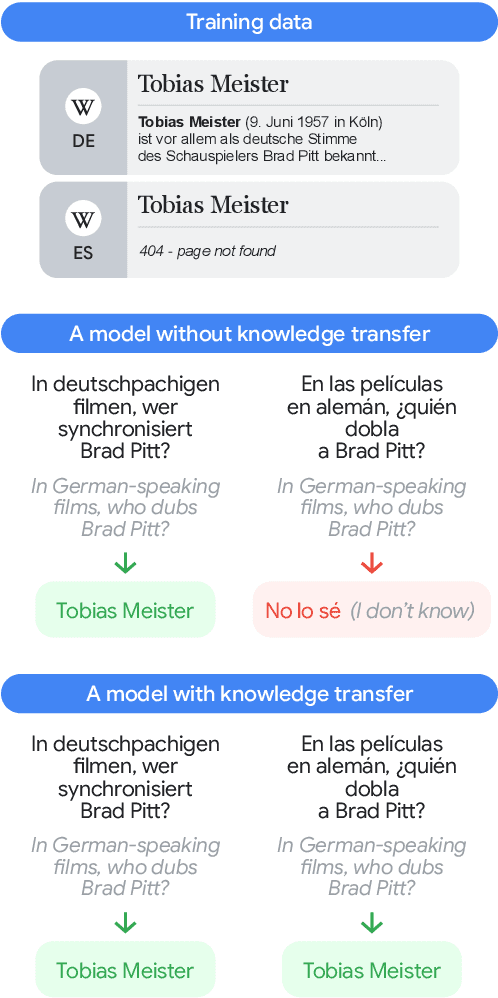
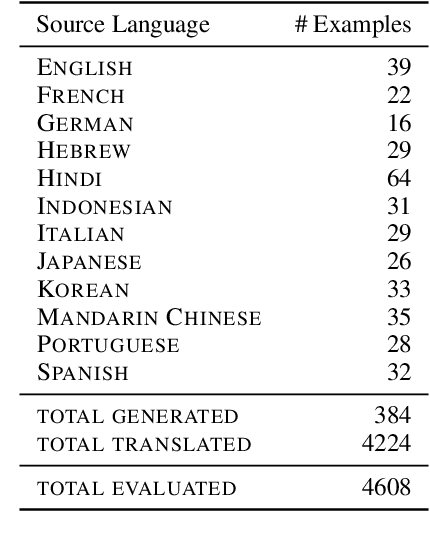
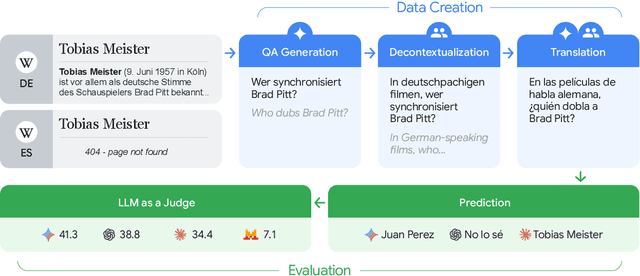
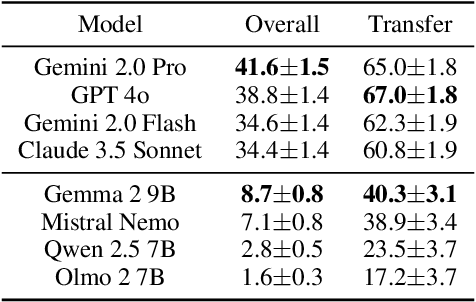
To achieve equitable performance across languages, multilingual large language models (LLMs) must be able to abstract knowledge beyond the language in which it was acquired. However, the current literature lacks reliable ways to measure LLMs' capability of cross-lingual knowledge transfer. To that end, we present ECLeKTic, a multilingual closed-book QA (CBQA) dataset that Evaluates Cross-Lingual Knowledge Transfer in a simple, black-box manner. We detected information with uneven coverage across languages by controlling for presence and absence of Wikipedia articles in 12 languages. We generated knowledge-seeking questions in a source language, for which the answer appears in a relevant Wikipedia article and translated them to all other 11 languages, for which the respective Wikipedias lack equivalent articles. Assuming that Wikipedia reflects the prominent knowledge in the LLM's training data, to solve ECLeKTic's CBQA task the model is required to transfer knowledge between languages. Experimenting with 8 LLMs, we show that SOTA models struggle to effectively share knowledge across, languages even if they can predict the answer well for queries in the same language the knowledge was acquired in.