 Add to Chrome
 Add to Firefox
 Add to Edge
Location Not Found: Exposing Implicit Local and Global Biases in Multilingual LLMs
Apr 21, 2026
Multilingual large language models (LLMs) have minimized the fluency gap between languages. This advancement, however, exposes models to the risk of biased behavior, as knowledge and norms may propagate across languages. In this work, we aim to quantify models' inter- and intra-lingual biases, via their ability to answer locale-ambiguous questions. To this end, we present LocQA, a test set containing 2,156 questions in 12 languages, referring to various locale-dependent facts such as laws, dates, and measurements. The questions do not contain indications of the locales they relate to, other than the querying language itself. LLMs' responses to LocQA locale-ambiguous questions thus reveal models' implicit priors. We used LocQA to evaluate 32 models, and detected two types of structural biases. Inter-lingually, we show a global bias towards answers relevant to the US-locale, even when models are asked in languages other than English. Moreover, we discovered that this global bias is exacerbated in models that underwent instruction tuning, compared to their base counterparts. Intra-lingually, we show that when multiple locales are relevant for the same language, models act as demographic probability engines, prioritizing locales with larger populations. Taken together, insights from LocQA may help in shaping LLMs' desired local behavior, and in quantifying the impact of various training phases on different kinds of biases.

Exploring Factual Entailment with NLI: A News Media Study
Jun 24, 2024


We explore the relationship between factuality and Natural Language Inference (NLI) by introducing FactRel -- a novel annotation scheme that models \textit{factual} rather than \textit{textual} entailment, and use it to annotate a dataset of naturally occurring sentences from news articles. Our analysis shows that 84\% of factually supporting pairs and 63\% of factually undermining pairs do not amount to NLI entailment or contradiction, respectively, suggesting that factual relationships are more apt for analyzing media discourse. We experiment with models for pairwise classification on the new dataset, and find that in some cases, generating synthetic data with GPT-4 on the basis of the annotated dataset can improve performance. Surprisingly, few-shot learning with GPT-4 yields strong results on par with medium LMs (DeBERTa) trained on the labelled dataset. We hypothesize that these results indicate the fundamental dependence of this task on both world knowledge and advanced reasoning abilities.
IsraParlTweet: The Israeli Parliamentary and Twitter Resource
May 30, 2024

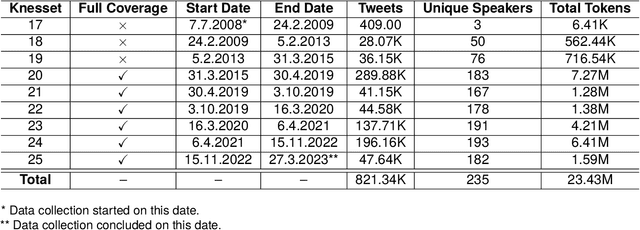
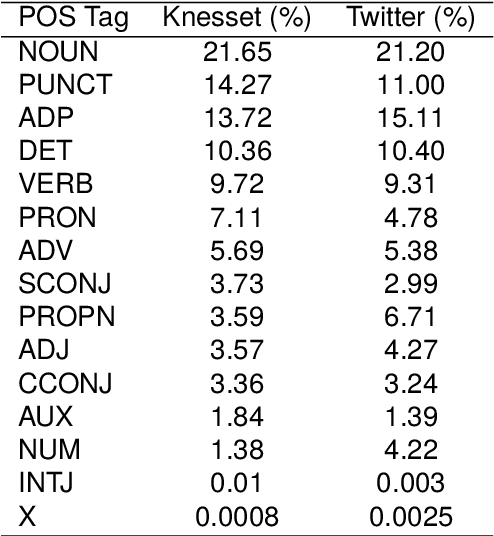
We introduce IsraParlTweet, a new linked corpus of Hebrew-language parliamentary discussions from the Knesset (Israeli Parliament) between the years 1992-2023 and Twitter posts made by Members of the Knesset between the years 2008-2023, containing a total of 294.5 million Hebrew tokens. In addition to raw text, the corpus contains comprehensive metadata on speakers and Knesset sessions as well as several linguistic annotations. As a result, IsraParlTweet can be used to conduct a wide variety of quantitative and qualitative analyses and provide valuable insights into political discourse in Israel.