 Add to Chrome
 Add to Firefox
 Add to Edge
Why Your Tokenizer Fails in Information Fusion: A Timing-Aware Pre-Quantization Fusion for Video-Enhanced Audio Tokenization
Apr 13, 2026
Audio tokenization has emerged as a critical component in end-to-end audio language models, enabling efficient discrete representation learning for both audio understanding and generation tasks. However, existing audio tokenizers face fundamental limitations in understanding tasks due to single-modality constraints, particularly when audio signals contain ambiguous or incomplete information. While incorporating additional modality information can significantly enhance audio understanding, current multimodal fusion approaches invariably degrade reconstruction quality. This degradation is unacceptable for end-to-end audio systems that require high-fidelity audio generation capabilities. In this work, we investigate the root causes of reconstruction quality degradation in video-enhanced audio tokenization and present three key findings. First, the location of fusion within the tokenizer architecture is crucial for preserving reconstruction quality. Second, we show that contrastive learning, though effective in continuous representation fusion, is unsuitable for discrete tokenizers as it fails to enhance downstream task performance. Third, while feature-dimension fusion approaches achieve moderate success, we discover that fusing along the temporal axis -- guided by the concept of distinctive features -- yields significantly better results. Building on these insights, we introduce the Timing-Aware Pre-Quantization Fusion for Video-Enhanced Audio Tokenization, the first approach to successfully integrate visual information into audio tokenizer architectures while preserving reconstruction fidelity. Our approach not only maintains high-fidelity reconstruction but also achieves superior performance on downstream understanding tasks compared with audio-only tokenizers and established multimodal fusion baselines.

Spatial HuBERT: Self-supervised Spatial Speech Representation Learning for a Single Talker from Multi-channel Audio
Oct 17, 2023Self-supervised learning has been used to leverage unlabelled data, improving accuracy and generalisation of speech systems through the training of representation models. While many recent works have sought to produce effective representations across a variety of acoustic domains, languages, modalities and even simultaneous speakers, these studies have all been limited to single-channel audio recordings. This paper presents Spatial HuBERT, a self-supervised speech representation model that learns both acoustic and spatial information pertaining to a single speaker in a potentially noisy environment by using multi-channel audio inputs. Spatial HuBERT learns representations that outperform state-of-the-art single-channel speech representations on a variety of spatial downstream tasks, particularly in reverberant and noisy environments. We also demonstrate the utility of the representations learned by Spatial HuBERT on a speech localisation downstream task. Along with this paper, we publicly release a new dataset of 100 000 simulated first-order ambisonics room impulse responses.
Low latency transformers for speech processing
Feb 27, 2023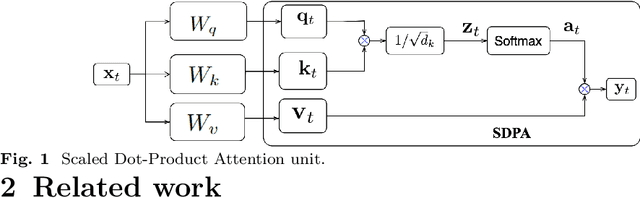

The transformer is a widely-used building block in modern neural networks. However, when applied to audio data, the transformer's acausal behaviour, which we term Acausal Attention (AA), has generally limited its application to offline tasks. In this paper we introduce Streaming Attention (SA), which operates causally with fixed latency, and requires lower compute and memory resources than AA to train. Next, we introduce Low Latency Streaming Attention (LLSA), a method which combines multiple SA layers without latency build-up proportional to the layer count. Comparative analysis between AA, SA and LLSA on Automatic Speech Recognition (ASR) and Speech Emotion Recognition (SER) tasks are presented. The results show that causal SA-based networks with fixed latencies of a few seconds (e.g. 1.8 seconds) and LLSA networks with latencies as short as 300 ms can perform comparably with acausal (AA) networks. We conclude that SA and LLSA methods retain many of the benefits of conventional acausal transformers, but with latency characteristics that make them practical to run in real-time streaming applications.