 Add to Chrome
 Add to Firefox
 Add to Edge
Video2Reaction: Mapping Video to Audience Reaction Distribution in the Wild
Jul 08, 2026
Understanding and forecasting audience reactions to video content are crucial for improving content creation, recommendation systems, and media analysis. To enable audience reaction prediction and other content engagement applications, we introduce $\textbf{Video2Reaction}$, a multimodal dataset that maps short movie segments to a distribution of $\textit{induced emotions}$ of viewers in the wild, as expressed through social media. $\textbf{Video2Reaction}$ spans more than 10,000 videos and serves as a reliable benchmark as well as a training resource for audience reaction prediction. To enable cost-effective continuous annotations as reactions may change over time, we develop a two-stage multi-agent pipeline using only open-source LLMs, achieving 86% correctness under blind human verification despite the inherently noisy and subjective nature of the task. We establish the first benchmark for video-to-reaction-distribution prediction in the wild and show that pretrained foundation video models fail in zero-shot settings, while finetuning transforms them into state-of-the-art predictors capable of modeling both full reaction distributions and dominant responses from video alone. However, the task remains challenging: even the strongest methods achieve only 77% Top-3 F1 in dominant reaction prediction (LLaVA-Next), highlighting a substantial gap in modeling collective audience reaction. \modification{Dataset and code are available at our project page: https://information-fusion-lab-umass.github.io/video2reaction-bench.github.io

Low latency transformers for speech processing
Feb 27, 2023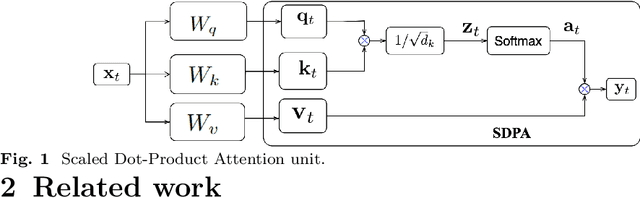
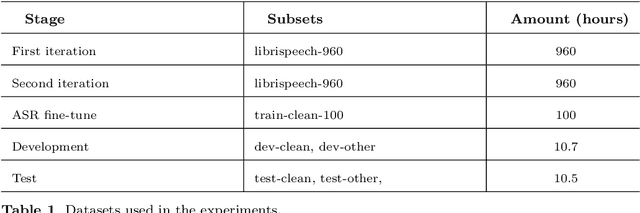
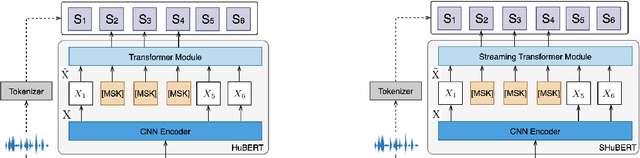

The transformer is a widely-used building block in modern neural networks. However, when applied to audio data, the transformer's acausal behaviour, which we term Acausal Attention (AA), has generally limited its application to offline tasks. In this paper we introduce Streaming Attention (SA), which operates causally with fixed latency, and requires lower compute and memory resources than AA to train. Next, we introduce Low Latency Streaming Attention (LLSA), a method which combines multiple SA layers without latency build-up proportional to the layer count. Comparative analysis between AA, SA and LLSA on Automatic Speech Recognition (ASR) and Speech Emotion Recognition (SER) tasks are presented. The results show that causal SA-based networks with fixed latencies of a few seconds (e.g. 1.8 seconds) and LLSA networks with latencies as short as 300 ms can perform comparably with acausal (AA) networks. We conclude that SA and LLSA methods retain many of the benefits of conventional acausal transformers, but with latency characteristics that make them practical to run in real-time streaming applications.