 Add to Chrome
 Add to Firefox
 Add to Edge
A Multi-scale Fused Graph Neural Network with Inter-view Contrastive Learning for Spatial Transcriptomics Data Clustering
Dec 18, 2025
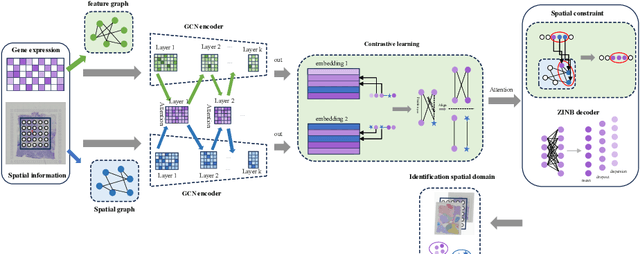
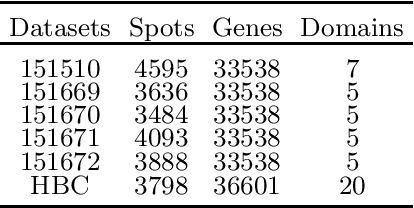
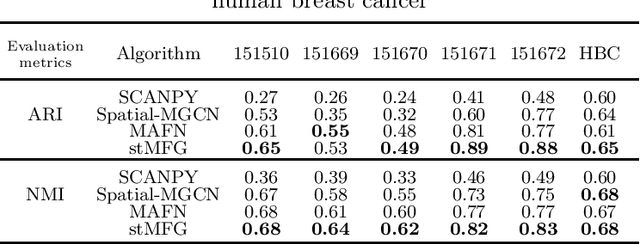

Spatial transcriptomics enables genome-wide expression analysis within native tissue context, yet identifying spatial domains remains challenging due to complex gene-spatial interactions. Existing methods typically process spatial and feature views separately, fusing only at output level - an "encode-separately, fuse-late" paradigm that limits multi-scale semantic capture and cross-view interaction. Accordingly, stMFG is proposed, a multi-scale interactive fusion graph network that introduces layer-wise cross-view attention to dynamically integrate spatial and gene features after each convolution. The model combines cross-view contrastive learning with spatial constraints to enhance discriminability while maintaining spatial continuity. On DLPFC and breast cancer datasets, stMFG outperforms state-of-the-art methods, achieving up to 14% ARI improvement on certain slices.

Multiscale Dual-path Feature Aggregation Network for Remaining Useful Life Prediction of Lithium-Ion Batteries
Dec 16, 2025Targeted maintenance strategies, ensuring the dependability and safety of industrial machinery. However, current modeling techniques for assessing both local and global correlation of battery degradation sequences are inefficient and difficult to meet the needs in real-life applications. For this reason, we propose a novel deep learning architecture, multiscale dual-path feature aggregation network (MDFA-Net), for RUL prediction. MDFA-Net consists of dual-path networks, the first path network, multiscale feature network (MF-Net) that maintains the shallow information and avoids missing information, and the second path network is an encoder network (EC-Net) that captures the continuous trend of the sequences and retains deep details. Integrating both deep and shallow attributes effectively grasps both local and global patterns. Testing conducted with two publicly available Lithium-ion battery datasets reveals our approach surpasses existing top-tier methods in RUL forecasting, accurately mapping the capacity degradation trajectory.
HGC-Herd: Efficient Heterogeneous Graph Condensation via Representative Node Herding
Dec 08, 2025Heterogeneous graph neural networks (HGNNs) have demonstrated strong capability in modeling complex semantics across multi-type nodes and relations. However, their scalability to large-scale graphs remains challenging due to structural redundancy and high-dimensional node features. Existing graph condensation approaches, such as GCond, are primarily developed for homogeneous graphs and rely on gradient matching, resulting in considerable computational, memory, and optimization overhead. We propose HGC-Herd, a training-free condensation framework that generates compact yet informative heterogeneous graphs while maintaining both semantic and structural fidelity. HGC-Herd integrates lightweight feature propagation to encode multi-hop relational context and employs a class-wise herding mechanism to identify representative nodes per class, producing balanced and discriminative subsets for downstream learning tasks. Extensive experiments on ACM, DBLP, and Freebase validate that HGC-Herd attains comparable or superior accuracy to full-graph training while markedly reducing both runtime and memory consumption. These results underscore its practical value for efficient and scalable heterogeneous graph representation learning.