 Add to Chrome
 Add to Firefox
 Add to Edge
A Multi-scale Fused Graph Neural Network with Inter-view Contrastive Learning for Spatial Transcriptomics Data Clustering
Paper and Code
Dec 18, 2025
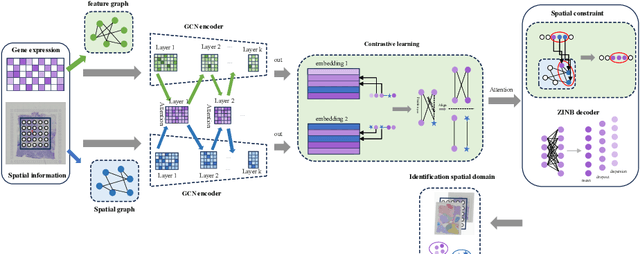
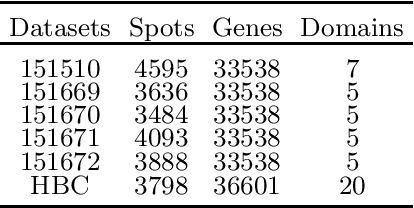
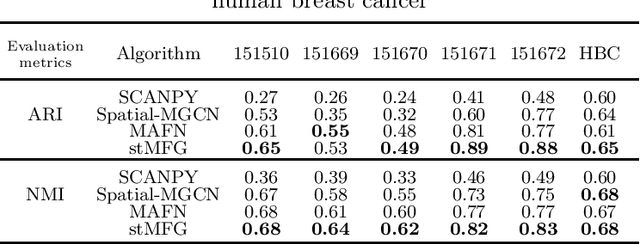

Spatial transcriptomics enables genome-wide expression analysis within native tissue context, yet identifying spatial domains remains challenging due to complex gene-spatial interactions. Existing methods typically process spatial and feature views separately, fusing only at output level - an "encode-separately, fuse-late" paradigm that limits multi-scale semantic capture and cross-view interaction. Accordingly, stMFG is proposed, a multi-scale interactive fusion graph network that introduces layer-wise cross-view attention to dynamically integrate spatial and gene features after each convolution. The model combines cross-view contrastive learning with spatial constraints to enhance discriminability while maintaining spatial continuity. On DLPFC and breast cancer datasets, stMFG outperforms state-of-the-art methods, achieving up to 14% ARI improvement on certain slices.
