 Add to Chrome
 Add to Firefox
 Add to Edge
MPM: Mutual Pair Merging for Efficient Vision Transformers
Apr 07, 2026
Decreasing sequence length is a common way to accelerate transformers, but prior token reduction work often targets classification and reports proxy metrics rather than end-to-end latency. For semantic segmentation, token reduction is further constrained by the need to reconstruct dense, pixel-aligned features, and on modern accelerators the overhead of computing merge maps can erase expected gains. We propose Mutual Pair Merging (MPM), a training-free token aggregation module that forms mutual nearest-neighbor pairs in cosine space, averages each pair, and records a merge map enabling a gather-based reconstruction before the decoder so that existing segmentation heads can be used unchanged. MPM introduces no learned parameters and no continuous compression knob (no keep-rate or threshold). The speed-accuracy trade-off is set by a discrete insertion schedule. We benchmark end-to-end latency on an NVIDIA H100 GPU (with and without FlashAttention-2) and a Raspberry Pi 5 across standard segmentation datasets. On ADE20K, MPM reduces per-image latency by up to 60% for ViT-Tiny on Raspberry Pi 5, and increases throughput by up to 20% on H100 with FlashAttention-2 while keeping the mIoU drop below 3%. These results suggest that simple, reconstruction-aware, training-free token merging can translate into practical wall-clock gains for segmentation when overhead is explicitly accounted for.

Unlocking Zero-Shot Plant Segmentation with Pl@ntNet Intelligence
Oct 14, 2025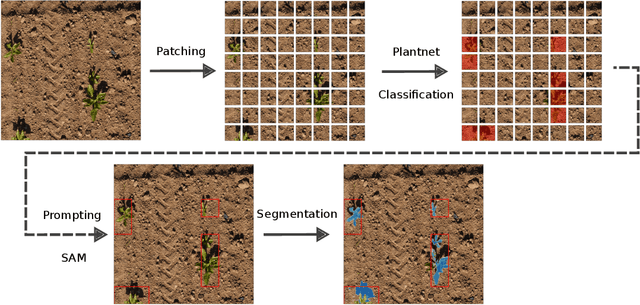
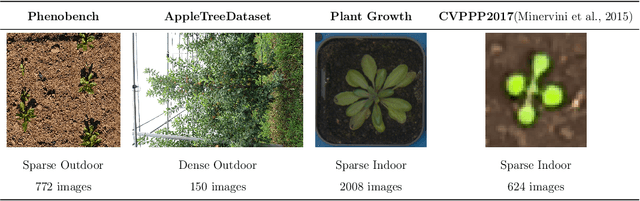
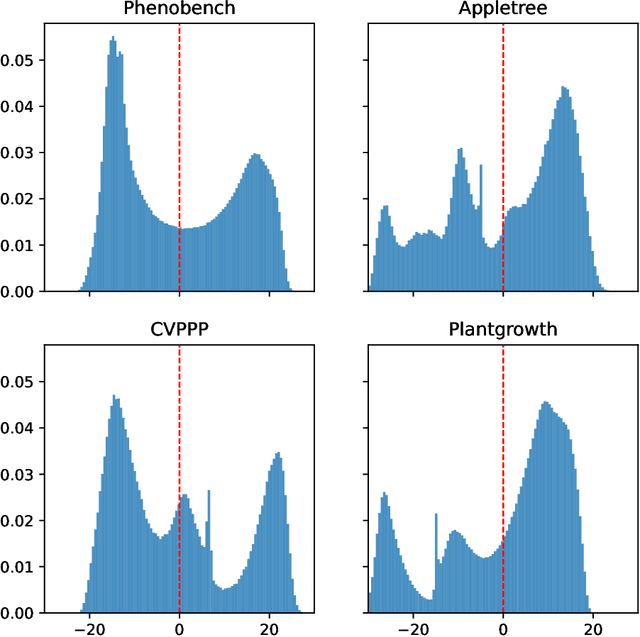

We present a zero-shot segmentation approach for agricultural imagery that leverages Plantnet, a large-scale plant classification model, in conjunction with its DinoV2 backbone and the Segment Anything Model (SAM). Rather than collecting and annotating new datasets, our method exploits Plantnet's specialized plant representations to identify plant regions and produce coarse segmentation masks. These masks are then refined by SAM to yield detailed segmentations. We evaluate on four publicly available datasets of various complexity in terms of contrast including some where the limited size of the training data and complex field conditions often hinder purely supervised methods. Our results show consistent performance gains when using Plantnet-fine-tuned DinoV2 over the base DinoV2 model, as measured by the Jaccard Index (IoU). These findings highlight the potential of combining foundation models with specialized plant-centric models to alleviate the annotation bottleneck and enable effective segmentation in diverse agricultural scenarios.