 Add to Chrome
 Add to Firefox
 Add to Edge
Formal Disco: Scalable Open-Ended Generation of Formally Verified Programs
Jul 06, 2026
The cost of producing code is rapidly diminishing with increasingly capable AI agents, while quality assurance of generated programs has not kept pace. Formal verification provides the strongest possible guarantees, but the ability of AI models to work with verification-aware languages is hindered by the scarcity of human-written examples of programs in those languages. To tackle this prevalent data scarcity issue, we propose Formal Disco: a distributed system for coordination of LLM-based workers that can be easily applied to open-ended synthetic data generation at scale. We use Formal Disco to share tasks and programs between three classes of workers: "initiators", which read random READMEs from open-source repositories and documentation snippets to sketch a related verified program, "fixers" which take compiler and verifier feedback and attempt to resolve issues, and "extenders" that take working programs and propose patches to expand them. Formal Disco records all agent-generated traces and uses them both for initial distillation from a stronger model as well as self-improvement. We also propose a principle of maximum entropy for synthetic program generation, and use entropy maximization via iterative supervised fine-tuning to learn to generate increasingly diverse programs over time. We release large datasets of synthetic verified programs in three languages - Dafny, Verus, and Frama-C -, and fine-tune open models for verification-relevant tasks, often matching or exceeding the performance of Claude Opus 4.5. Overall, our work offers a path to create synthetic data at scale for formal reasoning domains and overcome the long-standing data barrier.

Vision-Language Models Suppress Female Representations Under Ambiguous Input
May 29, 2026Alignment teaches vision-language models (VLMs) to avoid expressing demographic biases, and when gender is clearly visible they largely succeed. Far less is known about ambiguous inputs (a worker in full gear, a figure seen from behind) cases common in practice yet rarely studied. We find that minimal prompting pressure exposes occupation-gender defaults when prompting ambiguous input images, with models collapsing to male even for strongly female-stereotyped occupations. But do these outputs reflect what models actually encode internally? We introduce LALS (Latent Association Leaning Score), a zero-shot metric that projects visual-token activations into the model's text-embedding space to measure concept associations per token and layer. Across 15 occupations, over 800 gender-ambiguous images, and four VLMs, internal representations and outputs are systematically decoupled: models often encode a female association internally yet output male. Layer-wise analysis reveals an asymmetric filter -- male signal amplifies end-to-end while female signal peaks mid-network and is suppressed before generation -- and a color ablation shows that culturally loaded visual cues such as clothing color further modulate these internal associations.
Verified Multi-Step Synthesis using Large Language Models and Monte Carlo Tree Search
Feb 13, 2024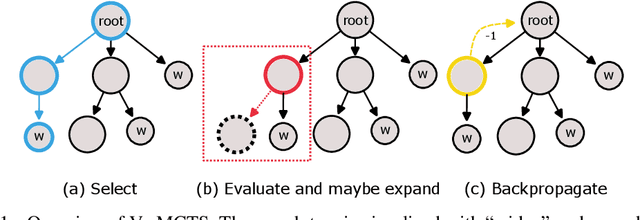


We present an approach using Monte Carlo Tree Search (MCTS) to guide Large Language Models (LLMs) to generate verified programs in Dafny, Lean and Coq. Our method, which we call VMCTS, leverages the verifier inside the search algorithm by checking partial programs at each step. In combination with the LLM prior, the verifier feedback raises the synthesis capabilities of open source models. On a set of five verified programming problems, we find that in four problems where the base model cannot solve the question even when re-sampling solutions for one hour, VMCTS can solve the problems within 6 minutes. The base model with VMCTS is even competitive with ChatGPT4 augmented with plugins and multiple re-tries on these problems. Our code and benchmarks are available at https://github.com/namin/llm-verified-with-monte-carlo-tree-search .