 Add to Chrome
 Add to Firefox
 Add to Edge
An Event-Based Opto-Tactile Skin
Jan 07, 2026
This paper presents a neuromorphic, event-driven tactile sensing system for soft, large-area skin, based on the Dynamic Vision Sensors (DVS) integrated with a flexible silicone optical waveguide skin. Instead of repetitively scanning embedded photoreceivers, this design uses a stereo vision setup comprising two DVS cameras looking sideways through the skin. Such a design produces events as changes in brightness are detected, and estimates press positions on the 2D skin surface through triangulation, utilizing Density-Based Spatial Clustering of Applications with Noise (DBSCAN) to find the center of mass of contact events resulting from pressing actions. The system is evaluated over a 4620 mm2 probed area of the skin using a meander raster scan. Across 95 % of the presses visible to both cameras, the press localization achieved a Root-Mean-Squared Error (RMSE) of 4.66 mm. The results highlight the potential of this approach for wide-area flexible and responsive tactile sensors in soft robotics and interactive environments. Moreover, we examined how the system performs when the amount of event data is strongly reduced. Using stochastic down-sampling, the event stream was reduced to 1/1024 of its original size. Under this extreme reduction, the average localization error increased only slightly (from 4.66 mm to 9.33 mm), and the system still produced valid press localizations for 85 % of the trials. This reduction in pass rate is expected, as some presses no longer produce enough events to form a reliable cluster for triangulation. These results show that the sensing approach remains functional even with very sparse event data, which is promising for reducing power consumption and computational load in future implementations. The system exhibits a detection latency distribution with a characteristic width of 31 ms.

WaLiN-GUI: a graphical and auditory tool for neuron-based encoding
Oct 25, 2023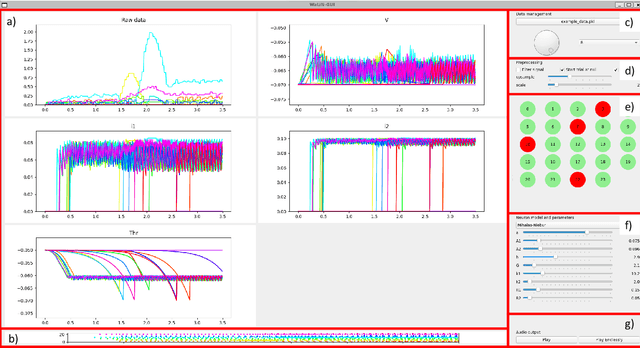
Neuromorphic computing relies on spike-based, energy-efficient communication, inherently implying the need for conversion between real-valued (sensory) data and binary, sparse spiking representation. This is usually accomplished using the real valued data as current input to a spiking neuron model, and tuning the neuron's parameters to match a desired, often biologically inspired behaviour. We developed a tool, the WaLiN-GUI, that supports the investigation of neuron models and parameter combinations to identify suitable configurations for neuron-based encoding of sample-based data into spike trains. Due to the generalized LIF model implemented by default, next to the LIF and Izhikevich neuron models, many spiking behaviors can be investigated out of the box, thus offering the possibility of tuning biologically plausible responses to the input data. The GUI is provided open source and with documentation, being easy to extend with further neuron models and personalize with data analysis functions.