 Add to Chrome
 Add to Firefox
 Add to Edge
Continuous and large-scale: ELEANOR, the soft architected arm inspired by the elephant trunk
Jul 08, 2026
The elephant trunk is a dexterous and versatile manipulator whose performance is still unmatched in robotics. In previous works, modularity was prioritized and relatively small-scale continuum robots were built. We take the natural proboscis of the *Loxodonta africana* species as a model and propose a different design approach which favors structural continuity and dynamic properties that plausibly emulate those of the natural trunk, while conferring high adaptability to the environment and humans. Instead of targeting prescribed behaviors, we show that a biomimetic design based on the macroscopic properties of the natural system enables elephant-like movements and grasping. We build by 3D printing an 85 cm long, compliant, tapered, volumetrically tessellated continuum arm, which is combined with tendon-driven actuation mimicking the longitudinal and oblique muscles of the natural model. We demonstrate whole-body grasping of objects having different shapes and dimensions and discuss a comparison to the biological trunk highlighting aspects of both biology and robotics.

Selective Unit-Cell Actuation in Lattice Structures for Distributed Morphology in Soft Robots
Jun 17, 2026Soft lattice structures are increasingly used in robotics to tailor compliance and guide deformation; however, actuation is typically introduced at the device or module level, with actuators inserted into otherwise passive architectures. In this work, we move actuator-lattice co-design to the unit-cell scale. We present an embedded pneumatic unit cell that integrates curved-strut lattice geometry with a bidirectional bellow actuator within a single monolithic element. When tessellated, the lattice functions as a distributed actuation field in which global morphology is governed by spatial actuation patterns rather than uniform pressurization. Experimental characterization of 1x1, 2x2, and 3x3 tessellations demonstrates scalable displacement and force generation with repeatable cyclic performance. Selective actuation of unit cells in a 3x3x3 array produces distinct global deformation modes, including bending and directional grasping, without altering hardware configuration. Additionally, coupling active and passive unit cells enables bending-driven crawling locomotion, demonstrating that heterogeneous tessellations can translate through asymmetric deformation. These results establish unit-cell-level actuation as a strategy for distributed morphing in lattice-based soft robots and provide a foundation for scalable, monolithic robotic architectures.
Bidirectional Optical sensors for Actuation Tracking (BOAT) in soft lattice systems
May 18, 2026The growing adoption of lattice-based structures in soft robotics creates a need for advanced sensing solutions capable of monitoring their global deformation, particularly compression and extension. In this work, we address this challenge by introducing a novel optical sensor based on two patterned waveguides arranged in an ellipsoidal geometry. This Bidirectional Optical sensor for Actuation Tracking (BOAT) is seamlessly co-printed with a lattice structure actuated by an embedded pneumatic artificial muscle (PAM), and its performance is assessed. During PAM elongation or contraction, the bending of the embedded BOAT waveguides induces output signal variations that enable a clear discrimination between compression and extension states. The designs of both each specific waveguide structure (by surface patterning) and of the sensorized lattice-based unit embedding two BOATs are supported by numerical simulations. Experimental calibration over 100 consecutive pressure cycles ranging from +50 kPa to $-$40 kPa demonstrates a highly repeatable response, allowing a reliable distinction between extension and compression. Finally, sensor feedback is used to implement a digital shadow, enabling continuous synchronization between the whole sensorized unit and its virtual counterpart. These results establish BOAT as a powerful and reliable approach for deformation monitoring in soft lattice-based robotic systems.
Surface-based Manipulation Using Tunable Compliant Porous-Elastic Soft Sensing
Feb 24, 2026There is a growing need for soft robotic platforms that perform gentle, precise handling of a wide variety of objects. Existing surface-based manipulation systems, however, lack the compliance and tactile feedback needed for delicate handling. This work introduces the COmpliant Porous-Elastic Soft Sensing (COPESS) integrated with inductive sensors for adaptive object manipulation and localised sensing. The design features a tunable lattice layer that simultaneously modulates mechanical compliance and sensing performance. By adjusting lattice geometry, both stiffness and sensor response can be tailored to handle objects with varying mechanical properties. Experiments demonstrate that by easily adjusting one parameter, the lattice density, from 7 % to 20 %, it is possible to significantly alter the sensitivity and operational force range (about -23x and 9x, respectively). This approach establishes a blueprint for creating adaptive, sensorized surfaces where mechanical and sensory properties are co-optimized, enabling passive, yet programmable, delicate manipulation.
3D-printed Soft Optical sensor with a Lens (SOLen) for light guidance in mechanosensing
Feb 19, 2026Additive manufacturing is enabling soft robots with increasingly complex geometries, creating a demand for sensing solutions that remain compatible with single-material, one-step fabrication. Optical soft sensors are attractive for monolithic printing, but their performance is often degraded by uncontrolled light propagation (ambient coupling, leakage, scattering), while common miti- gation strategies typically require multimaterial interfaces. Here, we present an approach for 3D printed soft optical sensing (SOLen), in which a printed lens is placed in front of an emitter within a Y-shaped waveguide. The sensing mechanism relies on deformation-induced lens rotation and focal-spot translation, redistributing optical power between the two branches to generate a differential output that encodes both motion direction and amplitude. An acrylate polyurethane resin was modified with lauryl acrylate to improve compliance and optical transmittance, and single-layer optical characterization was used to derive wavelength-dependent refractive index and transmittance while minimizing DLP layer-related artifacts. The measured refractive index was used in simulations to design a lens profile for a target focal distance, which was then printed with sub-millimeter fidelity. Rotational tests demonstrated reproducible branch-selective signal switching over multiple cycles. These results establish a transferable material-to-optics workflow for soft optical sensors with lens with new functionalities for next-generation soft robots
Optically Sensorized Electro-Ribbon Actuator (OS-ERA)
Feb 19, 2026Electro-Ribbon Actuators (ERAs) are lightweight flexural actuators that exhibit ultrahigh displacement and fast movement. However, their embedded sensing relies on capacitive sensors with limited precision, which hinders accurate control. We introduce OS-ERA, an optically sensorized ERA that yields reliable proprioceptive information, and we focus on the design and integration of a sensing solution without affecting actuation. To analyse the complex curvature of an ERA in motion, we design and embed two soft optical waveguide sensors. A classifier is trained to map the sensing signals in order to distinguish eight bending states. We validate our model on six held-out trials and compare it against signals' trajectories learned from training runs. Across all tests, the sensing output signals follow the training manifold, and the predicted sequence mirrors real performance and confirms repeatability. Despite deliberate train-test mismatches in actuation speed, the signal trajectories preserve their shape, and classification remains consistently accurate, demonstrating practical voltage- and speed-invariance. As a result, OS-ERA classifies bending states with high fidelity; it is fast and repeatable, solving a longstanding bottleneck of the ERA, enabling steps toward closed-loop control.
An Event-Based Opto-Tactile Skin
Jan 07, 2026This paper presents a neuromorphic, event-driven tactile sensing system for soft, large-area skin, based on the Dynamic Vision Sensors (DVS) integrated with a flexible silicone optical waveguide skin. Instead of repetitively scanning embedded photoreceivers, this design uses a stereo vision setup comprising two DVS cameras looking sideways through the skin. Such a design produces events as changes in brightness are detected, and estimates press positions on the 2D skin surface through triangulation, utilizing Density-Based Spatial Clustering of Applications with Noise (DBSCAN) to find the center of mass of contact events resulting from pressing actions. The system is evaluated over a 4620 mm2 probed area of the skin using a meander raster scan. Across 95 % of the presses visible to both cameras, the press localization achieved a Root-Mean-Squared Error (RMSE) of 4.66 mm. The results highlight the potential of this approach for wide-area flexible and responsive tactile sensors in soft robotics and interactive environments. Moreover, we examined how the system performs when the amount of event data is strongly reduced. Using stochastic down-sampling, the event stream was reduced to 1/1024 of its original size. Under this extreme reduction, the average localization error increased only slightly (from 4.66 mm to 9.33 mm), and the system still produced valid press localizations for 85 % of the trials. This reduction in pass rate is expected, as some presses no longer produce enough events to form a reliable cluster for triangulation. These results show that the sensing approach remains functional even with very sparse event data, which is promising for reducing power consumption and computational load in future implementations. The system exhibits a detection latency distribution with a characteristic width of 31 ms.
Monolithic Units: Actuation, Sensing, and Simulation for Integrated Soft Robot Design
Nov 17, 2025This work introduces the Monolithic Unit (MU), an actuator-lattice-sensor building block for soft robotics. The MU integrates pneumatic actuation, a compliant lattice envelope, and candidate sites for optical waveguide sensing into a single printed body. In order to study reproducibility and scalability, a parametric design framework establishes deterministic rules linking actuator chamber dimensions to lattice unit cell size. Experimental homogenization of lattice specimens provides effective material properties for finite element simulation. Within this simulation environment, sensor placement is treated as a discrete optimization problem, where a finite set of candidate waveguide paths derived from lattice nodes is evaluated by introducing local stiffening, and the configuration minimizing deviation from baseline mechanical response is selected. Optimized models are fabricated and experimentally characterized, validating the preservation of mechanical performance while enabling embedded sensing. The workflow is further extended to scaled units and a two-finger gripper, demonstrating generality of the MU concept. This approach advances monolithic soft robotic design by combining reproducible co-design rules with simulation-informed sensor integration.
Neural Cellular Automata for Decentralized Sensing using a Soft Inductive Sensor Array for Distributed Manipulator Systems
Feb 03, 2025In Distributed Manipulator Systems (DMS), decentralization is a highly desirable property as it promotes robustness and facilitates scalability by distributing computational burden and eliminating singular points of failure. However, current DMS typically utilize a centralized approach to sensing, such as single-camera computer vision systems. This centralization poses a risk to system reliability and offers a significant limiting factor to system size. In this work, we introduce a decentralized approach for sensing and in a Distributed Manipulator Systems using Neural Cellular Automata (NCA). Demonstrating a decentralized sensing in a hardware implementation, we present a novel inductive sensor board designed for distributed sensing and evaluate its ability to estimate global object properties, such as the geometric center, through local interactions and computations. Experiments demonstrate that NCA-based sensing networks accurately estimate object position at 0.24 times the inter sensor distance. They maintain resilience under sensor faults and noise, and scale seamlessly across varying network sizes. These findings underscore the potential of local, decentralized computations to enable scalable, fault-tolerant, and noise-resilient object property estimation in DMS
Sensorimotor Control Strategies for Tactile Robotics
Jan 16, 2025
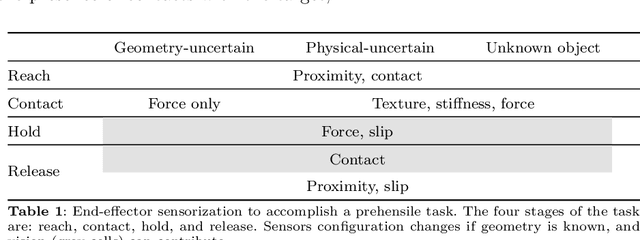

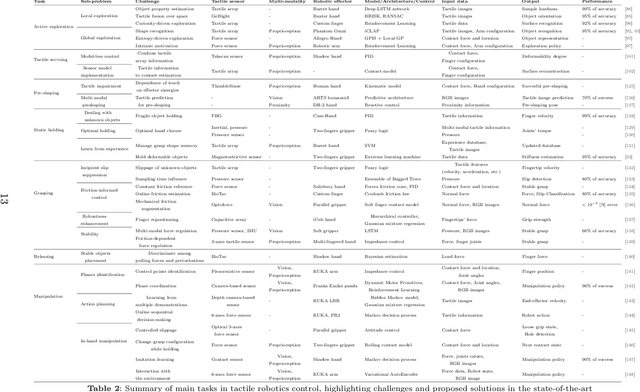
How are robots becoming smarter at interacting with their surroundings? Recent advances have reshaped how robots use tactile sensing to perceive and engage with the world. Tactile sensing is a game-changer, allowing robots to embed sensorimotor control strategies to interact with complex environments and skillfully handle heterogeneous objects. Such control frameworks plan contact-driven motions while staying responsive to sudden changes. We review the latest methods for building perception and control systems in tactile robotics while offering practical guidelines for their design and implementation. We also address key challenges to shape the future of intelligent robots.