 Add to Chrome
 Add to Firefox
 Add to Edge
Perceptually-Weighted Video Quality Metric for Asymmetric Encoded Sports Videos
Jun 16, 2026
Objective video quality metrics commonly assume uniform spatial attention, an assumption that conflicts with the selective nature of human visual perception, particularly in sports videos. Here, allocating more bits for salient regions through semantic encoding can lead to significant bitrate savings. We present a Perceptually-Weighted Video Quality Metric (PW-VQM), a full-reference metric that accounts for the unequal perceptual importance of spatial regions and therefore targets quality evaluation for asymmetrically encoded content. SSIM maps computed in a multiscale wavelet domain are weighted by differentiating between foreground and background regions. Perceptually salient foreground regions are identified by combining open-vocabulary object detection with optical flow analysis, and are assigned higher weight during quality aggregation. Evaluated on sports video content, PW-VQM achieves a Spearman Rank Order Correlation Coefficient of 0.9511, outperforming established metrics including SSIM, VMAF, FUNQUE, and LPIPS. An ablation study confirms the individual contributions of the components of the perceptual weighting.

LRC-DHVC: Towards Local Rate Control in Neural Video Compression
Jan 20, 2026Local rate control is a key enabler to generalize image and video compression for dedicated challenges, such as video coding for machines. While traditional hybrid video coding can easily adapt the local rate-distortion trade-off by changing the local quantization parameter, no such approach is currently available for learning-based video compression. In this paper, we propose LRC-DHVC, a hierarchical video compression network, which allows continuous local rate control on a pixel level to vary the spatial quality distribution within individual video frames. This is achieved by concatenating a quality map to the input frame and applying a weighted MSE loss which matches the pixelwise trade-off factors in the quality map. During training, the model sees a variety of quality maps due to a constrained-random generation. Our model is the first neural video compression network, which can continuously and spatially adapt to varying quality constraints. Due to the wide quality and bit rate range, a single set of network parameters is sufficient. Compared to single rate point networks, which scale linearly with the number of rate points, the memory requirements for our network parameters remain constant. The code and model are available at link-updated-upon-acceptance.
Stabilizing Training with Soft Dynamic Time Warping: A Case Study for Pitch Class Estimation with Weakly Aligned Targets
Aug 10, 2023
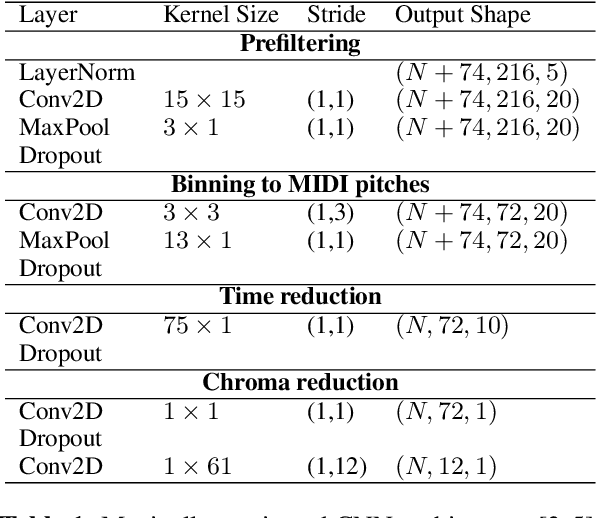
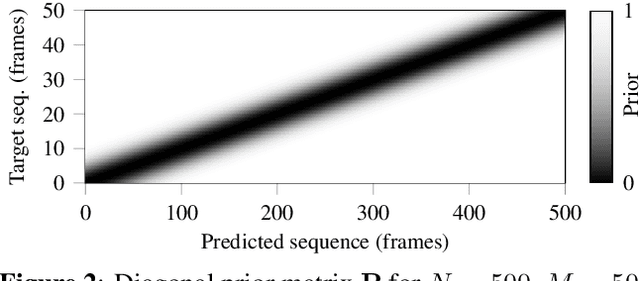
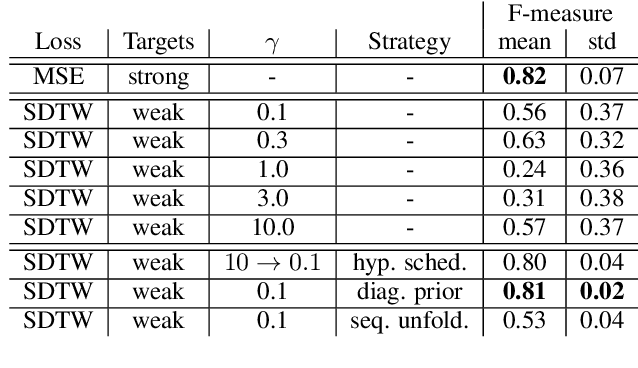
Soft dynamic time warping (SDTW) is a differentiable loss function that allows for training neural networks from weakly aligned data. Typically, SDTW is used to iteratively compute and refine soft alignments that compensate for temporal deviations between the training data and its weakly annotated targets. One major problem is that a mismatch between the estimated soft alignments and the reference alignments in the early training stage leads to incorrect parameter updates, making the overall training procedure unstable. In this paper, we investigate such stability issues by considering the task of pitch class estimation from music recordings as an illustrative case study. In particular, we introduce and discuss three conceptually different strategies (a hyperparameter scheduling, a diagonal prior, and a sequence unfolding strategy) with the objective of stabilizing intermediate soft alignment results. Finally, we report on experiments that demonstrate the effectiveness of the strategies and discuss efficiency and implementation issues.