 Add to Chrome
 Add to Firefox
 Add to Edge
Perceptually-Weighted Video Quality Metric for Asymmetric Encoded Sports Videos
Jun 16, 2026
Objective video quality metrics commonly assume uniform spatial attention, an assumption that conflicts with the selective nature of human visual perception, particularly in sports videos. Here, allocating more bits for salient regions through semantic encoding can lead to significant bitrate savings. We present a Perceptually-Weighted Video Quality Metric (PW-VQM), a full-reference metric that accounts for the unequal perceptual importance of spatial regions and therefore targets quality evaluation for asymmetrically encoded content. SSIM maps computed in a multiscale wavelet domain are weighted by differentiating between foreground and background regions. Perceptually salient foreground regions are identified by combining open-vocabulary object detection with optical flow analysis, and are assigned higher weight during quality aggregation. Evaluated on sports video content, PW-VQM achieves a Spearman Rank Order Correlation Coefficient of 0.9511, outperforming established metrics including SSIM, VMAF, FUNQUE, and LPIPS. An ablation study confirms the individual contributions of the components of the perceptual weighting.

Parallel Context Modeling for Sliding Window Attention in Neural Video Coding
May 20, 2026Most neural video codecs rely on temporal conditioning, which makes them susceptible to error propagation over long sequences. While Transformer-based architectures like the VCT offer a drift-free alternative, they suffer from high computational complexity and inferior RD performance. The recent SWA addresses these shortcomings by reducing complexity and enhancing RD performance, yet it restricts decoding to a strictly sequential raster-scan order, creating a critical bottleneck in decoding latency. To resolve this, we propose P-SWA, utilizing diagonal wavefronts to enable parallel decoding. By embedding a hyperprior and introducing an accumulator to fuse side information and local spatial context, our method increases decoding speed by 36% over the parallel VCT. Simultaneously, it achieves Bjøntegaard Delta-rate savings of up to 10.0% for I-frames and 7.1% for P-frames over the SWA baseline.
Spatially-Adaptive Learning-Based Image Compression with Hierarchical Multi-Scale Latent Spaces
Jul 12, 2023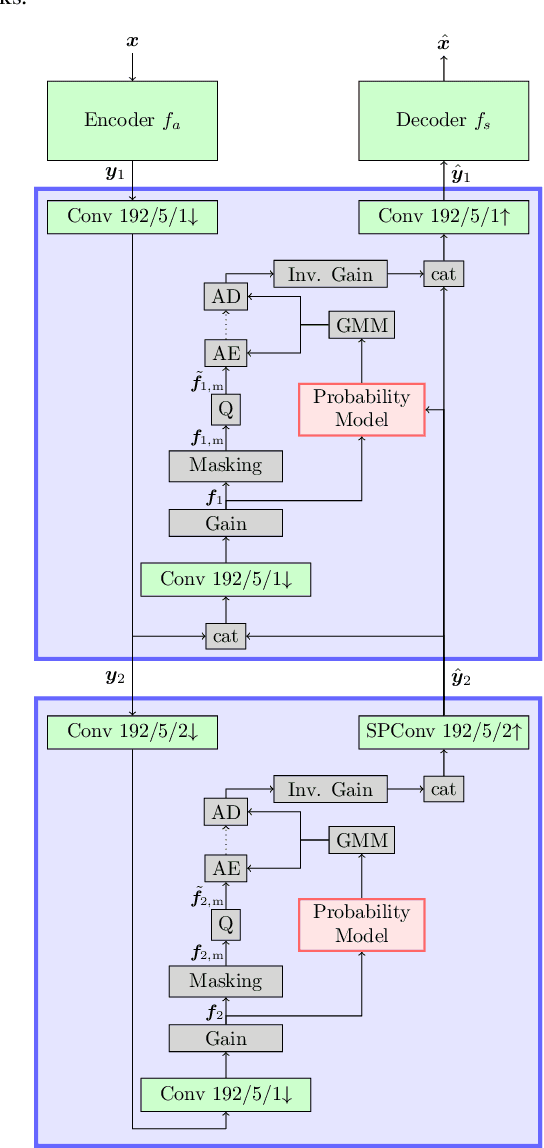

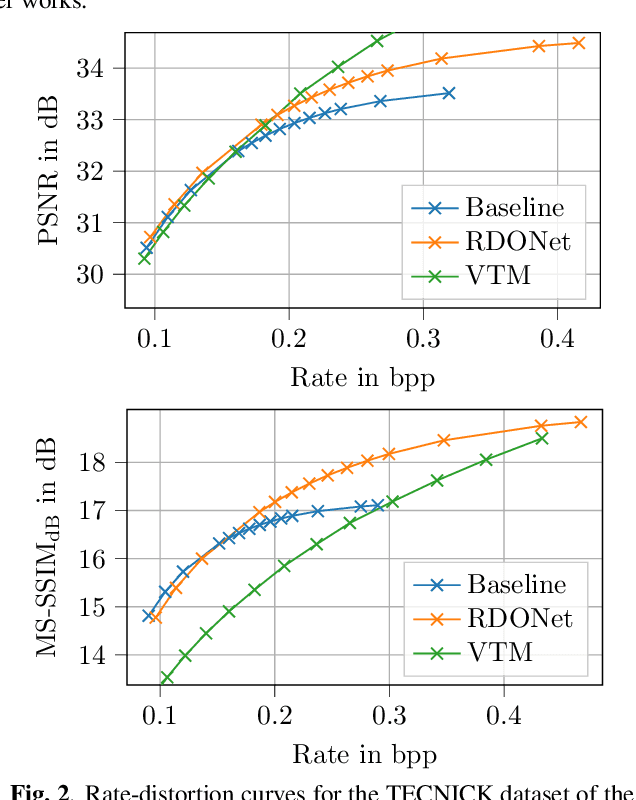
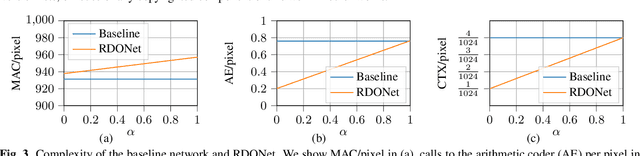
Adaptive block partitioning is responsible for large gains in current image and video compression systems. This method is able to compress large stationary image areas with only a few symbols, while maintaining a high level of quality in more detailed areas. Current state-of-the-art neural-network-based image compression systems however use only one scale to transmit the latent space. In previous publications, we proposed RDONet, a scheme to transmit the latent space in multiple spatial resolutions. Following this principle, we extend a state-of-the-art compression network by a second hierarchical latent-space level to enable multi-scale processing. We extend the existing rate variability capabilities of RDONet by a gain unit. With that we are able to outperform an equivalent traditional autoencoder by 7% rate savings. Furthermore, we show that even though we add an additional latent space, the complexity only increases marginally and the decoding time can potentially even be decreased.
Learning True Rate-Distortion-Optimization for End-To-End Image Compression
Jan 05, 2022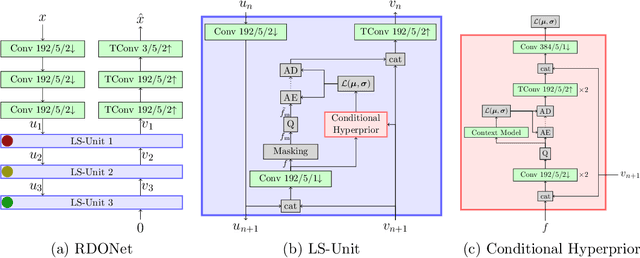
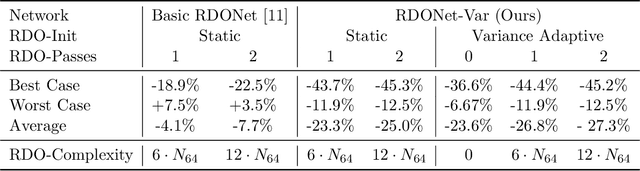
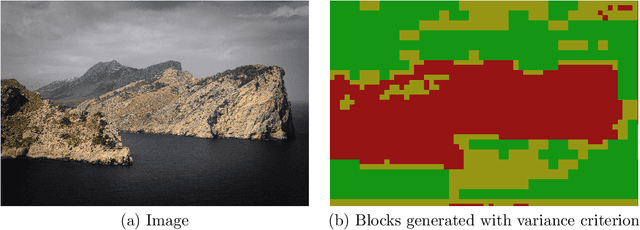
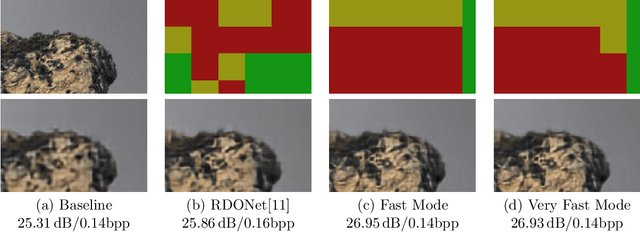
Even though rate-distortion optimization is a crucial part of traditional image and video compression, not many approaches exist which transfer this concept to end-to-end-trained image compression. Most frameworks contain static compression and decompression models which are fixed after training, so efficient rate-distortion optimization is not possible. In a previous work, we proposed RDONet, which enables an RDO approach comparable to adaptive block partitioning in HEVC. In this paper, we enhance the training by introducing low-complexity estimations of the RDO result into the training. Additionally, we propose fast and very fast RDO inference modes. With our novel training method, we achieve average rate savings of 19.6% in MS-SSIM over the previous RDONet model, which equals rate savings of 27.3% over a comparable conventional deep image coder.