 Add to Chrome
 Add to Firefox
 Add to Edge
Retrieving Patient-Specific Radiomic Feature Sets for Transparent Knee MRI Assessment
Mar 02, 2026
Classical radiomic features are designed to quantify image appearance and intensity patterns. Compared with end-to-end deep learning (DL) models trained for disease classification, radiomics pipelines with low-dimensional parametric classifiers offer enhanced transparency and interpretability, yet often underperform because of the reliance on population-level predefined feature sets. Recent work on adaptive radiomics uses DL to predict feature weights over a radiomic pool, then thresholds these weights to retain the top-k features from large radiomic pool F (often ~10^3). However, such marginal ranking can over-admit redundant descriptors and overlook complementary feature interactions. We propose a patient-specific feature-set selection framework that predicts a single compact feature set per subject, targeting complementary and diverse evidence rather than marginal top-k features. To overcome the intractable combinatorial search space of F choose k features, our method utilizes a 2-stage retrieval strategy: randomly sample diverse candidate feature sets, then rank these sets with a learned scoring function to select a high-performing feature set for the specific patient. The system consists of a feature-set scorer, and a classifier that performs the final diagnosis. We empirically show that the proposed two-stage retrieval approximates the original exhaustive all k-feature selection. Validating on tasks including ACL tear detection and KL grading for osteoarthritis, the experimental results achieve diagnostic performance, outperforming the top-k approach with the same k values, and competitive with end-to-end DL models while maintaining high transparency. The model generates auditable feature sets that link clinical outcomes to specific anatomical regions and radiomic families, allowing clinicians to inspect which anatomical structures and quantitative descriptors drive the prediction.

Radiomics-Integrated Deep Learning with Hierarchical Loss for Osteosarcoma Histology Classification
Jan 14, 2026Osteosarcoma (OS) is an aggressive primary bone malignancy. Accurate histopathological assessment of viable versus non-viable tumor regions after neoadjuvant chemotherapy is critical for prognosis and treatment planning, yet manual evaluation remains labor-intensive, subjective, and prone to inter-observer variability. Recent advances in digital pathology have enabled automated necrosis quantification. Evaluating on test data, independently sampled on patient-level, revealed that the deep learning model performance dropped significantly from the tile-level generalization ability reported in previous studies. First, this work proposes the use of radiomic features as additional input in model training. We show that, despite that they are derived from the images, such a multimodal input effectively improved the classification performance, in addition to its added benefits in interpretability. Second, this work proposes to optimize two binary classification tasks with hierarchical classes (i.e. tumor-vs-non-tumor and viable-vs-non-viable), as opposed to the alternative ``flat'' three-class classification task (i.e. non-tumor, non-viable tumor, viable tumor), thereby enabling a hierarchical loss. We show that such a hierarchical loss, with trainable weightings between the two tasks, the per-class performance can be improved significantly. Using the TCIA OS Tumor Assessment dataset, we experimentally demonstrate the benefits from each of the proposed new approaches and their combination, setting a what we consider new state-of-the-art performance on this open dataset for this application. Code and trained models: https://github.com/YaxiiC/RadiomicsOS.git.
Interpretability and Individuality in Knee MRI: Patient-Specific Radiomic Fingerprint with Reconstructed Healthy Personas
Jan 13, 2026For automated assessment of knee MRI scans, both accuracy and interpretability are essential for clinical use and adoption. Traditional radiomics rely on predefined features chosen at the population level; while more interpretable, they are often too restrictive to capture patient-specific variability and can underperform end-to-end deep learning (DL). To address this, we propose two complementary strategies that bring individuality and interpretability: radiomic fingerprints and healthy personas. First, a radiomic fingerprint is a dynamically constructed, patient-specific feature set derived from MRI. Instead of applying a uniform population-level signature, our model predicts feature relevance from a pool of candidate features and selects only those most predictive for each patient, while maintaining feature-level interpretability. This fingerprint can be viewed as a latent-variable model of feature usage, where an image-conditioned predictor estimates usage probabilities and a transparent logistic regression with global coefficients performs classification. Second, a healthy persona synthesises a pathology-free baseline for each patient using a diffusion model trained to reconstruct healthy knee MRIs. Comparing features extracted from pathological images against their personas highlights deviations from normal anatomy, enabling intuitive, case-specific explanations of disease manifestations. We systematically compare fingerprints, personas, and their combination across three clinical tasks. Experimental results show that both approaches yield performance comparable to or surpassing state-of-the-art DL models, while supporting interpretability at multiple levels. Case studies further illustrate how these perspectives facilitate human-explainable biomarker discovery and pathology localisation.
Patient-specific radiomic feature selection with reconstructed healthy persona of knee MR images
Mar 17, 2025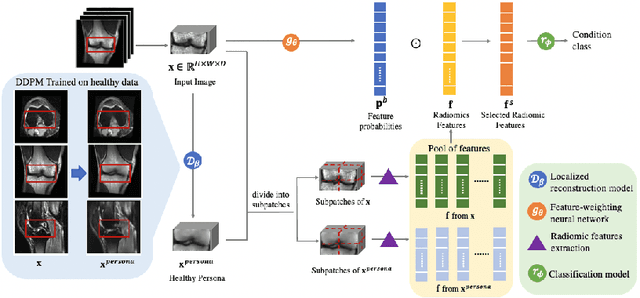
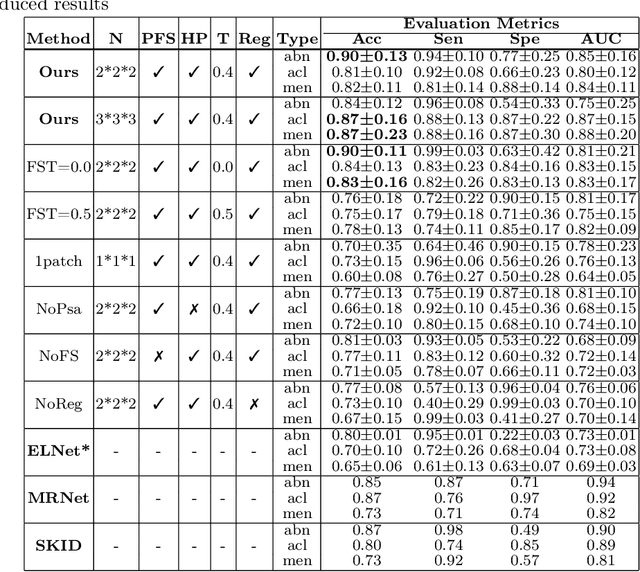
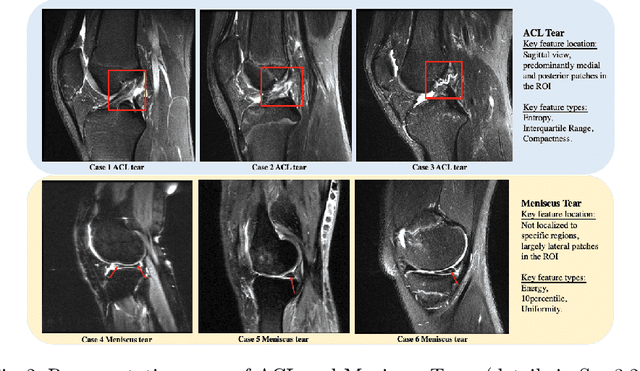
Classical radiomic features have been designed to describe image appearance and intensity patterns. These features are directly interpretable and readily understood by radiologists. Compared with end-to-end deep learning (DL) models, lower dimensional parametric models that use such radiomic features offer enhanced interpretability but lower comparative performance in clinical tasks. In this study, we propose an approach where a standard logistic regression model performance is substantially improved by learning to select radiomic features for individual patients, from a pool of candidate features. This approach has potentials to maintain the interpretability of such approaches while offering comparable performance to DL. We also propose to expand the feature pool by generating a patient-specific healthy persona via mask-inpainting using a denoising diffusion model trained on healthy subjects. Such a pathology-free baseline feature set allows further opportunity in novel feature discovery and improved condition classification. We demonstrate our method on multiple clinical tasks of classifying general abnormalities, anterior cruciate ligament tears, and meniscus tears. Experimental results demonstrate that our approach achieved comparable or even superior performance than state-of-the-art DL approaches while offering added interpretability by using radiomic features extracted from images and supplemented by generating healthy personas. Example clinical cases are discussed in-depth to demonstrate the intepretability-enabled utilities such as human-explainable feature discovery and patient-specific location/view selection. These findings highlight the potentials of the combination of subject-specific feature selection with generative models in augmenting radiomic analysis for more interpretable decision-making. The codes are available at: https://github.com/YaxiiC/RadiomicsPersona.git