 Add to Chrome
 Add to Firefox
 Add to Edge
RELOAD: A Robust and Efficient Learned Query Optimizer for Database Systems
Apr 16, 2026
Recent advances in query optimization have shifted from traditional rule-based and cost-based techniques towards machine learning-driven approaches. Among these, reinforcement learning (RL) has attracted significant attention due to its ability to optimize long-term performance by learning policies over query planning. However, existing RL-based query optimizers often exhibit unstable performance at the level of individual queries, including severe performance regressions, and require prolonged training to reach the plan quality of expert, cost-based optimizers. These shortcomings make learned query optimizers difficult to deploy in practice and remain a major barrier to their adoption in production database systems. To address these challenges, we present RELOAD, a robust and efficient learned query optimizer for database systems. RELOAD focuses on (i) robustness, by minimizing query-level performance regressions and ensuring consistent optimization behavior across executions, and (ii) efficiency, by accelerating convergence to expert-level plan quality. Through extensive experiments on standard benchmarks, including Join Order Benchmark, TPC-DS, and Star Schema Benchmark, RELOAD demonstrates up to 2.4x higher robustness and 3.1x greater efficiency compared to state-of-the-art RL-based query optimization techniques.

Classification of Goods Using Text Descriptions With Sentences Retrieval
Nov 02, 2021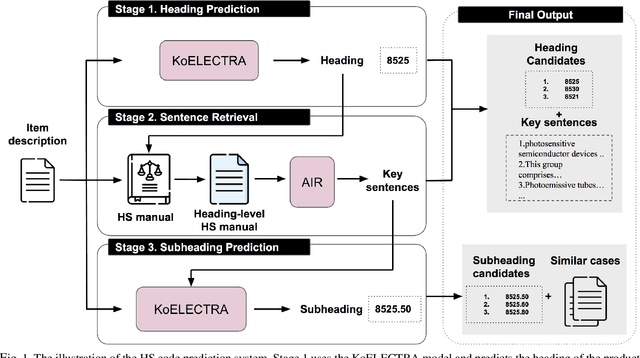
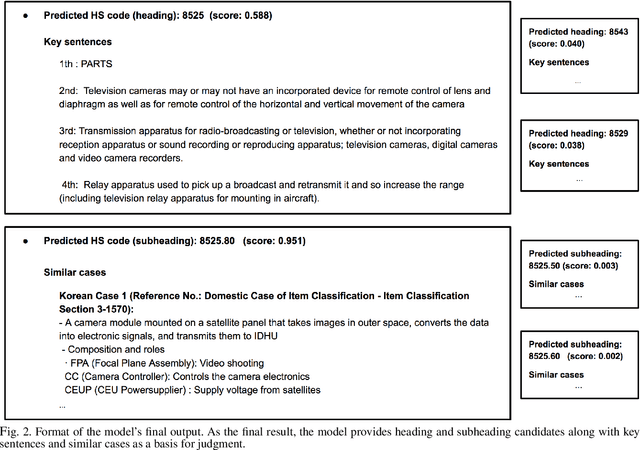
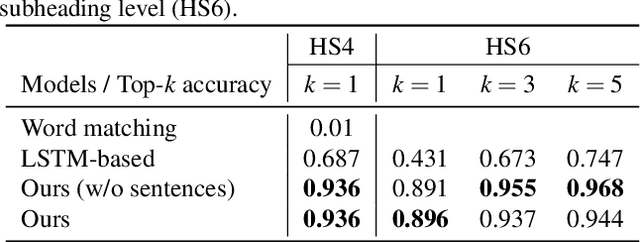
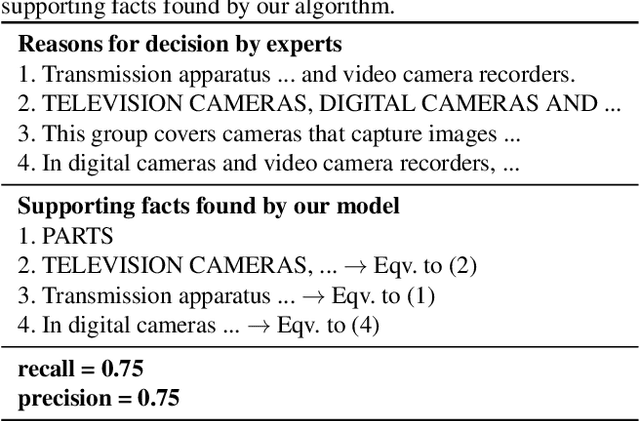
The task of assigning and validating internationally accepted commodity code (HS code) to traded goods is one of the critical functions at the customs office. This decision is crucial to importers and exporters, as it determines the tariff rate. However, similar to court decisions made by judges, the task can be non-trivial even for experienced customs officers. The current paper proposes a deep learning model to assist this seemingly challenging HS code classification. Together with Korea Customs Service, we built a decision model based on KoELECTRA that suggests the most likely heading and subheadings (i.e., the first four and six digits) of the HS code. Evaluation on 129,084 past cases shows that the top-3 suggestions made by our model have an accuracy of 95.5% in classifying 265 subheadings. This promising result implies algorithms may reduce the time and effort taken by customs officers substantially by assisting the HS code classification task.