 Add to Chrome
 Add to Firefox
 Add to Edge
EndoWave: Rational-Wavelet 4D Gaussian Splatting for Endoscopic Reconstruction
Oct 27, 2025
In robot-assisted minimally invasive surgery, accurate 3D reconstruction from endoscopic video is vital for downstream tasks and improved outcomes. However, endoscopic scenarios present unique challenges, including photometric inconsistencies, non-rigid tissue motion, and view-dependent highlights. Most 3DGS-based methods that rely solely on appearance constraints for optimizing 3DGS are often insufficient in this context, as these dynamic visual artifacts can mislead the optimization process and lead to inaccurate reconstructions. To address these limitations, we present EndoWave, a unified spatio-temporal Gaussian Splatting framework by incorporating an optical flow-based geometric constraint and a multi-resolution rational wavelet supervision. First, we adopt a unified spatio-temporal Gaussian representation that directly optimizes primitives in a 4D domain. Second, we propose a geometric constraint derived from optical flow to enhance temporal coherence and effectively constrain the 3D structure of the scene. Third, we propose a multi-resolution rational orthogonal wavelet as a constraint, which can effectively separate the details of the endoscope and enhance the rendering performance. Extensive evaluations on two real surgical datasets, EndoNeRF and StereoMIS, demonstrate that our method EndoWave achieves state-of-the-art reconstruction quality and visual accuracy compared to the baseline method.

Difficult Task Yes but Simple Task No: Unveiling the Laziness in Multimodal LLMs
Oct 15, 2024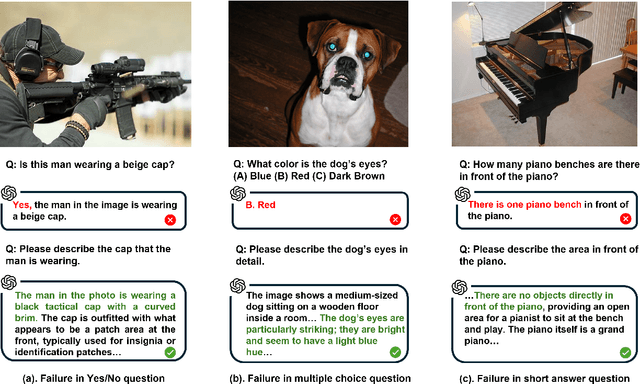
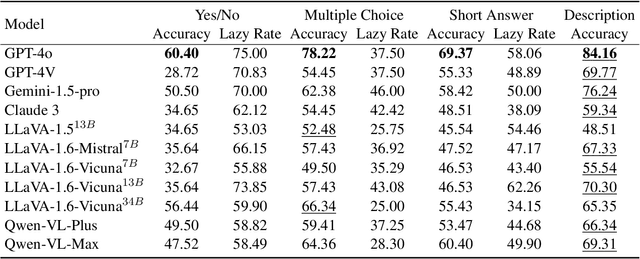
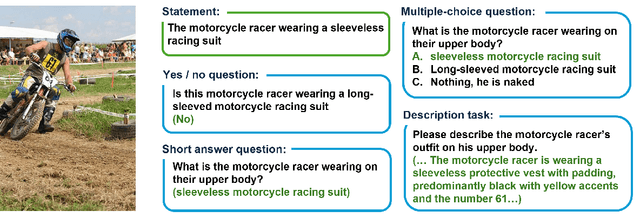
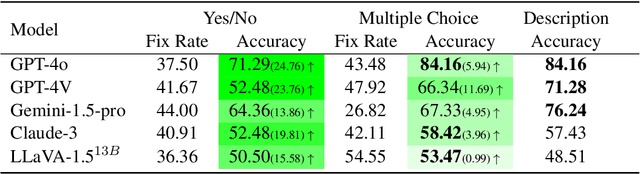
Multimodal Large Language Models (MLLMs) demonstrate a strong understanding of the real world and can even handle complex tasks. However, they still fail on some straightforward visual question-answering (VQA) problems. This paper dives deeper into this issue, revealing that models tend to err when answering easy questions (e.g. Yes/No questions) about an image, even though they can correctly describe it. We refer to this model behavior discrepancy between difficult and simple questions as model laziness. To systematically investigate model laziness, we manually construct LazyBench, a benchmark that includes Yes/No, multiple choice, short answer questions, and image description tasks that are related to the same subjects in the images. Based on LazyBench, we observe that laziness widely exists in current advanced MLLMs (e.g. GPT-4o, Gemini-1.5-pro, Claude 3 and LLaVA-v1.5-13B), and it is more pronounced on stronger models. We also analyze the VQA v2 (LLaVA-v1.5-13B) benchmark and find that about half of its failure cases are caused by model laziness, which further highlights the importance of ensuring that the model fully utilizes its capability. To this end, we conduct preliminary exploration on how to mitigate laziness and find that chain of thought (CoT) can effectively address this issue.