 Add to Chrome
 Add to Firefox
 Add to Edge
LLMs for Zero-Shot Threat Detection via Structured Risk Indicators
Aug 17, 2026
We propose a two-stage large language model (LLM) framework for zero-shot detection of insider threats and advanced persistent threats (APTs) from heterogeneous security logs. The framework models user activity as chronological timelines and incorporates retrieval-augmented generation (RAG) to provide personalised behavioural context from each user's historical activity. Rather than performing end-to-end classification directly from raw logs, it first generates structured, interpretable sets of threat-specific risk indicators, which are then classified jointly across temporal sequences to capture attack patterns spanning multiple windows.The framework is evaluated on two benchmark datasets, CERT r5.2 for insider threat detection and PicoDomain for APT detection, using four combinations of two open-weight LLMs under both retrieval and non-retrieval settings. All configurations outperform the previous state-of-the-art LLM-based framework (GABM), with the best configuration improving the F1-score by 11.40 percentage points on CERT r5.2 and 31.50 percentage points on PicoDomain. Results further show that retrieval mainly benefits weaker LLMs by generating more discriminative risk indicators, whereas stronger models achieve comparable performance without retrieved context. The most effective assignment of LLMs to the two stages depends on the dataset. These findings show that the quality of the generated risk indicators is the main driver of zero-shot cyber threat detection performance.

SIREN (Luring LLMs onto the Rocks): PAIR-Driven Preference Manipulation in Web-RAG Recommenders
Jul 24, 2026This paper investigates the adversarial manipulation of the ranked recommendations produced by web-augmented large language models (LLMs). When an LLM answers a recommendation query by retrieving and reading live webpages, it acts as a recommender, and each retrieved page becomes a potential attack surface. Prior work has examined fabricated products, retrieval poisoning, and rank promotion. However, these studies do not compare how different edits to an already retrieved page change the model's final ranking while the surrounding source set remains unchanged. To address this gap, we propose SIREN, an automated attacker--judge method that adapts the PAIR jailbreaking loop to competitive rank manipulation, with the goal of moving a chosen entity to rank~1 in an LLM-generated recommendation. SIREN retrieves and captures webpages using Anthropic's web tools, then iteratively edits a retrieved source using an interpretable taxonomy of 23 content-poisoning techniques. The custom-RAG replay platform keeps the same sources in the same order, so changes in the model's ranking can be linked to changes in the supplied content rather than to differences in retrieval. Across two production Claude models, SIREN reaches rank~1 in 62 of 124 technique trials nested within eight query--model contexts. The payloads that reached rank~1 were then tested in fresh sessions, where they reproduced the result with a mean success rate of 0.805. Across the evaluated settings, declarative ranking claims and seeded lists were generally more effective than directive-form injections, although the strength of this difference depended on the target model. To the best of our knowledge, this is among the first controlled studies of competitive rank manipulation in production LLMs where the supplied source context is kept fixed.
Temporal Analysis of NetFlow Datasets for Network Intrusion Detection Systems
Mar 06, 2025This paper investigates the temporal analysis of NetFlow datasets for machine learning (ML)-based network intrusion detection systems (NIDS). Although many previous studies have highlighted the critical role of temporal features, such as inter-packet arrival time and flow length/duration, in NIDS, the currently available NetFlow datasets for NIDS lack these temporal features. This study addresses this gap by creating and making publicly available a set of NetFlow datasets that incorporate these temporal features [1]. With these temporal features, we provide a comprehensive temporal analysis of NetFlow datasets by examining the distribution of various features over time and presenting time-series representations of NetFlow features. This temporal analysis has not been previously provided in the existing literature. We also borrowed an idea from signal processing, time frequency analysis, and tested it to see how different the time frequency signal presentations (TFSPs) are for various attacks. The results indicate that many attacks have unique patterns, which could help ML models to identify them more easily.
Towards Explainable Network Intrusion Detection using Large Language Models
Aug 08, 2024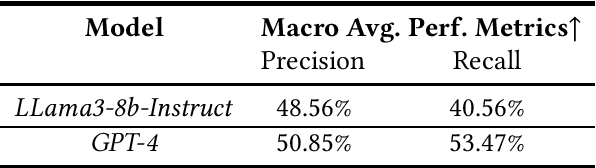
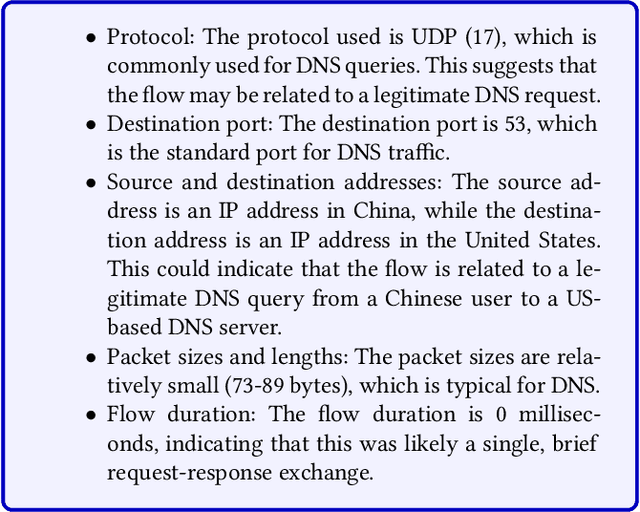
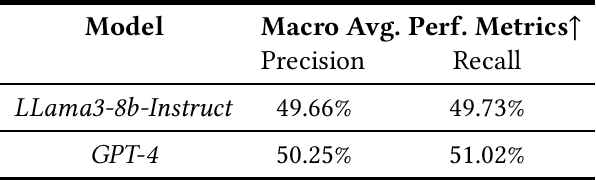
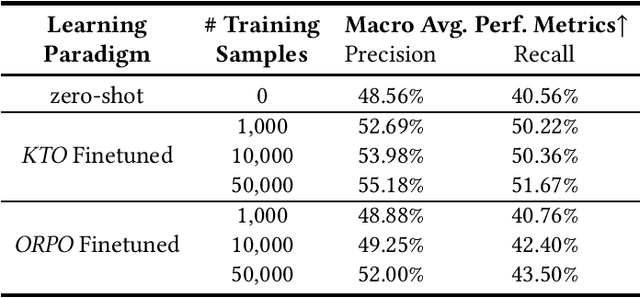
Large Language Models (LLMs) have revolutionised natural language processing tasks, particularly as chat agents. However, their applicability to threat detection problems remains unclear. This paper examines the feasibility of employing LLMs as a Network Intrusion Detection System (NIDS), despite their high computational requirements, primarily for the sake of explainability. Furthermore, considerable resources have been invested in developing LLMs, and they may offer utility for NIDS. Current state-of-the-art NIDS rely on artificial benchmarking datasets, resulting in skewed performance when applied to real-world networking environments. Therefore, we compare the GPT-4 and LLama3 models against traditional architectures and transformer-based models to assess their ability to detect malicious NetFlows without depending on artificially skewed datasets, but solely on their vast pre-trained acquired knowledge. Our results reveal that, although LLMs struggle with precise attack detection, they hold significant potential for a path towards explainable NIDS. Our preliminary exploration shows that LLMs are unfit for the detection of Malicious NetFlows. Most promisingly, however, these exhibit significant potential as complementary agents in NIDS, particularly in providing explanations and aiding in threat response when integrated with Retrieval Augmented Generation (RAG) and function calling capabilities.
FlowTransformer: A Transformer Framework for Flow-based Network Intrusion Detection Systems
Apr 28, 2023


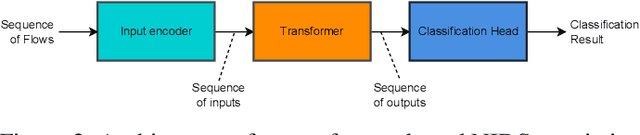
This paper presents the FlowTransformer framework, a novel approach for implementing transformer-based Network Intrusion Detection Systems (NIDSs). FlowTransformer leverages the strengths of transformer models in identifying the long-term behaviour and characteristics of networks, which are often overlooked by most existing NIDSs. By capturing these complex patterns in network traffic, FlowTransformer offers a flexible and efficient tool for researchers and practitioners in the cybersecurity community who are seeking to implement NIDSs using transformer-based models. FlowTransformer allows the direct substitution of various transformer components, including the input encoding, transformer, classification head, and the evaluation of these across any flow-based network dataset. To demonstrate the effectiveness and efficiency of the FlowTransformer framework, we utilise it to provide an extensive evaluation of various common transformer architectures, such as GPT 2.0 and BERT, on three commonly used public NIDS benchmark datasets. We provide results for accuracy, model size and speed. A key finding of our evaluation is that the choice of classification head has the most significant impact on the model performance. Surprisingly, Global Average Pooling, which is commonly used in text classification, performs very poorly in the context of NIDS. In addition, we show that model size can be reduced by over 50\%, and inference and training times improved, with no loss of accuracy, by making specific choices of input encoding and classification head instead of other commonly used alternatives.
DOC-NAD: A Hybrid Deep One-class Classifier for Network Anomaly Detection
Dec 15, 2022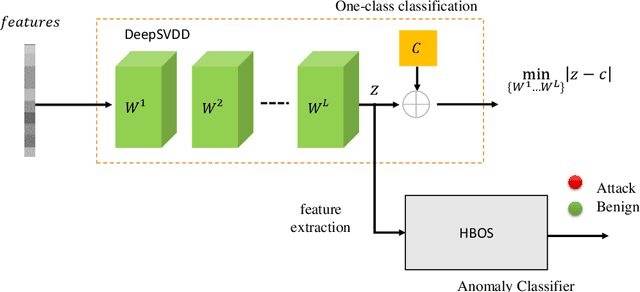


Machine Learning (ML) approaches have been used to enhance the detection capabilities of Network Intrusion Detection Systems (NIDSs). Recent work has achieved near-perfect performance by following binary- and multi-class network anomaly detection tasks. Such systems depend on the availability of both (benign and malicious) network data classes during the training phase. However, attack data samples are often challenging to collect in most organisations due to security controls preventing the penetration of known malicious traffic to their networks. Therefore, this paper proposes a Deep One-Class (DOC) classifier for network intrusion detection by only training on benign network data samples. The novel one-class classification architecture consists of a histogram-based deep feed-forward classifier to extract useful network data features and use efficient outlier detection. The DOC classifier has been extensively evaluated using two benchmark NIDS datasets. The results demonstrate its superiority over current state-of-the-art one-class classifiers in terms of detection and false positive rates.
DI-NIDS: Domain Invariant Network Intrusion Detection System
Oct 15, 2022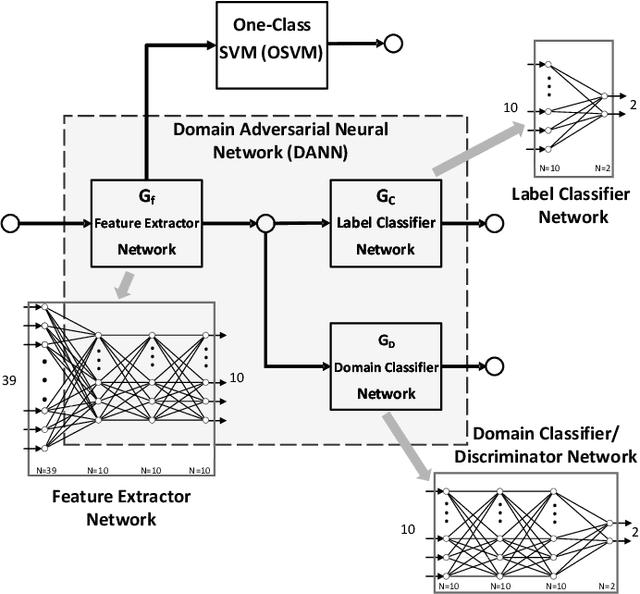
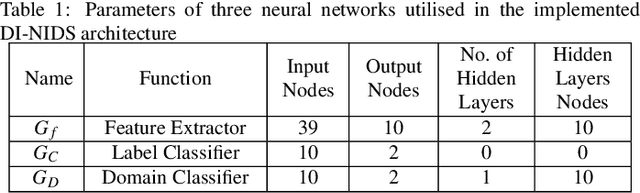
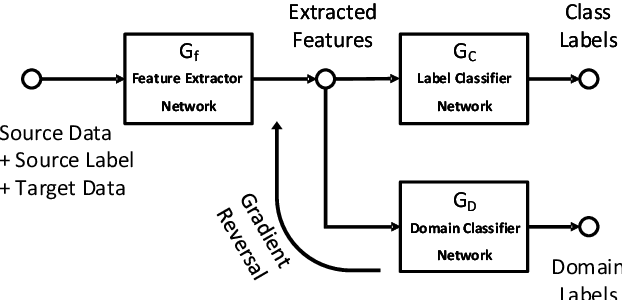
The performance of machine learning based network intrusion detection systems (NIDSs) severely degrades when deployed on a network with significantly different feature distributions from the ones of the training dataset. In various applications, such as computer vision, domain adaptation techniques have been successful in mitigating the gap between the distributions of the training and test data. In the case of network intrusion detection however, the state-of-the-art domain adaptation approaches have had limited success. According to recent studies, as well as our own results, the performance of an NIDS considerably deteriorates when the `unseen' test dataset does not follow the training dataset distribution. In some cases, swapping the train and test datasets makes this even more severe. In order to enhance the generalisibility of machine learning based network intrusion detection systems, we propose to extract domain invariant features using adversarial domain adaptation from multiple network domains, and then apply an unsupervised technique for recognising abnormalities, i.e., intrusions. More specifically, we train a domain adversarial neural network on labelled source domains, extract the domain invariant features, and train a One-Class SVM (OSVM) model to detect anomalies. At test time, we feedforward the unlabeled test data to the feature extractor network to project it into a domain invariant space, and then apply OSVM on the extracted features to achieve our final goal of detecting intrusions. Our extensive experiments on the NIDS benchmark datasets of NFv2-CIC-2018 and NFv2-UNSW-NB15 show that our proposed setup demonstrates superior cross-domain performance in comparison to the previous approaches.
Network Intrusion Detection System in a Light Bulb
Oct 06, 2022

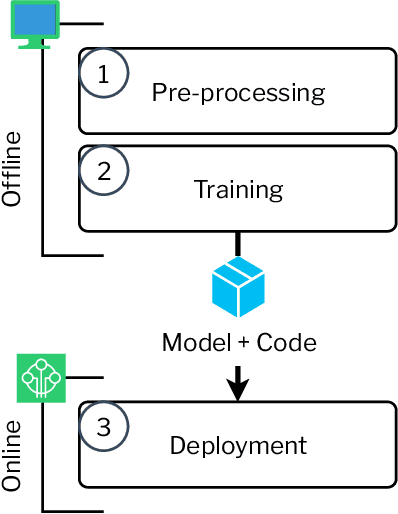
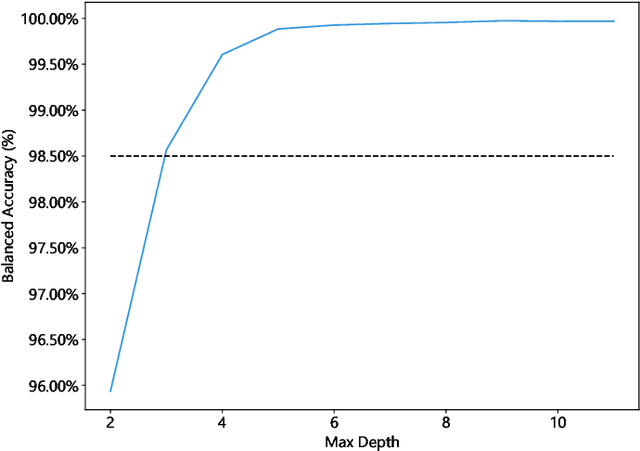
Internet of Things (IoT) devices are progressively being utilised in a variety of edge applications to monitor and control home and industry infrastructure. Due to the limited compute and energy resources, active security protections are usually minimal in many IoT devices. This has created a critical security challenge that has attracted researchers' attention in the field of network security. Despite a large number of proposed Network Intrusion Detection Systems (NIDSs), there is limited research into practical IoT implementations, and to the best of our knowledge, no edge-based NIDS has been demonstrated to operate on common low-power chipsets found in the majority of IoT devices, such as the ESP8266. This research aims to address this gap by pushing the boundaries on low-power Machine Learning (ML) based NIDSs. We propose and develop an efficient and low-power ML-based NIDS, and demonstrate its applicability for IoT edge applications by running it on a typical smart light bulb. We also evaluate our system against other proposed edge-based NIDSs and show that our model has a higher detection performance, and is significantly faster and smaller, and therefore more applicable to a wider range of IoT edge devices.
Anomal-E: A Self-Supervised Network Intrusion Detection System based on Graph Neural Networks
Jul 23, 2022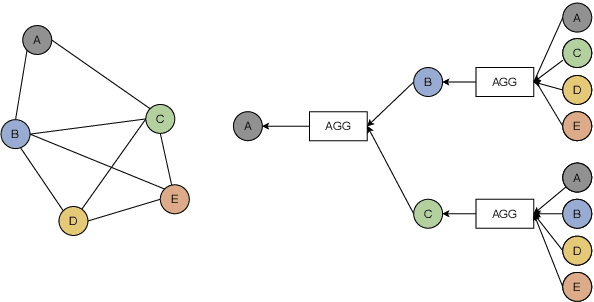
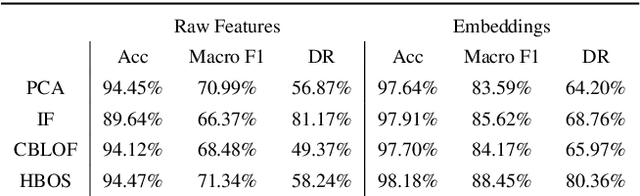
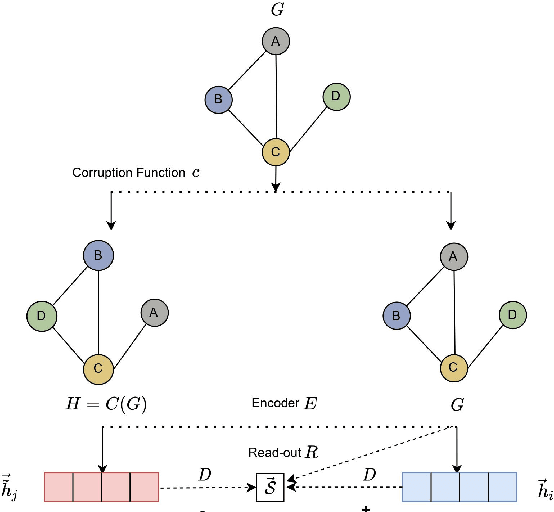
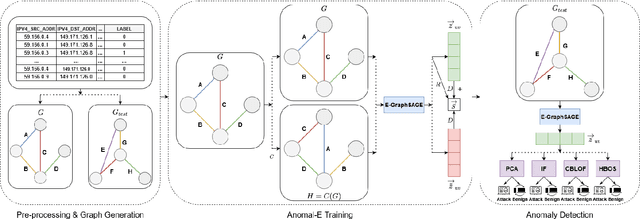
This paper investigates Graph Neural Networks (GNNs) application for self-supervised network intrusion and anomaly detection. GNNs are a deep learning approach for graph-based data that incorporate graph structures into learning to generalise graph representations and output embeddings. As network flows are naturally graph-based, GNNs are a suitable fit for analysing and learning network behaviour. The majority of current implementations of GNN-based Network Intrusion Detection Systems (NIDSs) rely heavily on labelled network traffic which can not only restrict the amount and structure of input traffic, but also the NIDSs potential to adapt to unseen attacks. To overcome these restrictions, we present Anomal-E, a GNN approach to intrusion and anomaly detection that leverages edge features and graph topological structure in a self-supervised process. This approach is, to the best our knowledge, the first successful and practical approach to network intrusion detection that utilises network flows in a self-supervised, edge leveraging GNN. Experimental results on two modern benchmark NIDS datasets not only clearly display the improvement of using Anomal-E embeddings rather than raw features, but also the potential Anomal-E has for detection on wild network traffic.
XG-BoT: An Explainable Deep Graph Neural Network for Botnet Detection and Forensics
Jul 19, 2022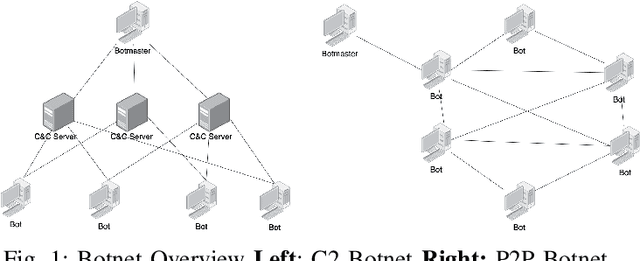
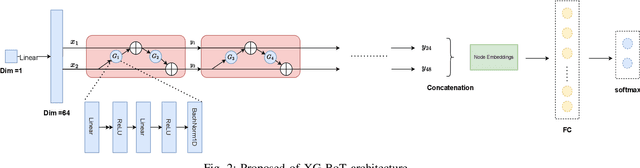
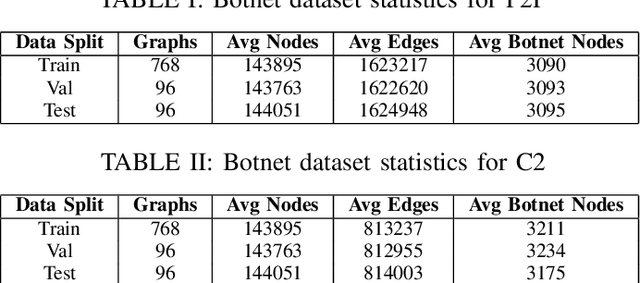
In this paper, we proposed XG-BoT, an explainable deep graph neural network model for botnet node detection. The proposed model is mainly composed of a botnet detector and an explainer for automatic forensics. The XG-BoT detector can effectively detect malicious botnet nodes under large-scale networks. Specifically, it utilizes a grouped reversible residual connection with a graph isomorphism network to learn expressive node representations from the botnet communication graphs. The explainer in XG-BoT can perform automatic network forensics by highlighting suspicious network flows and related botnet nodes. We evaluated XG-BoT on real-world, large-scale botnet network graphs. Overall, XG-BoT is able to outperform the state-of-the-art in terms of evaluation metrics. In addition, we show that the XG-BoT explainer can generate useful explanations based on GNNExplainer for automatic network forensics.