 Add to Chrome
 Add to Firefox
 Add to Edge
SIREN (Luring LLMs onto the Rocks): PAIR-Driven Preference Manipulation in Web-RAG Recommenders
Jul 24, 2026
This paper investigates the adversarial manipulation of the ranked recommendations produced by web-augmented large language models (LLMs). When an LLM answers a recommendation query by retrieving and reading live webpages, it acts as a recommender, and each retrieved page becomes a potential attack surface. Prior work has examined fabricated products, retrieval poisoning, and rank promotion. However, these studies do not compare how different edits to an already retrieved page change the model's final ranking while the surrounding source set remains unchanged. To address this gap, we propose SIREN, an automated attacker--judge method that adapts the PAIR jailbreaking loop to competitive rank manipulation, with the goal of moving a chosen entity to rank~1 in an LLM-generated recommendation. SIREN retrieves and captures webpages using Anthropic's web tools, then iteratively edits a retrieved source using an interpretable taxonomy of 23 content-poisoning techniques. The custom-RAG replay platform keeps the same sources in the same order, so changes in the model's ranking can be linked to changes in the supplied content rather than to differences in retrieval. Across two production Claude models, SIREN reaches rank~1 in 62 of 124 technique trials nested within eight query--model contexts. The payloads that reached rank~1 were then tested in fresh sessions, where they reproduced the result with a mean success rate of 0.805. Across the evaluated settings, declarative ranking claims and seeded lists were generally more effective than directive-form injections, although the strength of this difference depended on the target model. To the best of our knowledge, this is among the first controlled studies of competitive rank manipulation in production LLMs where the supplied source context is kept fixed.

Anomal-E: A Self-Supervised Network Intrusion Detection System based on Graph Neural Networks
Jul 23, 2022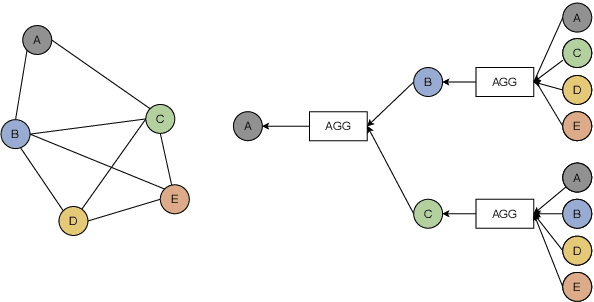
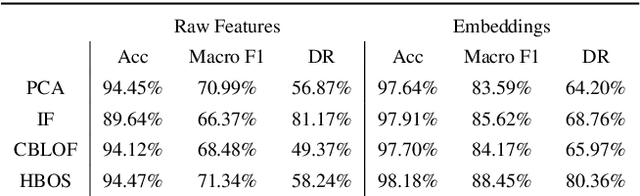
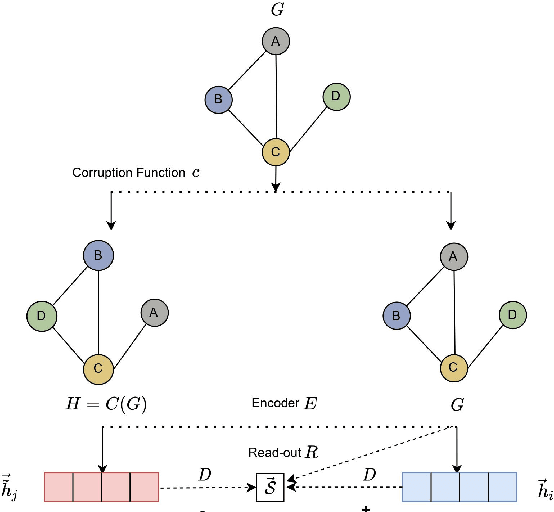
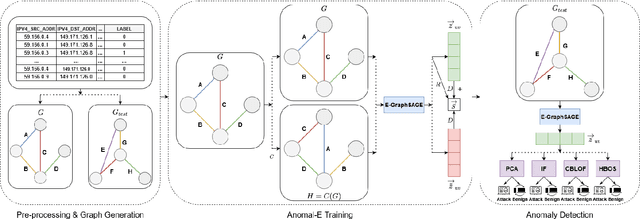
This paper investigates Graph Neural Networks (GNNs) application for self-supervised network intrusion and anomaly detection. GNNs are a deep learning approach for graph-based data that incorporate graph structures into learning to generalise graph representations and output embeddings. As network flows are naturally graph-based, GNNs are a suitable fit for analysing and learning network behaviour. The majority of current implementations of GNN-based Network Intrusion Detection Systems (NIDSs) rely heavily on labelled network traffic which can not only restrict the amount and structure of input traffic, but also the NIDSs potential to adapt to unseen attacks. To overcome these restrictions, we present Anomal-E, a GNN approach to intrusion and anomaly detection that leverages edge features and graph topological structure in a self-supervised process. This approach is, to the best our knowledge, the first successful and practical approach to network intrusion detection that utilises network flows in a self-supervised, edge leveraging GNN. Experimental results on two modern benchmark NIDS datasets not only clearly display the improvement of using Anomal-E embeddings rather than raw features, but also the potential Anomal-E has for detection on wild network traffic.