 Add to Chrome
 Add to Firefox
 Add to Edge
Automated Customization of LLMs for Enterprise Code Repositories Using Semantic Scopes
Feb 05, 2026
Code completion (CC) is a task frequently used by developers when working in collaboration with LLM-based programming assistants. Despite the increased performance of LLMs on public benchmarks, out of the box LLMs still have a hard time generating code that aligns with a private code repository not previously seen by the model's training data. Customizing code LLMs to a private repository provides a way to improve the model performance. In this paper we present our approach for automated LLM customization based on semantic scopes in the code. We evaluate LLMs on real industry cases with two private enterprise code repositories with two customization strategies: Retrieval-Augmented Generation (RAG) and supervised Fine-Tuning (FT). Our mechanism for ingesting the repository's data and formulating the training data pairs with semantic scopes helps models to learn the underlying patterns specific to the repository, providing more precise code to developers and helping to boost their productivity. The code completions of moderately sized customized models can be significantly better than those of uncustomized models of much larger capacity. We also include an analysis of customization on two public benchmarks and present opportunities for future work.

Understanding Software Engineering Agents Through the Lens of Traceability: An Empirical Study
Jun 10, 2025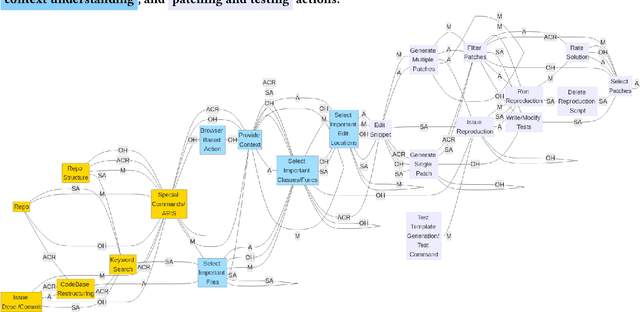
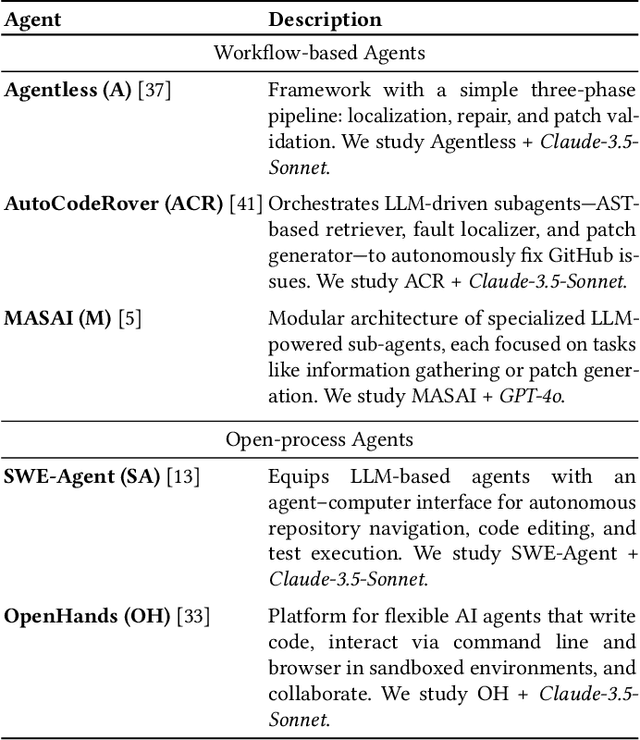
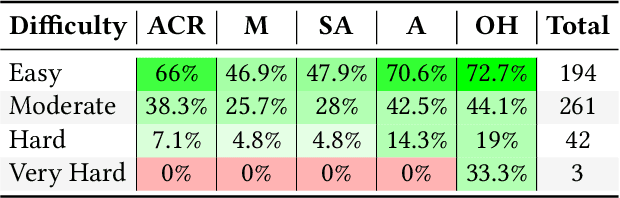
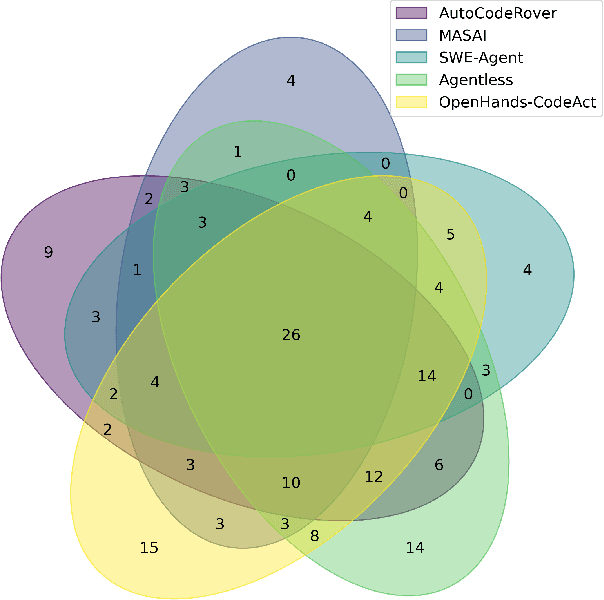
With the advent of large language models (LLMs), software engineering agents (SWE agents) have emerged as a powerful paradigm for automating a range of software tasks -- from code generation and repair to test case synthesis. These agents operate autonomously by interpreting user input and responding to environmental feedback. While various agent architectures have demonstrated strong empirical performance, the internal decision-making worfklows that drive their behavior remain poorly understood. Deeper insight into these workflows hold promise for improving both agent reliability and efficiency. In this work, we present the first systematic study of SWE agent behavior through the lens of execution traces. Our contributions are as follows: (1) we propose the first taxonomy of decision-making pathways across five representative agents; (2) using this taxonomy, we identify three core components essential to agent success -- bug localization, patch generation, and reproduction test generation -- and study each in depth; (3) we study the impact of test generation on successful patch production; and analyze strategies that can lead to successful test generation; (4) we further conduct the first large-scale code clone analysis comparing agent-generated and developer-written patches and provide a qualitative study revealing structural and stylistic differences in patch content. Together, these findings offer novel insights into agent design and open avenues for building agents that are both more effective and more aligned with human development practices.
Customizing a Large Language Model for VHDL Design of High-Performance Microprocessors
May 14, 2025The use of Large Language Models (LLMs) in hardware design has taken off in recent years, principally through its incorporation in tools that increase chip designer productivity. There has been considerable discussion about the use of LLMs in RTL specifications of chip designs, for which the two most popular languages are Verilog and VHDL. LLMs and their use in Verilog design has received significant attention due to the higher popularity of the language, but little attention so far has been given to VHDL despite its continued popularity in the industry. There has also been little discussion about the unique needs of organizations that engage in high-performance processor design, and techniques to deploy AI solutions in these settings. In this paper, we describe our journey in developing a Large Language Model (LLM) specifically for the purpose of explaining VHDL code, a task that has particular importance in an organization with decades of experience and assets in high-performance processor design. We show how we developed test sets specific to our needs and used them for evaluating models as we performed extended pretraining (EPT) of a base LLM. Expert evaluation of the code explanations produced by the EPT model increased to 69% compared to a base model rating of 43%. We further show how we developed an LLM-as-a-judge to gauge models similar to expert evaluators. This led us to deriving and evaluating a host of new models, including an instruction-tuned version of the EPT model with an expected expert evaluator rating of 71%. Our experiments also indicate that with the potential use of newer base models, this rating can be pushed to 85% and beyond. We conclude with a discussion on further improving the quality of hardware design LLMs using exciting new developments in the Generative AI world.