 Add to Chrome
 Add to Firefox
 Add to Edge
One QK Channel, Many Sources: Guarding Low-Precision Attention Collapse
Aug 03, 2026
A bfloat16 transformer can train normally for many steps and then collapse abruptly. Distinct low-precision errors can trigger the same failure, leaving unclear whether each source needs its own repair or one shared route can be blocked. We isolate a reproduced GPT-2-class collapse to the streaming-softmax accumulator, where fp32 accumulation repairs it, and use the fault as an assay for moving controlled errors across sources. Errors placed outside attention still drive the same query-key (QK) spectral runaway, while correcting only QK keeps training stable with the source fault active. This source-channel dissociation shows that fault source is not failure channel. It holds across the tested architectures and scales and reproduces on a second GPU architecture. A causal probe projects each update off the current QK weights' leading three singular directions: the query projection's largest singular value stays at 11.1, whereas removing equal energy elsewhere leaves it at 237. The QK channel therefore drives the early runaway rather than merely tracking it. Entry depends on temporal sign-coherence across steps, not aggregate deviation. QK-Guard closes the channel with a dormant controller that switches on parameter-free QK normalization when attention-logit saturation begins. It contains every tested runaway and matches always-on QK normalization over 60k steps, while non-QK actions at the same trigger fail. The results support intervention at the shared QK locus rather than separate repair at each fault source.

Coding Agents as Test-Suite Auditors: Finding What Official Suites Miss While Approaching What They Catch
Aug 03, 2026Online-judge verdicts and the datasets and benchmarks built on them are treated as ground truth for evaluating and training large language models for code. Yet prior audits have sounded a warning: official suites accept buggy submissions. These audits, however, stop at the warning and offer no practical remedy. Our remedy has two parts: an off-the-shelf coding agent, serving as a test-suite auditor, both builds adversarial test suites to expose what official suites miss and supplies these suites where no official suite exists; a certification chain determines whether each agent-flagged submission is genuinely buggy without relying on the official judge: multiple independently written accepted solutions agree on the expected output for every test, brute-force solutions settle disagreements, and a per-problem validator certifies each failing input legal. One such agent identifies 589 verified accepted-but-buggy submissions among AtCoder's 20,375 audited accepted submissions; extending the same certification to all five agents yields a union floor of 906 such submissions. Five agents, scored separately, each stay within 1.7pp of official-suite coverage on logic bugs those suites catch. On post-cutoff Codeforces problems with no available official suites, the same test-building method leads all five reproduced baselines at every tested input budget. Where an official suite exists, the agent audits suite adequacy instead of assuming it; where none exists, agent suites catch the most buggy submissions among methods we reproduced and tested.
OPERA: An Agent for Image Restoration with End-to-End Joint Planning-Execution Optimization
May 21, 2026Real-world image restoration is challenging due to complex and interacting mixed degradations. Recent agent-based approaches address this problem by composing multiple task-specific restoration tools. However, empirical analysis reveals that their performance is fundamentally limited by implicitly constrained planning spaces and the lack of coordination among independently pretrained tools. To address these issues, we propose OPERA (Optimized Planning-Execution Restoration Agent), a framework that jointly optimizes restoration planning and tool execution in an end-to-end manner. On the planning side, OPERA uses reinforcement learning to directly optimize tool composition over a combinatorial plan space, with the final restoration quality as the reward. On the execution side, OPERA introduces agent-guided co-training of restoration tools, enabling them to learn cooperative behaviors under sequential composition. Extensive experiments on multi-degradation benchmarks and real-world datasets demonstrate that OPERA consistently outperforms both all-in-one restoration models and existing agent-based methods across diverse and complex degradation scenarios.
JPEG-Inspired Cloud-Edge Holography
Dec 13, 2025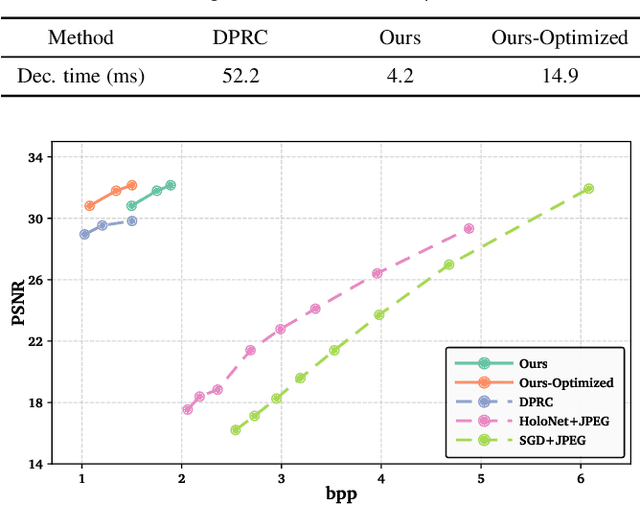

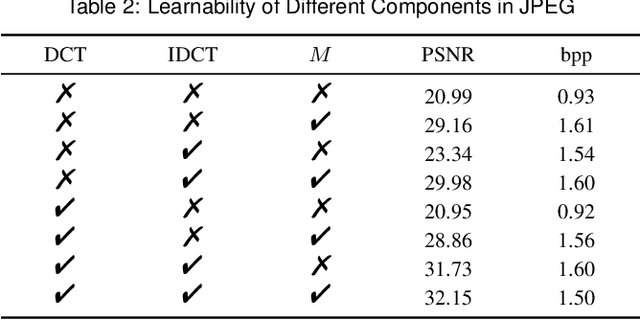
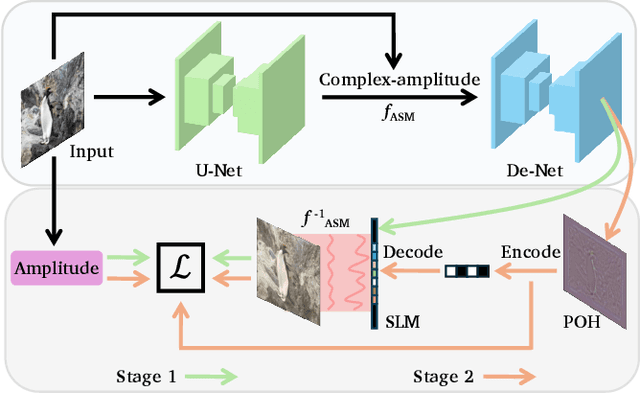
Computer-generated holography (CGH) presents a transformative solution for near-eye displays in augmented and virtual reality. Recent advances in deep learning have greatly improved CGH in reconstructed quality and computational efficiency. However, deploying neural CGH pipelines directly on compact, eyeglass-style devices is hindered by stringent constraints on computation and energy consumption, while cloud offloading followed by transmission with natural image codecs often distorts phase information and requires high bandwidth to maintain reconstruction quality. Neural compression methods can reduce bandwidth but impose heavy neural decoders at the edge, increasing inference latency and hardware demand. In this work, we introduce JPEG-Inspired Cloud-Edge Holography, an efficient pipeline designed around a learnable transform codec that retains the block-structured and hardware-friendly nature of JPEG. Our system shifts all heavy neural processing to the cloud, while the edge device performs only lightweight decoding without any neural inference. To further improve throughput, we implement custom CUDA kernels for entropy coding on both cloud and edge. This design achieves a peak signal-to-noise ratio of 32.15 dB at $<$ 2 bits per pixel with decode latency as low as 4.2 ms. Both numerical simulations and optical experiments confirm the high reconstruction quality of the holograms. By aligning CGH with a codec that preserves JPEG's structural efficiency while extending it with learnable components, our framework enables low-latency, bandwidth-efficient hologram streaming on resource-constrained wearable devices-using only simple block-based decoding readily supported by modern system-on-chips, without requiring neural decoders or specialized hardware.
Eyepiece-free pupil-optimized holographic near-eye displays
Jul 30, 2025Computer-generated holography (CGH) represents a transformative visualization approach for next-generation immersive virtual and augmented reality (VR/AR) displays, enabling precise wavefront modulation and naturally providing comprehensive physiological depth cues without the need for bulky optical assemblies. Despite significant advancements in computational algorithms enhancing image quality and achieving real-time generation, practical implementations of holographic near-eye displays (NEDs) continue to face substantial challenges arising from finite and dynamically varying pupil apertures, which degrade image quality and compromise user experience. In this study, we introduce an eyepiece-free pupil-optimized holographic NED. Our proposed method employs a customized spherical phase modulation strategy to generate multiple viewpoints within the pupil, entirely eliminating the dependence on conventional optical eyepieces. Through the joint optimization of amplitude and phase distributions across these viewpoints, the method markedly mitigates image degradation due to finite pupil sampling and resolves inapparent depth cues induced by the spherical phase. The demonstrated method signifies a substantial advancement toward the realization of compact, lightweight, and flexible holographic NED systems, fulfilling stringent requirements for future VR/AR display technologies.