 Add to Chrome
 Add to Firefox
 Add to Edge
Spectral-Spatial Synergistic Guided Network for Hyperspectral Salient Object Detection
Jul 23, 2026
Hyperspectral salient object detection aims to identify visually salient regions from hyperspectral images. Existing methods often fail because they fundamentally misunderstand the data, confusing incidental spectral variations caused by external factors such as illumination with essential spectral differences caused by the intrinsic material properties of the object. This leads to fragile representations and noisy predictions. To this end, we propose a lightweight and efficient Spectral-Spatial Synergistic Guided Network (S3GNet), with structure perception as the core, to build a closed-loop information flow around spectrum robust modeling, cross-stream co-perception and multi-scale refinement decoding. S3GNet introduces a parameter-free Spectral Structure-Aware Module that leverages spectral derivatives and regional hierarchical modeling to extract intrinsic features of robustness against illumination variations. Our Stream-Aware Attention Module achieves effective spectral-spatial collaboration through inter-stream global interaction and intra-stream spatial guidance. Furthermore, a Progressive Gated Refinement Decoder ensures precise object boundaries and detail recovery by optimally integrating multi-scale features. Experimental results show that S3GNet achieves superior performance in both computational efficiency and detection accuracy compared to existing methods.

HyperCOD: The First Challenging Benchmark and Baseline for Hyperspectral Camouflaged Object Detection
Jan 07, 2026RGB-based camouflaged object detection struggles in real-world scenarios where color and texture cues are ambiguous. While hyperspectral image offers a powerful alternative by capturing fine-grained spectral signatures, progress in hyperspectral camouflaged object detection (HCOD) has been critically hampered by the absence of a dedicated, large-scale benchmark. To spur innovation, we introduce HyperCOD, the first challenging benchmark for HCOD. Comprising 350 high-resolution hyperspectral images, It features complex real-world scenarios with minimal objects, intricate shapes, severe occlusions, and dynamic lighting to challenge current models. The advent of foundation models like the Segment Anything Model (SAM) presents a compelling opportunity. To adapt the Segment Anything Model (SAM) for HCOD, we propose HyperSpectral Camouflage-aware SAM (HSC-SAM). HSC-SAM ingeniously reformulates the hyperspectral image by decoupling it into a spatial map fed to SAM's image encoder and a spectral saliency map that serves as an adaptive prompt. This translation effectively bridges the modality gap. Extensive experiments show that HSC-SAM sets a new state-of-the-art on HyperCOD and generalizes robustly to other public HSI datasets. The HyperCOD dataset and our HSC-SAM baseline provide a robust foundation to foster future research in this emerging area.
MCOD: The First Challenging Benchmark for Multispectral Camouflaged Object Detection
Sep 19, 2025
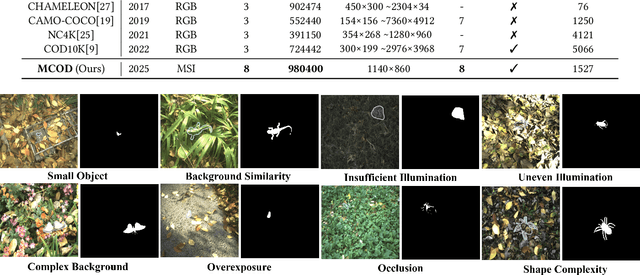
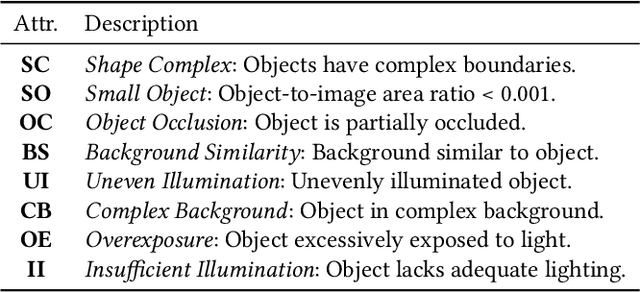
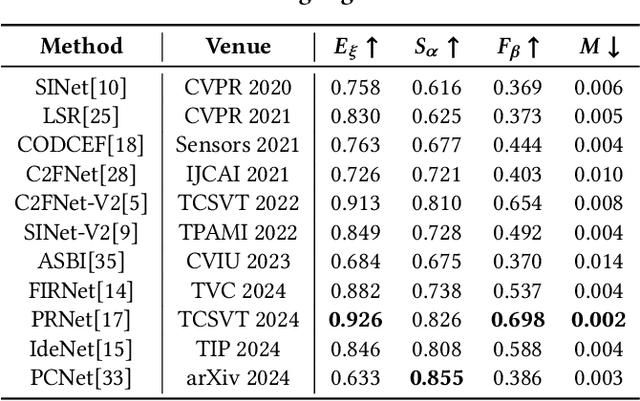
Camouflaged Object Detection (COD) aims to identify objects that blend seamlessly into natural scenes. Although RGB-based methods have advanced, their performance remains limited under challenging conditions. Multispectral imagery, providing rich spectral information, offers a promising alternative for enhanced foreground-background discrimination. However, existing COD benchmark datasets are exclusively RGB-based, lacking essential support for multispectral approaches, which has impeded progress in this area. To address this gap, we introduce MCOD, the first challenging benchmark dataset specifically designed for multispectral camouflaged object detection. MCOD features three key advantages: (i) Comprehensive challenge attributes: It captures real-world difficulties such as small object sizes and extreme lighting conditions commonly encountered in COD tasks. (ii) Diverse real-world scenarios: The dataset spans a wide range of natural environments to better reflect practical applications. (iii) High-quality pixel-level annotations: Each image is manually annotated with precise object masks and corresponding challenge attribute labels. We benchmark eleven representative COD methods on MCOD, observing a consistent performance drop due to increased task difficulty. Notably, integrating multispectral modalities substantially alleviates this degradation, highlighting the value of spectral information in enhancing detection robustness. We anticipate MCOD will provide a strong foundation for future research in multispectral camouflaged object detection. The dataset is publicly accessible at https://github.com/yl2900260-bit/MCOD.
HSOD-BIT-V2: A New Challenging Benchmarkfor Hyperspectral Salient Object Detection
Mar 18, 2025Salient Object Detection (SOD) is crucial in computer vision, yet RGB-based methods face limitations in challenging scenes, such as small objects and similar color features. Hyperspectral images provide a promising solution for more accurate Hyperspectral Salient Object Detection (HSOD) by abundant spectral information, while HSOD methods are hindered by the lack of extensive and available datasets. In this context, we introduce HSOD-BIT-V2, the largest and most challenging HSOD benchmark dataset to date. Five distinct challenges focusing on small objects and foreground-background similarity are designed to emphasize spectral advantages and real-world complexity. To tackle these challenges, we propose Hyper-HRNet, a high-resolution HSOD network. Hyper-HRNet effectively extracts, integrates, and preserves effective spectral information while reducing dimensionality by capturing the self-similar spectral features. Additionally, it conveys fine details and precisely locates object contours by incorporating comprehensive global information and detailed object saliency representations. Experimental analysis demonstrates that Hyper-HRNet outperforms existing models, especially in challenging scenarios.