 Add to Chrome
 Add to Firefox
 Add to Edge
StableMimic: Smooth Human-Like Recovery for Humanoid Motion Tracking - Learning Beyond the Tracking Distribution for Structured Post-Fall Behavior
Aug 03, 2026
Humanoid motion trackers perform reliably within learned tracking distributions, but falls can move the robot into low-height, contact-rich states from which an advancing command is temporarily unreachable. Tracking-only policies may chase infeasible references, producing rapid, large-amplitude limb corrections that increase risk to the robot and its surroundings. We present StableMimic, a unified tracker trained beyond the nominal tracking distribution. Perturbed resets around multiple human get-up references expose prone, supine, off-balance, and intermediate ground-contact states, shaping structured recovery that returns the robot to the trackable region. Because tracking and recovery occupy markedly different state--action distributions, StableMimic uses dedicated experts for each regime and a proprioceptive gate that continuously blends their actions. A hidden successor-state objective teaches human-reference-shaped recovery without exposing reference identity or phase to the deployed Actor; deployment requires no get-up reference, recovery command, trajectory retrieval, or external policy switch. On the complete retargeted LAFAN1 dance subset, StableMimic achieves the lowest errors on all four tracking metrics among five methods. Across 100 matched push-to-fall trials per method, it recovers in 100/100 and attains the lowest values on six of seven post-fall motion and load measures, supporting improved interaction safety under this protocol. Real Unitree G1 dance and standing-reference deployments qualitatively demonstrate bounded limb motion, autonomous recovery, and command resumption.

Lightweight Method for Interactive 3D Medical Image Segmentation with Multi-Round Result Fusion
Dec 11, 2024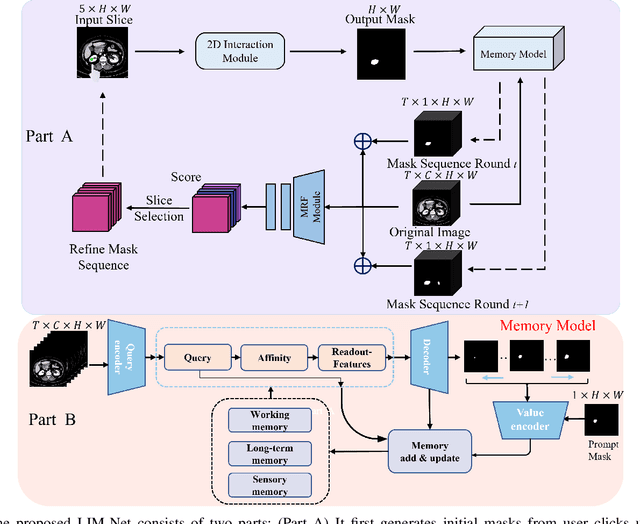

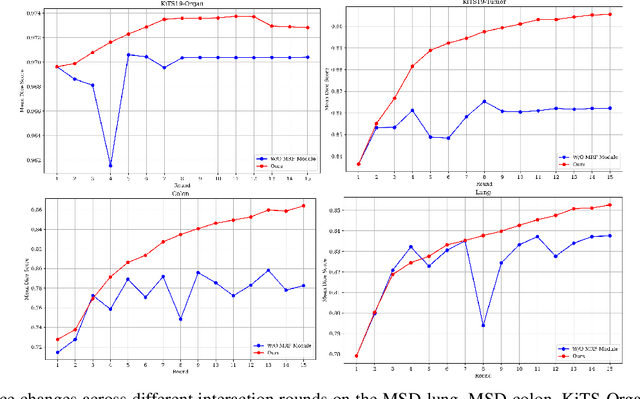
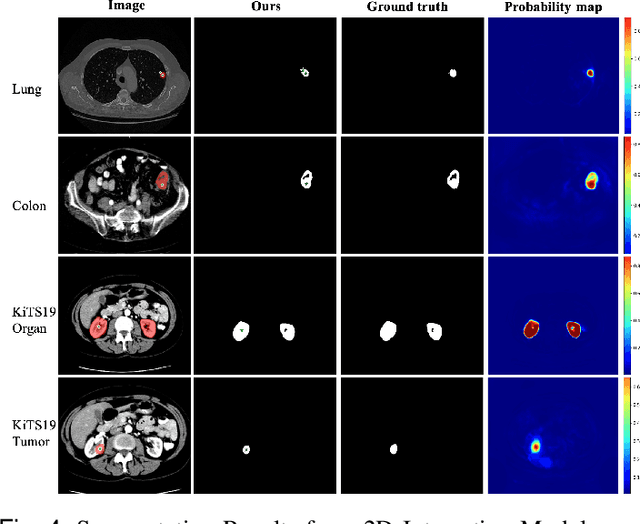
In medical imaging, precise annotation of lesions or organs is often required. However, 3D volumetric images typically consist of hundreds or thousands of slices, making the annotation process extremely time-consuming and laborious. Recently, the Segment Anything Model (SAM) has drawn widespread attention due to its remarkable zero-shot generalization capabilities in interactive segmentation. While researchers have explored adapting SAM for medical applications, such as using SAM adapters or constructing 3D SAM models, a key question remains: Can traditional CNN networks achieve the same strong zero-shot generalization in this task? In this paper, we propose the Lightweight Interactive Network for 3D Medical Image Segmentation (LIM-Net), a novel approach demonstrating the potential of compact CNN-based models. Built upon a 2D CNN backbone, LIM-Net initiates segmentation by generating a 2D prompt mask from user hints. This mask is then propagated through the 3D sequence via the Memory Module. To refine and stabilize results during interaction, the Multi-Round Result Fusion (MRF) Module selects and merges optimal masks from multiple rounds. Our extensive experiments across multiple datasets and modalities demonstrate LIM-Net's competitive performance. It exhibits stronger generalization to unseen data compared to SAM-based models, with competitive accuracy while requiring fewer interactions. Notably, LIM-Net's lightweight design offers significant advantages in deployment and inference efficiency, with low GPU memory consumption suitable for resource-constrained environments. These promising results demonstrate LIM-Net can serve as a strong baseline, complementing and contrasting with popular SAM models to further boost effective interactive medical image segmentation. The code will be released at \url{https://github.com/goodtime-123/LIM-Net}.