 Add to Chrome
 Add to Firefox
 Add to Edge
HybridINR-PCGC: Hybrid Lossless Point Cloud Geometry Compression Bridging Pretrained Model and Implicit Neural Representation
Feb 25, 2026
Learning-based point cloud compression presents superior performance to handcrafted codecs. However, pretrained-based methods, which are based on end-to-end training and expected to generalize to all the potential samples, suffer from training data dependency. Implicit neural representation (INR) based methods are distribution-agnostic and more robust, but they require time-consuming online training and suffer from the bitstream overhead from the overfitted model. To address these limitations, we propose HybridINR-PCGC, a novel hybrid framework that bridges the pretrained model and INR. Our framework retains distribution-agnostic properties while leveraging a pretrained network to accelerate convergence and reduce model overhead, which consists of two parts: the Pretrained Prior Network (PPN) and the Distribution Agnostic Refiner (DAR). We leverage the PPN, designed for fast inference and stable performance, to generate a robust prior for accelerating the DAR's convergence. The DAR is decomposed into a base layer and an enhancement layer, and only the enhancement layer needed to be packed into the bitstream. Finally, we propose a supervised model compression module to further supervise and minimize the bitrate of the enhancement layer parameters. Based on experiment results, HybridINR-PCGC achieves a significantly improved compression rate and encoding efficiency. Specifically, our method achieves a Bpp reduction of approximately 20.43% compared to G-PCC on 8iVFB. In the challenging out-of-distribution scenario Cat1B, our method achieves a Bpp reduction of approximately 57.85% compared to UniPCGC. And our method exhibits a superior time-rate trade-off, achieving an average Bpp reduction of 15.193% relative to the LINR-PCGC on 8iVFB.

Learning Dynamic Point Cloud Compression via Hierarchical Inter-frame Block Matching
May 16, 2023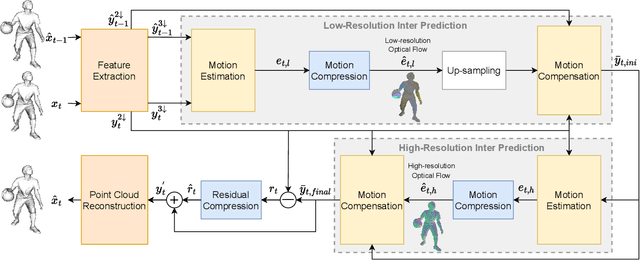
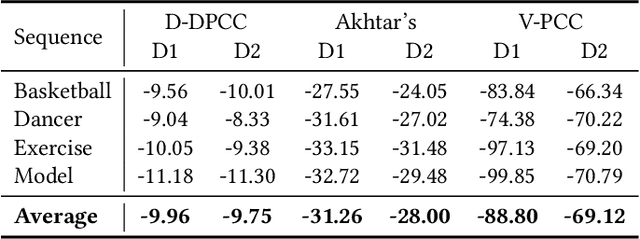
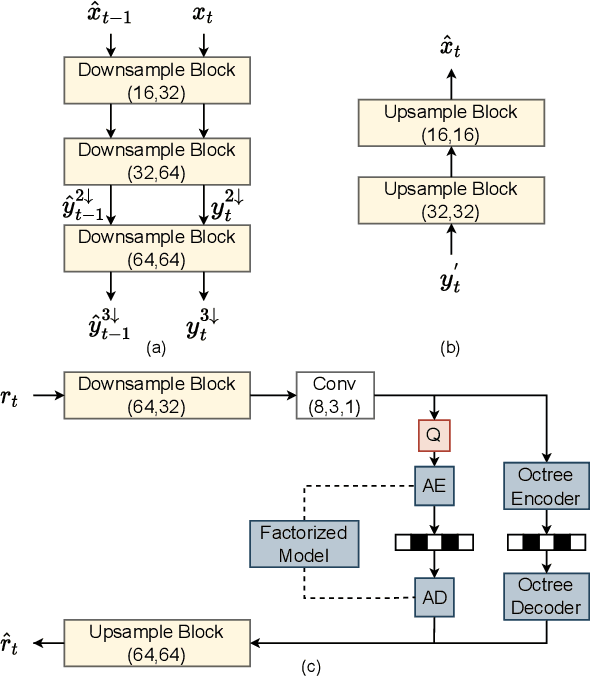
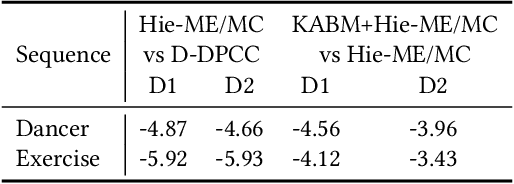
3D dynamic point cloud (DPC) compression relies on mining its temporal context, which faces significant challenges due to DPC's sparsity and non-uniform structure. Existing methods are limited in capturing sufficient temporal dependencies. Therefore, this paper proposes a learning-based DPC compression framework via hierarchical block-matching-based inter-prediction module to compensate and compress the DPC geometry in latent space. Specifically, we propose a hierarchical motion estimation and motion compensation (Hie-ME/MC) framework for flexible inter-prediction, which dynamically selects the granularity of optical flow to encapsulate the motion information accurately. To improve the motion estimation efficiency of the proposed inter-prediction module, we further design a KNN-attention block matching (KABM) network that determines the impact of potential corresponding points based on the geometry and feature correlation. Finally, we compress the residual and the multi-scale optical flow with a fully-factorized deep entropy model. The experiment result on the MPEG-specified Owlii Dynamic Human Dynamic Point Cloud (Owlii) dataset shows that our framework outperforms the previous state-of-the-art methods and the MPEG standard V-PCC v18 in inter-frame low-delay mode.