 Add to Chrome
 Add to Firefox
 Add to Edge
TED: Training-Free Experience Distillation for Multimodal Reasoning
Mar 25, 2026
Knowledge distillation is typically realized by transferring a teacher model's knowledge into a student's parameters through supervised or reinforcement-based optimization. While effective, such approaches require repeated parameter updates and large-scale training data, limiting their applicability in resource-constrained environments. In this work, we propose TED, a training-free, context-based distillation framework that shifts the update target of distillation from model parameters to an in-context experience injected into the student's prompt. For each input, the student generates multiple reasoning trajectories, while a teacher independently produces its own solution. The teacher then compares the student trajectories with its reasoning and the ground-truth answer, extracting generalized experiences that capture effective reasoning patterns. These experiences are continuously refined and updated over time. A key challenge of context-based distillation is unbounded experience growth and noise accumulation. TED addresses this with an experience compression mechanism that tracks usage statistics and selectively merges, rewrites, or removes low-utility experiences. Experiments on multimodal reasoning benchmarks MathVision and VisualPuzzles show that TED consistently improves performance. On MathVision, TED raises the performance of Qwen3-VL-8B from 0.627 to 0.702, and on VisualPuzzles from 0.517 to 0.561 with just 100 training samples. Under this low-data, no-update setting, TED achieves performance competitive with fully trained parameter-based distillation while reducing training cost by over 5x, demonstrating that meaningful knowledge transfer can be achieved through contextual experience.

MCTS-SQL: An Effective Framework for Text-to-SQL with Monte Carlo Tree Search
Jan 28, 2025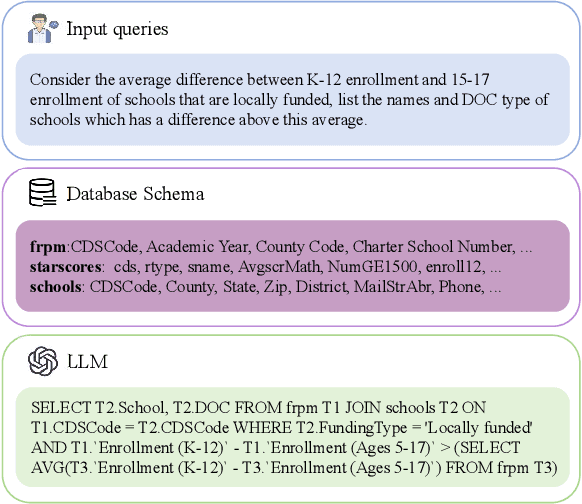
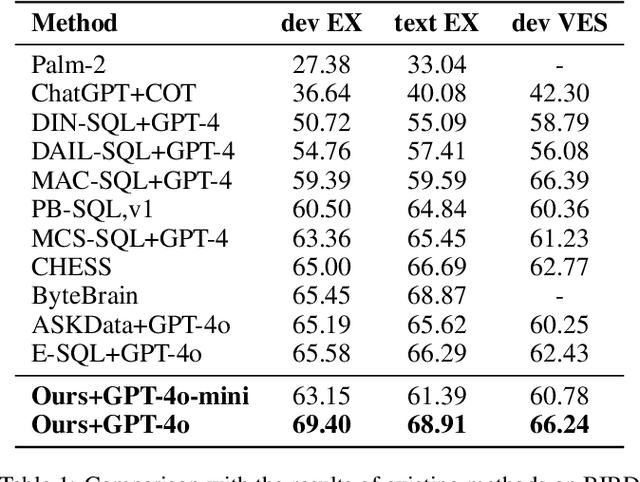
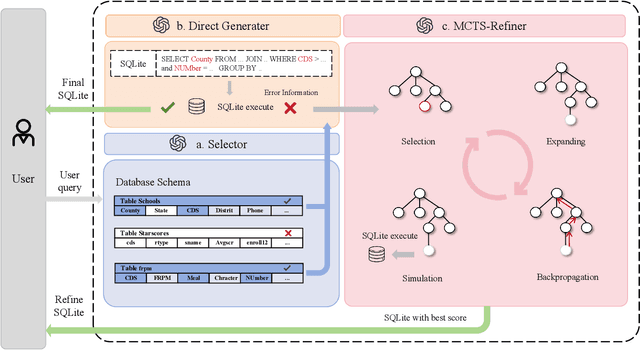
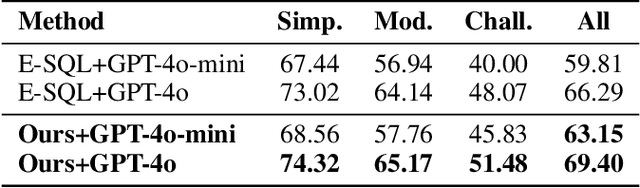
Text-to-SQL is a fundamental and longstanding problem in the NLP area, aiming at converting natural language queries into SQL, enabling non-expert users to operate databases. Recent advances in LLM have greatly improved text-to-SQL performance. However, challenges persist, especially when dealing with complex user queries. Current approaches (e.g., COT prompting and multi-agent frameworks) rely on the ability of models to plan and generate SQL autonomously, but controlling performance remains difficult. In addition, LLMs are still prone to hallucinations. To alleviate these challenges, we designed a novel MCTS-SQL to guide SQL generation iteratively. The approach generates SQL queries through Monte Carlo Tree Search (MCTS) and a heuristic self-refinement mechanism are used to enhance accuracy and reliability. Key components include a schema selector for extracting relevant information and an MCTS-based generator for iterative query refinement. Experimental results from the SPIDER and BIRD benchmarks show that MCTS-SQL achieves state-of-the-art performance. Specifically, on the BIRD development dataset, MCTS-SQL achieves an Execution (EX) accuracy of 69.40% using GPT-4o as the base model and a significant improvement when dealing with challenging tasks, with an EX of 51.48%, which is 3.41% higher than the existing method.