 Add to Chrome
 Add to Firefox
 Add to Edge
Learning to Refocus with Video Diffusion Models
Dec 24, 2025
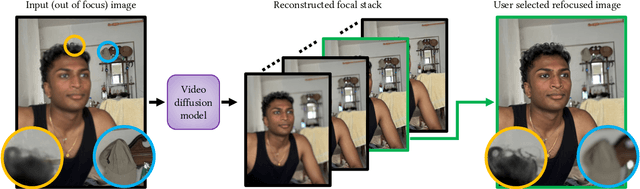
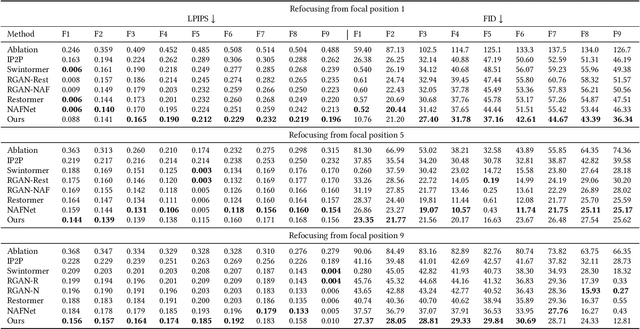
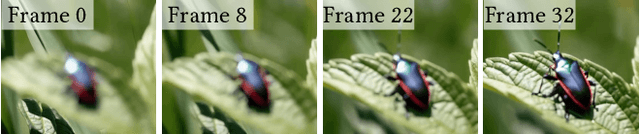
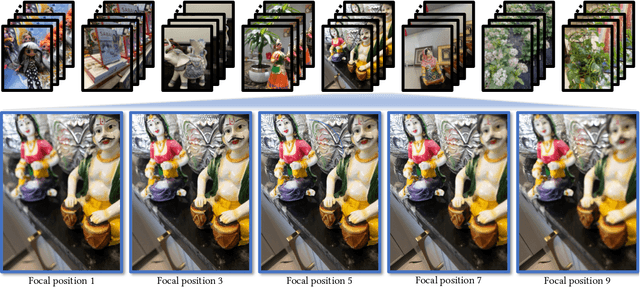
Focus is a cornerstone of photography, yet autofocus systems often fail to capture the intended subject, and users frequently wish to adjust focus after capture. We introduce a novel method for realistic post-capture refocusing using video diffusion models. From a single defocused image, our approach generates a perceptually accurate focal stack, represented as a video sequence, enabling interactive refocusing and unlocking a range of downstream applications. We release a large-scale focal stack dataset acquired under diverse real-world smartphone conditions to support this work and future research. Our method consistently outperforms existing approaches in both perceptual quality and robustness across challenging scenarios, paving the way for more advanced focus-editing capabilities in everyday photography. Code and data are available at https://learn2refocus.github.io

Defocus Map Estimation and Deblurring from a Single Dual-Pixel Image
Oct 12, 2021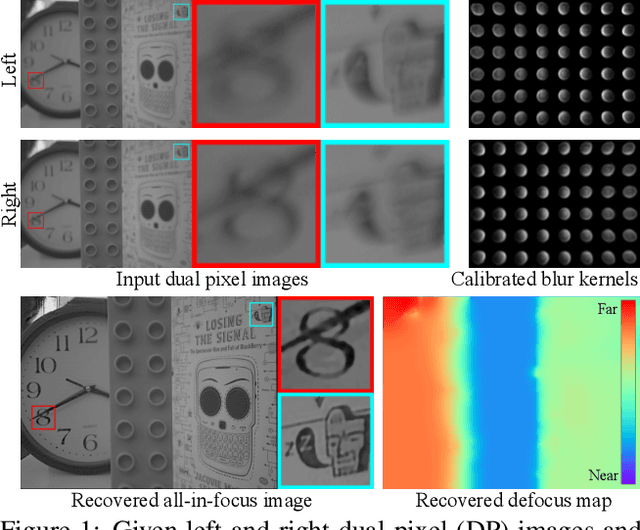
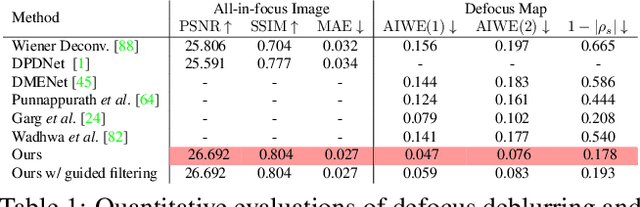
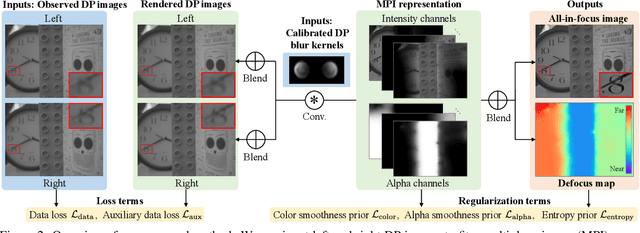
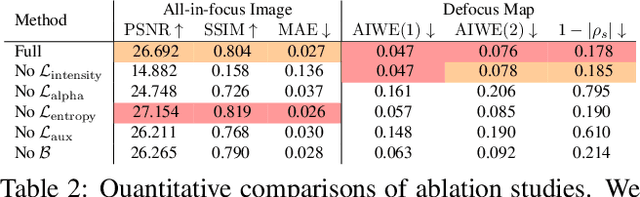
We present a method that takes as input a single dual-pixel image, and simultaneously estimates the image's defocus map -- the amount of defocus blur at each pixel -- and recovers an all-in-focus image. Our method is inspired from recent works that leverage the dual-pixel sensors available in many consumer cameras to assist with autofocus, and use them for recovery of defocus maps or all-in-focus images. These prior works have solved the two recovery problems independently of each other, and often require large labeled datasets for supervised training. By contrast, we show that it is beneficial to treat these two closely-connected problems simultaneously. To this end, we set up an optimization problem that, by carefully modeling the optics of dual-pixel images, jointly solves both problems. We use data captured with a consumer smartphone camera to demonstrate that, after a one-time calibration step, our approach improves upon prior works for both defocus map estimation and blur removal, despite being entirely unsupervised.