 Add to Chrome
 Add to Firefox
 Add to Edge
Generating HDR Video from SDR Video
May 14, 2026
The high dynamic range (HDR) video ecosystem is approaching maturity, but the problem of upconverting legacy standard dynamic range (SDR) videos persists without a convincing solution. We propose a framework for HDR video synthesis from casual SDR footage by leveraging large-scale generative video models. We introduce a Multi-Exposure Video Model (MEVM) that can predict exposure-bracketed linear SDR video sequences from a single nonlinear SDR video input. We further propose a learnable Video Merging Model (VMM) that merges the predicted exposure-bracketed video into a high-quality HDR sequence while preserving detail in both shadows and highlights. Extensive experiments, quantitative and qualitative evaluation, and a user study demonstrate that our approach enables robust HDR conversion for in-the-wild examples from casual consumer videos and even iconic films. Finally, our model can support HDR synthesis pipelines built upon existing SDR generative video models. Output HDR videos can be viewed on our supplementary webpage: sdr2hdrvideo.github.io

Dark3R: Learning Structure from Motion in the Dark
Mar 05, 2026We introduce Dark3R, a framework for structure from motion in the dark that operates directly on raw images with signal-to-noise ratios (SNRs) below $-4$ dB -- a regime where conventional feature- and learning-based methods break down. Our key insight is to adapt large-scale 3D foundation models to extreme low-light conditions through a teacher--student distillation process, enabling robust feature matching and camera pose estimation in low light. Dark3R requires no 3D supervision; it is trained solely on noisy--clean raw image pairs, which can be either captured directly or synthesized using a simple Poisson--Gaussian noise model applied to well-exposed raw images. To train and evaluate our approach, we introduce a new, exposure-bracketed dataset that includes $\sim$42,000 multi-view raw images with ground-truth 3D annotations, and we demonstrate that Dark3R achieves state-of-the-art structure from motion in the low-SNR regime. Further, we demonstrate state-of-the-art novel view synthesis in the dark using Dark3R's predicted poses and a coarse-to-fine radiance field optimization procedure.
Learning to Refocus with Video Diffusion Models
Dec 24, 2025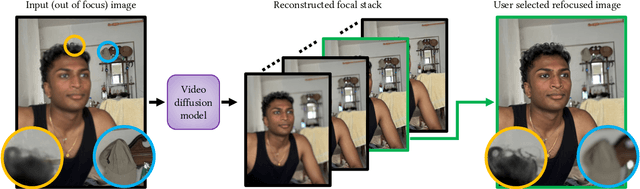
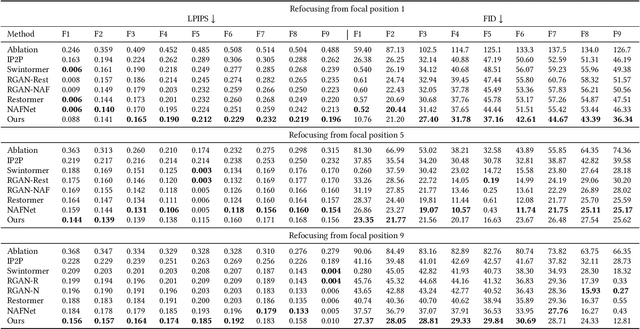
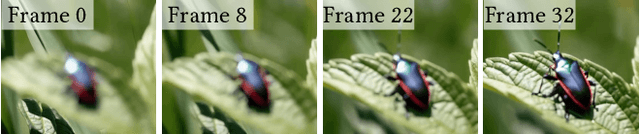
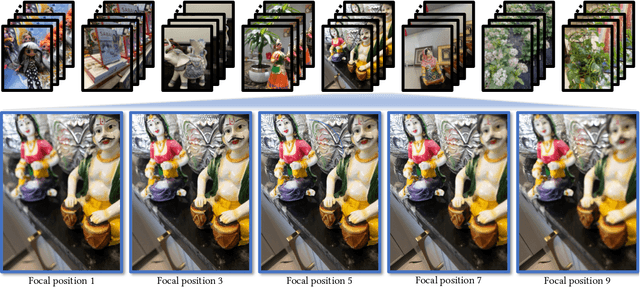
Focus is a cornerstone of photography, yet autofocus systems often fail to capture the intended subject, and users frequently wish to adjust focus after capture. We introduce a novel method for realistic post-capture refocusing using video diffusion models. From a single defocused image, our approach generates a perceptually accurate focal stack, represented as a video sequence, enabling interactive refocusing and unlocking a range of downstream applications. We release a large-scale focal stack dataset acquired under diverse real-world smartphone conditions to support this work and future research. Our method consistently outperforms existing approaches in both perceptual quality and robustness across challenging scenarios, paving the way for more advanced focus-editing capabilities in everyday photography. Code and data are available at https://learn2refocus.github.io
Generating the Past, Present and Future from a Motion-Blurred Image
Dec 22, 2025We seek to answer the question: what can a motion-blurred image reveal about a scene's past, present, and future? Although motion blur obscures image details and degrades visual quality, it also encodes information about scene and camera motion during an exposure. Previous techniques leverage this information to estimate a sharp image from an input blurry one, or to predict a sequence of video frames showing what might have occurred at the moment of image capture. However, they rely on handcrafted priors or network architectures to resolve ambiguities in this inverse problem, and do not incorporate image and video priors on large-scale datasets. As such, existing methods struggle to reproduce complex scene dynamics and do not attempt to recover what occurred before or after an image was taken. Here, we introduce a new technique that repurposes a pre-trained video diffusion model trained on internet-scale datasets to recover videos revealing complex scene dynamics during the moment of capture and what might have occurred immediately into the past or future. Our approach is robust and versatile; it outperforms previous methods for this task, generalizes to challenging in-the-wild images, and supports downstream tasks such as recovering camera trajectories, object motion, and dynamic 3D scene structure. Code and data are available at https://blur2vid.github.io
* Code and data are available at https://blur2vid.github.io
Examining Joint Demosaicing and Denoising for Single-, Quad-, and Nona-Bayer Patterns
Apr 08, 2025Camera sensors have color filters arranged in a mosaic layout, traditionally following the Bayer pattern. Demosaicing is a critical step camera hardware applies to obtain a full-channel RGB image. Many smartphones now have multiple sensors with different patterns, such as Quad-Bayer or Nona-Bayer. Most modern deep network-based models perform joint demosaicing and denoising with the current strategy of training a separate network per pattern. Relying on individual models per pattern requires additional memory overhead and makes it challenging to switch quickly between cameras. In this work, we are interested in analyzing strategies for joint demosaicing and denoising for the three main mosaic layouts (1x1 Single-Bayer, 2x2 Quad-Bayer, and 3x3 Nona-Bayer). We found that concatenating a three-channel mosaic embedding to the input image and training with a unified demosaicing architecture yields results that outperform existing Quad-Bayer and Nona-Bayer models and are comparable to Single-Bayer models. Additionally, we describe a maskout strategy that enhances the model performance and facilitates dead pixel correction -- a step often overlooked by existing AI-based demosaicing models. As part of this effort, we captured a new demosaicing dataset of 638 RAW images that contain challenging scenes with patches annotated for training, validation, and testing.
Multispectral Demosaicing via Dual Cameras
Mar 27, 2025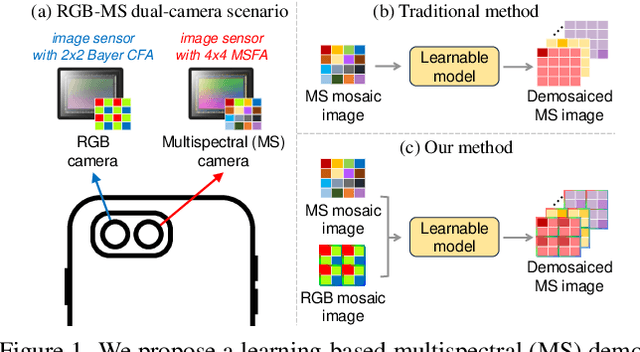

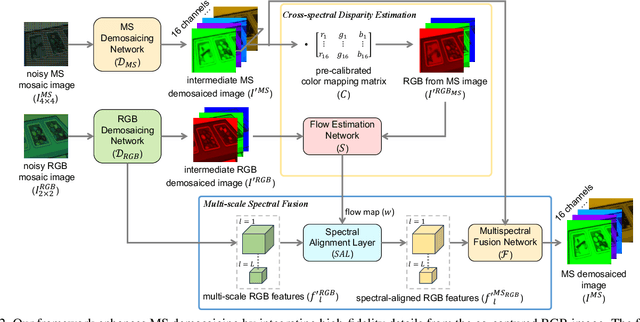
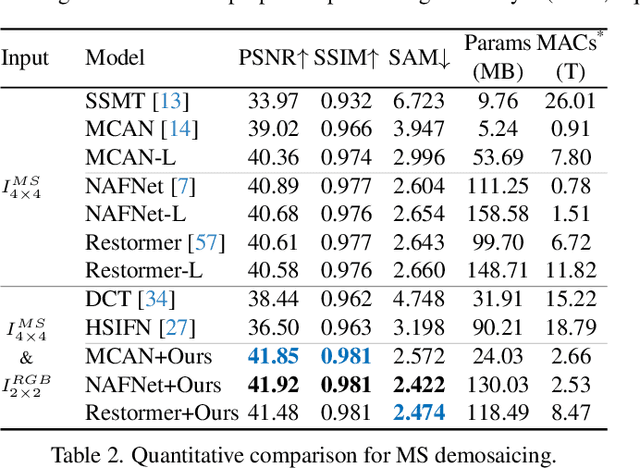
Multispectral (MS) images capture detailed scene information across a wide range of spectral bands, making them invaluable for applications requiring rich spectral data. Integrating MS imaging into multi camera devices, such as smartphones, has the potential to enhance both spectral applications and RGB image quality. A critical step in processing MS data is demosaicing, which reconstructs color information from the mosaic MS images captured by the camera. This paper proposes a method for MS image demosaicing specifically designed for dual-camera setups where both RGB and MS cameras capture the same scene. Our approach leverages co-captured RGB images, which typically have higher spatial fidelity, to guide the demosaicing of lower-fidelity MS images. We introduce the Dual-camera RGB-MS Dataset - a large collection of paired RGB and MS mosaiced images with ground-truth demosaiced outputs - that enables training and evaluation of our method. Experimental results demonstrate that our method achieves state-of-the-art accuracy compared to existing techniques.
Gain-MLP: Improving HDR Gain Map Encoding via a Lightweight MLP
Mar 14, 2025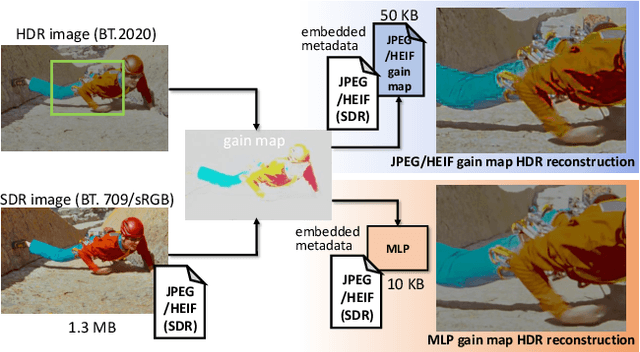


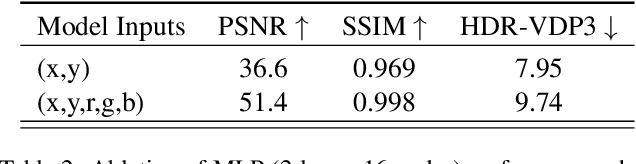
While most images shared on the web and social media platforms are encoded in standard dynamic range (SDR), many displays now can accommodate high dynamic range (HDR) content. Additionally, modern cameras can capture images in an HDR format but convert them to SDR to ensure maximum compatibility with existing workflows and legacy displays. To support both SDR and HDR, new encoding formats are emerging that store additional metadata in SDR images in the form of a gain map. When applied to the SDR image, the gain map recovers the HDR version of the image as needed. These gain maps, however, are typically down-sampled and encoded using standard image compression, such as JPEG and HEIC, which can result in unwanted artifacts. In this paper, we propose to use a lightweight multi-layer perceptron (MLP) network to encode the gain map. The MLP is optimized using the SDR image information as input and provides superior performance in terms of HDR reconstruction. Moreover, the MLP-based approach uses a fixed memory footprint (10 KB) and requires no additional adjustments to accommodate different image sizes or encoding parameters. We conduct extensive experiments on various MLP based HDR embedding strategies and demonstrate that our approach outperforms the current state-of-the-art.
Examining Autoexposure for Challenging Scenes
Sep 08, 2023
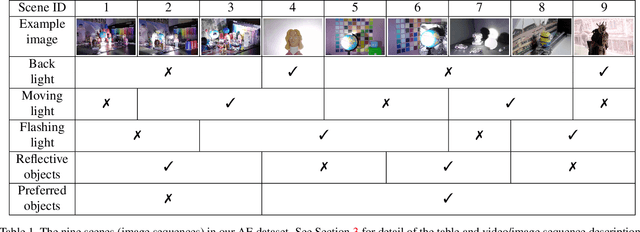
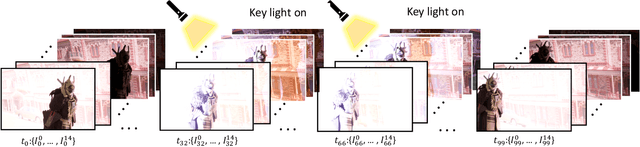
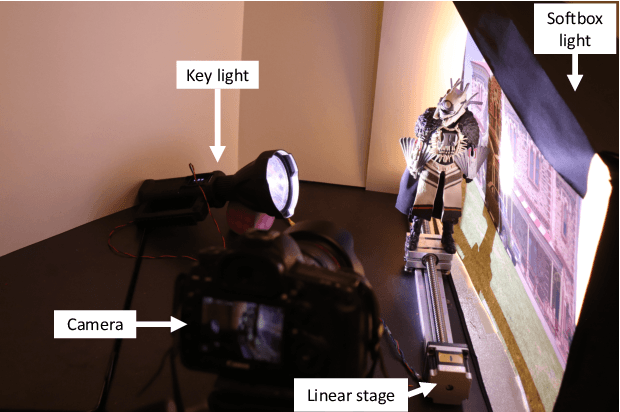
Autoexposure (AE) is a critical step applied by camera systems to ensure properly exposed images. While current AE algorithms are effective in well-lit environments with constant illumination, these algorithms still struggle in environments with bright light sources or scenes with abrupt changes in lighting. A significant hurdle in developing new AE algorithms for challenging environments, especially those with time-varying lighting, is the lack of suitable image datasets. To address this issue, we have captured a new 4D exposure dataset that provides a large solution space (i.e., shutter speed range from (1/500 to 15 seconds) over a temporal sequence with moving objects, bright lights, and varying lighting. In addition, we have designed a software platform to allow AE algorithms to be used in a plug-and-play manner with the dataset. Our dataset and associate platform enable repeatable evaluation of different AE algorithms and provide a much-needed starting point to develop better AE methods. We examine several existing AE strategies using our dataset and show that most users prefer a simple saliency method for challenging lighting conditions.