 Add to Chrome
 Add to Firefox
 Add to Edge
Policy-as-Data: Learning Generalizable HOI Diffusion Models from Simulated Physics
Jun 22, 2026
Synthesizing realistic Human-Object Interactions (HOI) is critical for creating embodied avatars and functional virtual environments. However, current data-driven approaches primarily rely on motion capture datasets, which are expensive to scale and limited in functional diversity. Models trained with these datasets fail to generalize to unseen objects and maintain physical consistency over long horizons. In this paper, we propose a novel framework that leverages a physics simulator to overcome the data-scarcity bottleneck in HOI generation. Specifically, we propose a scalable pipeline, called \ours, which leverages policies trained with reinforcement learning in a physics simulator for task-oriented data generation and trains a generative model on the augmented dataset for generalizable HOI generation. To seamlessly utilize the synthetic data, we introduce a coarse-to-fine retargeting process that bridges the representation gap between the simplified model used in physics simulator and the standard parametric body models required for generative training. Validated through comprehensive experiments, our method demonstrates enhanced generalization to unseen objects and the capability of long-horizon generation, while exhibiting greater dynamic diversity and physical plausibility.

DSSP: Diffusion State Space Policy with Full-History Encoding
May 14, 2026Diffusion-based imitation learning has shown strong promise for robot manipulation. However, most existing policies condition only on the current observation or a short window of recent observations, limiting their ability to resolve history-dependent ambiguities in long-horizon tasks. To address this, we introduce DSSP, a history-conditioned Diffusion State Space Policy that enables efficient, full-history conditioning for robot manipulation. Leveraging the continuous sequence modeling properties of State Space Models (SSMs), our history encoder effectively compresses the entire observation stream into a compact context representation. To ensure this context preserves critical information regarding future state evolution, the encoder is optimized with a dynamics-aware auxiliary training objective. This high-level context representation is then seamlessly fused with recent state observations to form a hierarchical conditioning mechanism for action generation. Furthermore, to maintain architectural consistency and minimize GPU memory overhead, we also instantiate the diffusion backbone itself using an SSM. Extensive experiments across simulation benchmarks and real-world manipulation tasks show that DSSP achieves state-of-the-art performance with a significantly smaller model size, demonstrating superior efficiency of the hierarchical conditioning in capturing crucial information as the history length increases.
GenHOI: Generalizing Text-driven 4D Human-Object Interaction Synthesis for Unseen Objects
Jun 18, 2025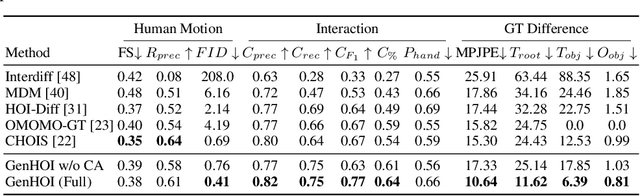
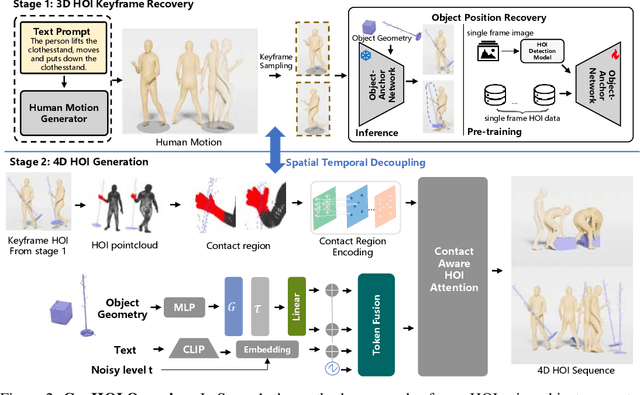
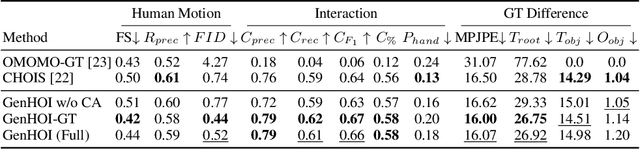
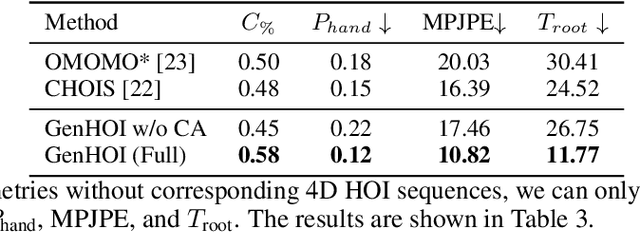
While diffusion models and large-scale motion datasets have advanced text-driven human motion synthesis, extending these advances to 4D human-object interaction (HOI) remains challenging, mainly due to the limited availability of large-scale 4D HOI datasets. In our study, we introduce GenHOI, a novel two-stage framework aimed at achieving two key objectives: 1) generalization to unseen objects and 2) the synthesis of high-fidelity 4D HOI sequences. In the initial stage of our framework, we employ an Object-AnchorNet to reconstruct sparse 3D HOI keyframes for unseen objects, learning solely from 3D HOI datasets, thereby mitigating the dependence on large-scale 4D HOI datasets. Subsequently, we introduce a Contact-Aware Diffusion Model (ContactDM) in the second stage to seamlessly interpolate sparse 3D HOI keyframes into densely temporally coherent 4D HOI sequences. To enhance the quality of generated 4D HOI sequences, we propose a novel Contact-Aware Encoder within ContactDM to extract human-object contact patterns and a novel Contact-Aware HOI Attention to effectively integrate the contact signals into diffusion models. Experimental results show that we achieve state-of-the-art results on the publicly available OMOMO and 3D-FUTURE datasets, demonstrating strong generalization abilities to unseen objects, while enabling high-fidelity 4D HOI generation.