 Add to Chrome
 Add to Firefox
 Add to Edge
Multi-Mode Pneumatic Artificial Muscles Driven by Hybrid Positive-Negative Pressure
Mar 16, 2026
Artificial muscles embody human aspirations for engineering lifelike robotic movements. This paper introduces an architecture for Inflatable Fluid-Driven Origami-Inspired Artificial Muscles (IN-FOAMs). A typical IN-FOAM consists of an inflatable skeleton enclosed within an outer skin, which can be driven using a combination of positive and negative pressures (e.g., compressed air and vacuum). IN-FOAMs are manufactured using low-cost heat-sealable sheet materials through heat-pressing and heat-sealing processes. Thus, they can be ultra-thin when not actuated, making them flexible, lightweight, and portable. The skeleton patterns are programmable, enabling a variety of motions, including contracting, bending, twisting, and rotating, based on specific skeleton designs. We conducted comprehensive experimental, theoretical, and numerical studies to investigate IN-FOAM's basic mechanical behavior and properties. The results show that IN-FOAM's output force and contraction can be tuned through multiple operation modes with the applied hybrid positive-negative pressure. Additionally, we propose multilayer skeleton structures to enhance the contraction ratio further, and we demonstrate a multi-channel skeleton approach that allows the integration of multiple motion modes into a single IN-FOAM. These findings indicate that IN-FOAMs hold great potential for future applications in flexible wearable devices and compact soft robotic systems.
* 20 pages, 17 figures. Published in IEEE Transactions on Robotics

A Decapod Robot with Rotary Bellows-Enclosed Soft Transmissions
Mar 10, 2025Soft crawling robots exhibit efficient locomotion across various terrains and demonstrate robustness to diverse environmental conditions. Here, we propose a valveless soft-legged robot that integrates a pair of rotary bellows-enclosed soft transmission systems (R-BESTS). The proposed R-BESTS can directly transmit the servo rotation into leg swing motion. A timing belt controls the pair of R-BESTS to maintain synchronous rotation in opposite phases, realizing alternating tripod gaits of walking and turning. We explored several designs to understand the role of a reinforcement skeleton in twisting the R-BESTS' input bellows units. The bending sequences of the robot legs are controlled through structural design for the output bellows units. Finally, we demonstrate untethered locomotion with the soft robotic decapod. Experimental results show that our robot can walk at 1.75 centimeters per second (0.07 body length per second) for 90 min, turn with a 15-centimeter (0.6 BL) radius, carry a payload of 200 g, and adapt to different terrains.
WHERE-Bot: a Wheel-less Helical-ring Everting Robot Capable of Omnidirectional Locomotion
Mar 10, 2025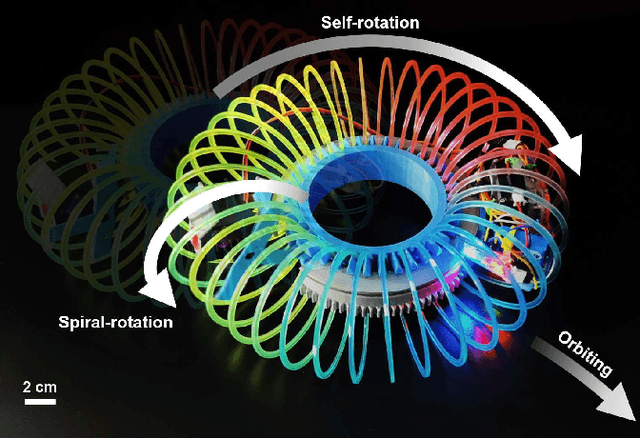
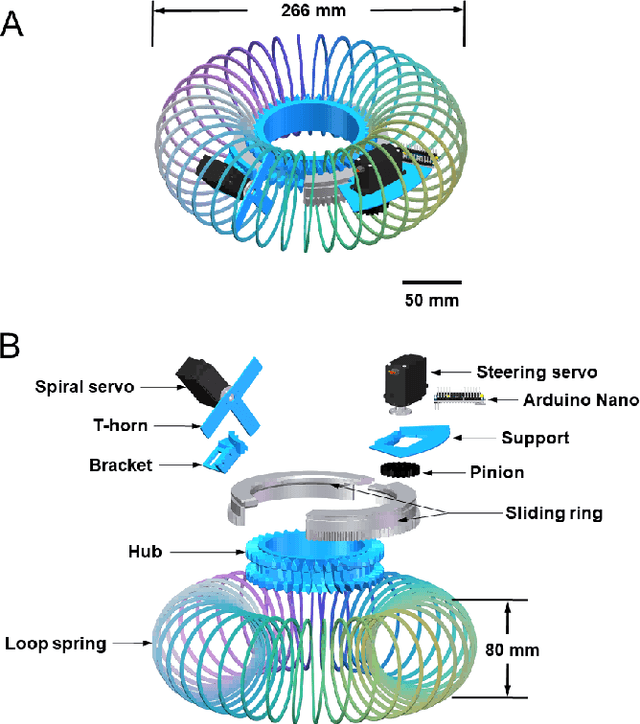
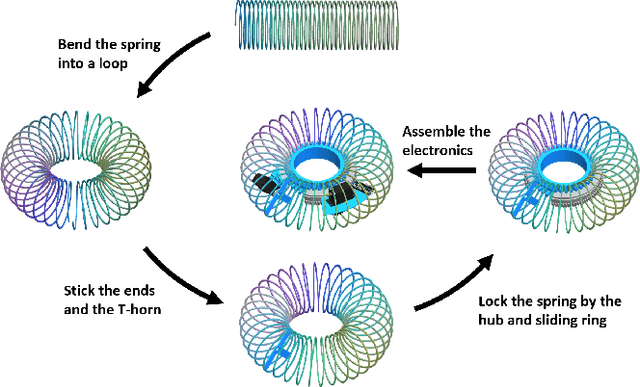
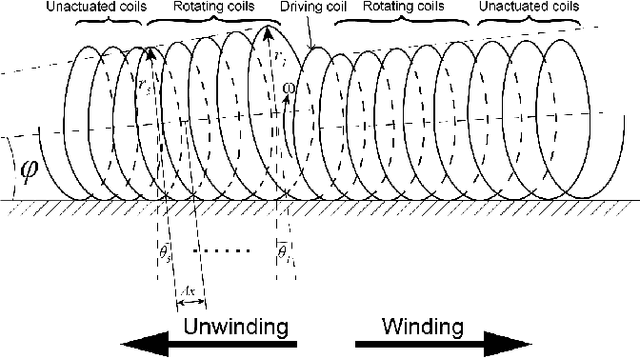
Compared to conventional wheeled transportation systems designed for flat surfaces, soft robots exhibit exceptional adaptability to various terrains, enabling stable movement in complex environments. However, due to the risk of collision with obstacles and barriers, most soft robots rely on sensors for navigation in unstructured environments with uncertain boundaries. In this work, we present the WHERE-Bot, a wheel-less everting soft robot capable of omnidirectional locomotion. Our WHERE-Bot can navigate through unstructured environments by leveraging its structural and motion advantages rather than relying on sensors for boundary detection. By configuring a spring toy ``Slinky'' into a loop shape, the WHERE-Bot performs multiple rotational motions: spiral-rotating along the hub circumference, self-rotating around the hub's center, and orbiting around a certain point. The robot's trajectories can be reprogrammed by actively altering its mass distribution. The WHERE-Bot shows significant potential for boundary exploration in unstructured environments.
Design and Fabrication of String-driven Origami Robots
Apr 14, 2024Origami designs and structures have been widely used in many fields, such as morphing structures, robotics, and metamaterials. However, the design and fabrication of origami structures rely on human experiences and skills, which are both time and labor-consuming. In this paper, we present a rapid design and fabrication method for string-driven origami structures and robots. We developed an origami design software to generate desired crease patterns based on analytical models and Evolution Strategies (ES). Additionally, the software can automatically produce 3D models of origami designs. We then used a dual-material 3D printer to fabricate those wrapping-based origami structures with the required mechanical properties. We utilized Twisted String Actuators (TSAs) to fold the target 3D structures from flat plates. To demonstrate the capability of these techniques, we built and tested an origami crawling robot and an origami robotic arm using 3D-printed origami structures driven by TSAs.