 Add to Chrome
 Add to Firefox
 Add to Edge
HCP-DCNet: A Hierarchical Causal Primitive Dynamic Composition Network for Self-Improving Causal Understanding
Mar 12, 2026
The ability to understand and reason about cause and effect -- encompassing interventions, counterfactuals, and underlying mechanisms -- is a cornerstone of robust artificial intelligence. While deep learning excels at pattern recognition, it fundamentally lacks a model of causality, making systems brittle under distribution shifts and unable to answer ``what-if'' questions. This paper introduces the \emph{Hierarchical Causal Primitive Dynamic Composition Network (HCP-DCNet)}, a unified framework that bridges continuous physical dynamics with discrete symbolic causal inference. Departing from monolithic representations, HCP-DCNet decomposes causal scenes into reusable, typed \emph{causal primitives} organized into four abstraction layers: physical, functional, event, and rule. A dual-channel routing network dynamically composes these primitives into task-specific, fully differentiable \emph{Causal Execution Graphs (CEGs)}. Crucially, the system employs a \emph{causal-intervention-driven meta-evolution} strategy, enabling autonomous self-improvement through a constrained Markov decision process. We establish rigorous theoretical guarantees, including type-safe composition, routing convergence, and universal approximation of causal dynamics. Extensive experiments across simulated physical and social environments demonstrate that HCP-DCNet significantly outperforms state-of-the-art baselines in causal discovery, counterfactual reasoning, and compositional generalization. This work provides a principled, scalable, and interpretable architecture for building AI systems with human-like causal abstraction and continual self-refinement capabilities.

A Geometrically-Grounded Drive for MDL-Based Optimization in Deep Learning
Mar 12, 2026This paper introduces a novel optimization framework that fundamentally integrates the Minimum Description Length (MDL) principle into the training dynamics of deep neural networks. Moving beyond its conventional role as a model selection criterion, we reformulate MDL as an active, adaptive driving force within the optimization process itself. The core of our method is a geometrically-grounded cognitive manifold whose evolution is governed by a \textit{coupled Ricci flow}, enriched with a novel \textit{MDL Drive} term derived from first principles. This drive, modulated by the task-loss gradient, creates a seamless harmony between data fidelity and model simplification, actively compressing the internal representation during training. We establish a comprehensive theoretical foundation, proving key properties including the monotonic decrease of description length (Theorem~\ref{thm:convergence}), a finite number of topological phase transitions via a geometric surgery protocol (Theorems~\ref{thm:surgery}, \ref{thm:ultimate_fate}), and the emergence of universal critical behavior (Theorem~\ref{thm:universality}). Furthermore, we provide a practical, computationally efficient algorithm with $O(N \log N)$ per-iteration complexity (Theorem~\ref{thm:complexity}), alongside guarantees for numerical stability (Theorem~\ref{thm:stability}) and exponential convergence under convexity assumptions (Theorem~\ref{thm:convergence_rate}). Empirical validation on synthetic regression and classification tasks confirms the theoretical predictions, demonstrating the algorithm's efficacy in achieving robust generalization and autonomous model simplification. This work provides a principled path toward more autonomous, generalizable, and interpretable AI systems by unifying geometric deep learning with information-theoretic principles.
Curve Text Detection with Local Segmentation Network and Curve Connection
Mar 23, 2019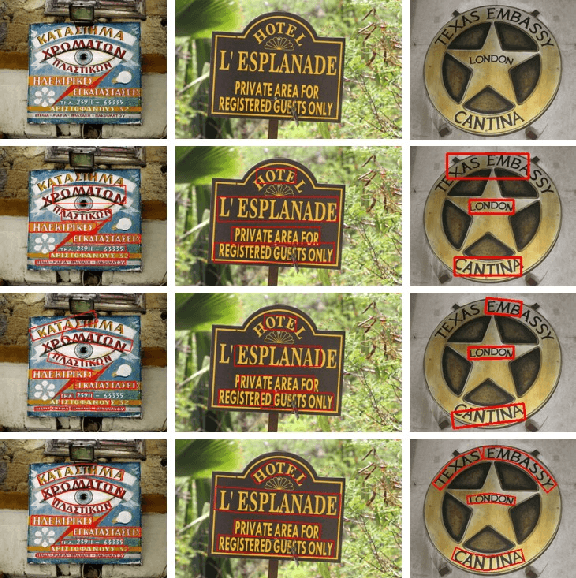
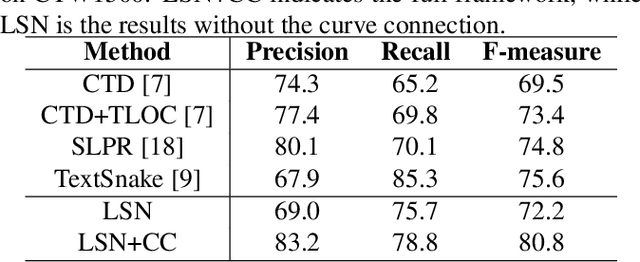
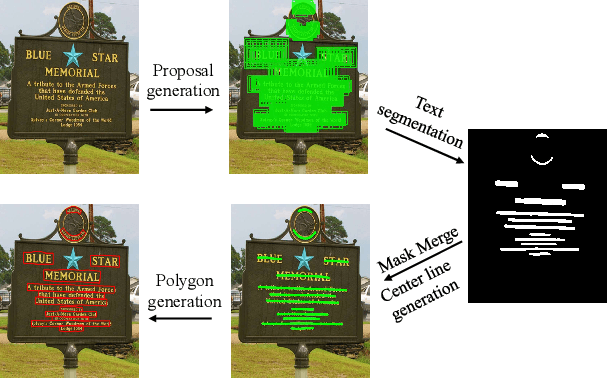
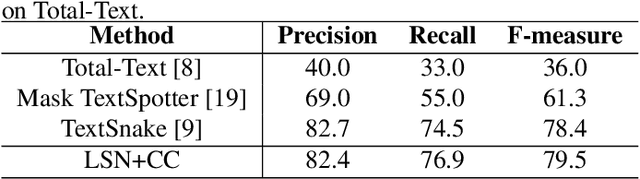
Curve text or arbitrary shape text is very common in real-world scenarios. In this paper, we propose a novel framework with the local segmentation network (LSN) followed by the curve connection to detect text in horizontal, oriented and curved forms. The LSN is composed of two elements, i.e., proposal generation to get the horizontal rectangle proposals with high overlap with text and text segmentation to find the arbitrary shape text region within proposals. The curve connection is then designed to connect the local mask to the detection results. We conduct experiments using the proposed framework on two real-world curve text detection datasets and demonstrate the effectiveness over previous approaches.