 Add to Chrome
 Add to Firefox
 Add to Edge
HCP-DCNet: A Hierarchical Causal Primitive Dynamic Composition Network for Self-Improving Causal Understanding
Mar 12, 2026
The ability to understand and reason about cause and effect -- encompassing interventions, counterfactuals, and underlying mechanisms -- is a cornerstone of robust artificial intelligence. While deep learning excels at pattern recognition, it fundamentally lacks a model of causality, making systems brittle under distribution shifts and unable to answer ``what-if'' questions. This paper introduces the \emph{Hierarchical Causal Primitive Dynamic Composition Network (HCP-DCNet)}, a unified framework that bridges continuous physical dynamics with discrete symbolic causal inference. Departing from monolithic representations, HCP-DCNet decomposes causal scenes into reusable, typed \emph{causal primitives} organized into four abstraction layers: physical, functional, event, and rule. A dual-channel routing network dynamically composes these primitives into task-specific, fully differentiable \emph{Causal Execution Graphs (CEGs)}. Crucially, the system employs a \emph{causal-intervention-driven meta-evolution} strategy, enabling autonomous self-improvement through a constrained Markov decision process. We establish rigorous theoretical guarantees, including type-safe composition, routing convergence, and universal approximation of causal dynamics. Extensive experiments across simulated physical and social environments demonstrate that HCP-DCNet significantly outperforms state-of-the-art baselines in causal discovery, counterfactual reasoning, and compositional generalization. This work provides a principled, scalable, and interpretable architecture for building AI systems with human-like causal abstraction and continual self-refinement capabilities.

A Geometrically-Grounded Drive for MDL-Based Optimization in Deep Learning
Mar 12, 2026This paper introduces a novel optimization framework that fundamentally integrates the Minimum Description Length (MDL) principle into the training dynamics of deep neural networks. Moving beyond its conventional role as a model selection criterion, we reformulate MDL as an active, adaptive driving force within the optimization process itself. The core of our method is a geometrically-grounded cognitive manifold whose evolution is governed by a \textit{coupled Ricci flow}, enriched with a novel \textit{MDL Drive} term derived from first principles. This drive, modulated by the task-loss gradient, creates a seamless harmony between data fidelity and model simplification, actively compressing the internal representation during training. We establish a comprehensive theoretical foundation, proving key properties including the monotonic decrease of description length (Theorem~\ref{thm:convergence}), a finite number of topological phase transitions via a geometric surgery protocol (Theorems~\ref{thm:surgery}, \ref{thm:ultimate_fate}), and the emergence of universal critical behavior (Theorem~\ref{thm:universality}). Furthermore, we provide a practical, computationally efficient algorithm with $O(N \log N)$ per-iteration complexity (Theorem~\ref{thm:complexity}), alongside guarantees for numerical stability (Theorem~\ref{thm:stability}) and exponential convergence under convexity assumptions (Theorem~\ref{thm:convergence_rate}). Empirical validation on synthetic regression and classification tasks confirms the theoretical predictions, demonstrating the algorithm's efficacy in achieving robust generalization and autonomous model simplification. This work provides a principled path toward more autonomous, generalizable, and interpretable AI systems by unifying geometric deep learning with information-theoretic principles.
Geometric Meta-Learning via Coupled Ricci Flow: Unifying Knowledge Representation and Quantum Entanglement
Mar 25, 2025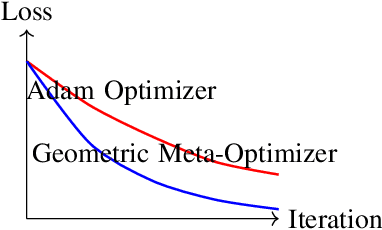
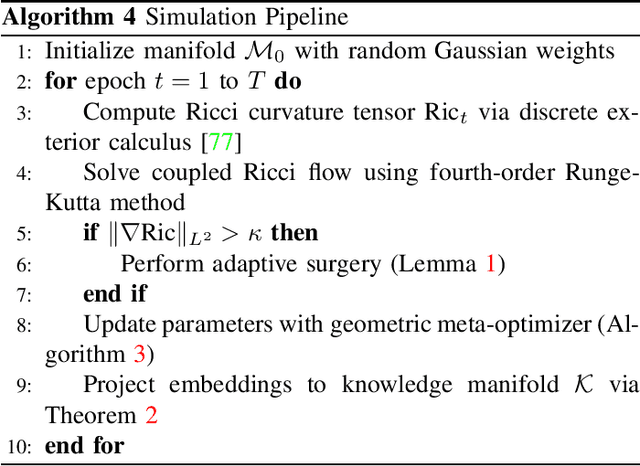
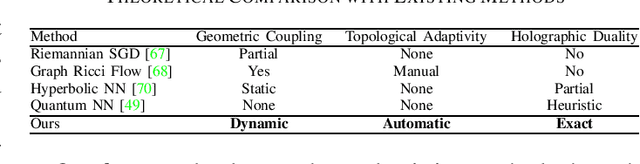

This paper establishes a unified framework integrating geometric flows with deep learning through three fundamental innovations. First, we propose a thermodynamically coupled Ricci flow that dynamically adapts parameter space geometry to loss landscape topology, formally proved to preserve isometric knowledge embedding (Theorem~\ref{thm:isometric}). Second, we derive explicit phase transition thresholds and critical learning rates (Theorem~\ref{thm:critical}) through curvature blowup analysis, enabling automated singularity resolution via geometric surgery (Lemma~\ref{lem:surgery}). Third, we establish an AdS/CFT-type holographic duality (Theorem~\ref{thm:ads}) between neural networks and conformal field theories, providing entanglement entropy bounds for regularization design. Experiments demonstrate 2.1$\times$ convergence acceleration and 63\% topological simplification while maintaining $\mathcal{O}(N\log N)$ complexity, outperforming Riemannian baselines by 15.2\% in few-shot accuracy. Theoretically, we prove exponential stability (Theorem~\ref{thm:converge}) through a new Lyapunov function combining Perelman entropy with Wasserstein gradient flows, fundamentally advancing geometric deep learning.