 Add to Chrome
 Add to Firefox
 Add to Edge
ReasFlow: Assisting Reasoning-Centric Scientific Discovery in Applied Mathematics via a Knowledge-Based Multi-Agent System
Jul 15, 2026
Recent advances in Large Language Models have fueled autonomous AI agents capable of tackling complex scientific tasks, yet existing automated research systems remain predominantly focused on empirically driven domains with quantitative benchmarks, leaving theory-driven discovery, particularly in mathematically grounded disciplines requiring rigorous proofs and synthesis of domain knowledge, largely underexplored. Key challenges include the difficulty of verifying theoretical reasoning at scale, insufficient reasoning ability for autonomous frontier exploration, and a scarcity of procedural heuristics in the literature. We introduce ReasFlow, an end-to-end autonomous agent system for reasoning-centric scientific discovery that operationalizes a collaborative paradigm where the human expert acts as Principal Investigator while the agent executes rigorous derivations as a capable graduate student. ReasFlow incorporates (i) a robust internal verification loop that audits logical coherence and corrects fundamental errors prior to human inspection, and (ii) an automated knowledge retrieval and self-improvement mechanism that proactively surfaces both declarative facts and overlooked procedural heuristics, substantially reducing expert intervention. The system unifies literature synthesis, algorithm design, theorem proving, experimentation, and manuscript preparation in a single system. Deployed to autonomously generate five complete research papers with rigorous theoretical and empirical content from minimal prompts, ReasFlow consistently achieves the highest evaluation scores among state-of-the-art open-access baselines under a curated LLM-based review rubric. ReasFlow is publicly accessible via the ReasLab platform, providing a collaborative workspace for AI-assisted theoretical research. Github repo: https://github.com/ReasLab/ReasFlow.git.

Negligible in Size, Significant in Effect: On Scale Vectors in Large Language Models
May 26, 2026Normalization layers in modern large language models (LLMs) consist of a deterministic normalization operation and a learnable scale vector. While the normalization operation has been extensively studied, the scale vector remains poorly understood despite its ubiquitous use. In this work, we present a systematic study of scale vectors in LLMs from the perspectives of expressivity, optimization, and architectural structure. First, we show empirically that although scale vectors constitute only a negligible fraction of model parameters, removing them substantially degrades LLM pre-training. Our theory further shows that, in Pre-Norm architectures, scale vectors do not increase expressivity; instead, they improve optimization through a self-amplifying preconditioning effect on subsequent linear mappings. Second, we investigate the role of weight decay for scale vectors. By distinguishing Input-Norm and Output-Norm layers, we theoretically show that weight decay is beneficial for the former but harmful for the latter, due to their distinct roles in optimization and expressivity. Third, motivated by this understanding, we propose three lightweight and complementary improvements to scale vectors: branch-specific heterogeneity, improved placement around linear mappings, and magnitude-direction reparameterization. Both theory and experiments show that each improvement yields consistent gains. Finally, we combine these improvements into a unified scale-vector strategy and evaluate it through extensive LLM pre-training experiments on dense and mixture-of-experts models ranging from 0.12B to 2B parameters, across multiple optimizers and learning rate schedules, under industrial-scale token budgets. The unified strategy consistently achieves lower terminal loss than well-tuned baselines and exhibits more favorable scaling behavior, while adding negligible parameter and computational overhead.
Subspace Optimization for Efficient Federated Learning under Heterogeneous Data
Apr 28, 2026Federated learning increasingly operates in a large-model regime where communication, memory, and computation are all scarce. Typically, non-IID client data induce drift that degrades the stability and performance of local training. Existing remedies such as SCAFFOLD introduce heterogeneity-correction mechanisms to address this challenge, but they incur substantial extra communication and memory overhead. This paper proposes a subspace optimization method for federated learning (SSF), which performs heterogeneity-corrected optimization in a low-dimensional subspace using only projected quantities, while preserving full-dimensional control information through a backfill-style update that retains residual components whenever the active subspace changes. Under standard smoothness and bounded-variance assumptions, SSF attains a non-asymptotic rate of order $\widetilde{\mathcal{O}}(1/T+1/\sqrt{NKT})$. Experiments show favorable accuracy--efficiency trade-offs under heterogeneous data.
Accelerating LLM Pre-Training through Flat-Direction Dynamics Enhancement
Feb 26, 2026Pre-training Large Language Models requires immense computational resources, making optimizer efficiency essential. The optimization landscape is highly anisotropic, with loss reduction driven predominantly by progress along flat directions. While matrix-based optimizers such as Muon and SOAP leverage fine-grained curvature information to outperform AdamW, their updates tend toward isotropy -- relatively conservative along flat directions yet potentially aggressive along sharp ones. To address this limitation, we first establish a unified Riemannian Ordinary Differential Equation (ODE) framework that elucidates how common adaptive algorithms operate synergistically: the preconditioner induces a Riemannian geometry that mitigates ill-conditioning, while momentum serves as a Riemannian damping term that promotes convergence. Guided by these insights, we propose LITE, a generalized acceleration strategy that enhances training dynamics by applying larger Hessian damping coefficients and learning rates along flat trajectories. Extensive experiments demonstrate that LITE significantly accelerates both Muon and SOAP across diverse architectures (Dense, MoE), parameter scales (130M--1.3B), datasets (C4, Pile), and learning-rate schedules (cosine, warmup-stable-decay). Theoretical analysis confirms that LITE facilitates faster convergence along flat directions in anisotropic landscapes, providing a principled approach to efficient LLM pre-training. The code is available at https://github.com/SHUCHENZHU/LITE.
SPARKLE: A Unified Single-Loop Primal-Dual Framework for Decentralized Bilevel Optimization
Nov 21, 2024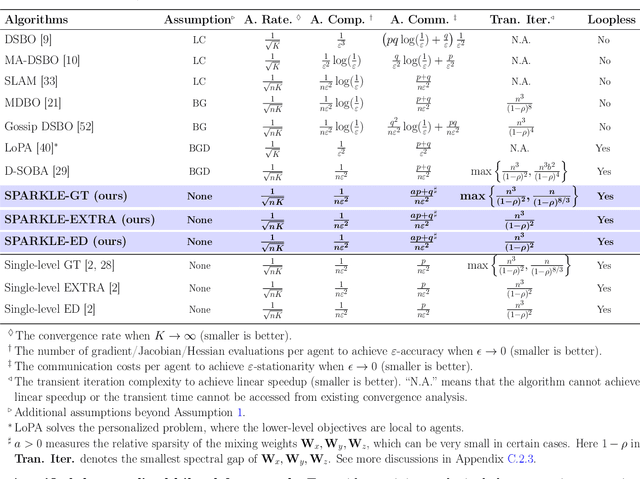
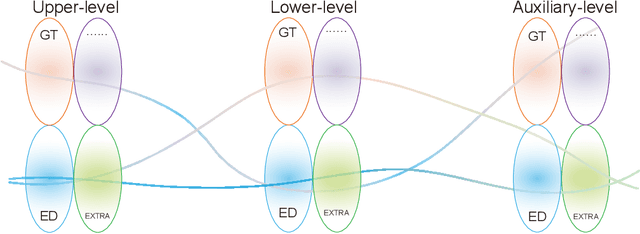
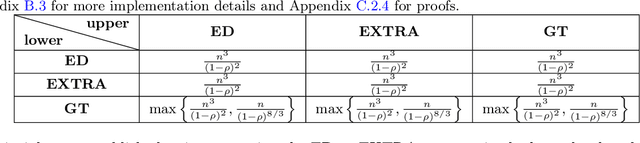
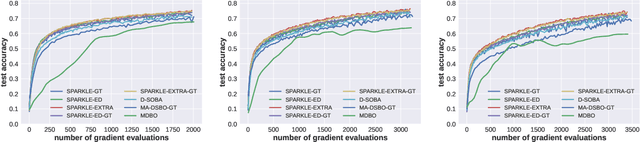
This paper studies decentralized bilevel optimization, in which multiple agents collaborate to solve problems involving nested optimization structures with neighborhood communications. Most existing literature primarily utilizes gradient tracking to mitigate the influence of data heterogeneity, without exploring other well-known heterogeneity-correction techniques such as EXTRA or Exact Diffusion. Additionally, these studies often employ identical decentralized strategies for both upper- and lower-level problems, neglecting to leverage distinct mechanisms across different levels. To address these limitations, this paper proposes SPARKLE, a unified Single-loop Primal-dual AlgoRithm frameworK for decentraLized bilEvel optimization. SPARKLE offers the flexibility to incorporate various heterogeneitycorrection strategies into the algorithm. Moreover, SPARKLE allows for different strategies to solve upper- and lower-level problems. We present a unified convergence analysis for SPARKLE, applicable to all its variants, with state-of-the-art convergence rates compared to existing decentralized bilevel algorithms. Our results further reveal that EXTRA and Exact Diffusion are more suitable for decentralized bilevel optimization, and using mixed strategies in bilevel algorithms brings more benefits than relying solely on gradient tracking.
Decentralized Bilevel Optimization over Graphs: Loopless Algorithmic Update and Transient Iteration Complexity
Feb 05, 2024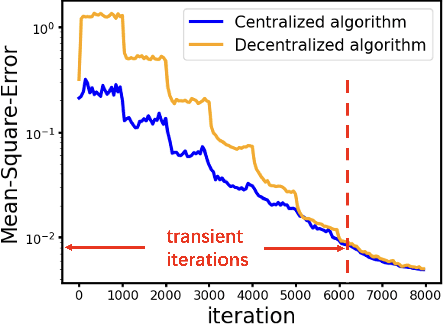
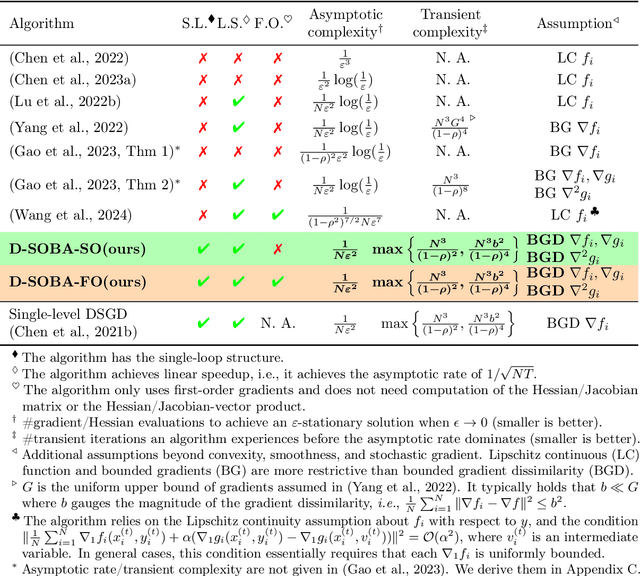
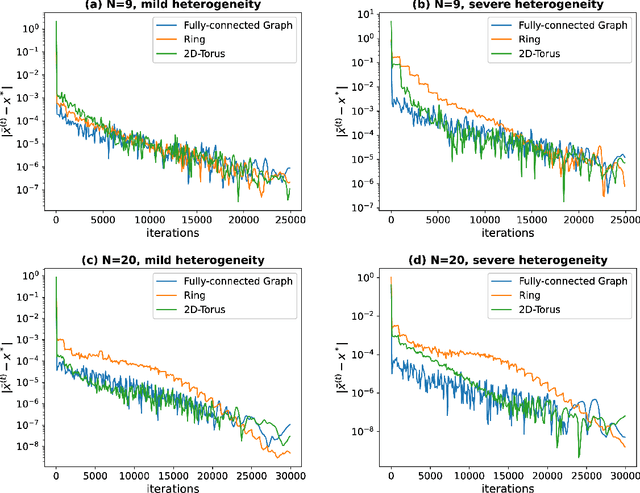
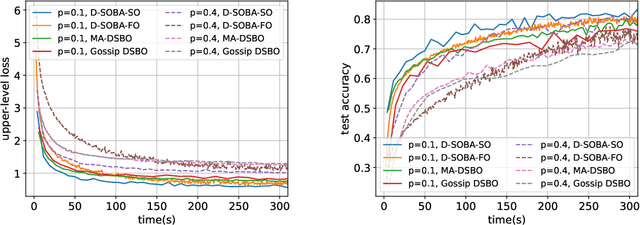
Stochastic bilevel optimization (SBO) is becoming increasingly essential in machine learning due to its versatility in handling nested structures. To address large-scale SBO, decentralized approaches have emerged as effective paradigms in which nodes communicate with immediate neighbors without a central server, thereby improving communication efficiency and enhancing algorithmic robustness. However, current decentralized SBO algorithms face challenges, including expensive inner-loop updates and unclear understanding of the influence of network topology, data heterogeneity, and the nested bilevel algorithmic structures. In this paper, we introduce a single-loop decentralized SBO (D-SOBA) algorithm and establish its transient iteration complexity, which, for the first time, clarifies the joint influence of network topology and data heterogeneity on decentralized bilevel algorithms. D-SOBA achieves the state-of-the-art asymptotic rate, asymptotic gradient/Hessian complexity, and transient iteration complexity under more relaxed assumptions compared to existing methods. Numerical experiments validate our theoretical findings.