 Add to Chrome
 Add to Firefox
 Add to Edge
High-Resolution Single-Shot Polarimetric Imaging Made Easy
Apr 07, 2026
Polarization-based vision has gained increasing attention for providing richer physical cues beyond RGB images. While achieving single-shot capture is highly desirable for practical applications, existing Division-of-Focal-Plane (DoFP) sensors inherently suffer from reduced spatial resolution and artifacts due to their spatial multiplexing mechanism. To overcome these limitations without sacrificing the snapshot capability, we propose EasyPolar, a multi-view polarimetric imaging framework. Our system is grounded in the physical insight that three independent intensity measurements are sufficient to fully characterize linear polarization. Guided by this, we design a triple-camera setup consisting of three synchronized RGB cameras that capture one unpolarized view and two polarized views with distinct orientations. Building upon this hardware design, we further propose a confidence-guided polarization reconstruction network to address the potential misalignment in multi-view fusion. The network performs multi-modal feature fusion under a confidence-aware physical guidance mechanism, which effectively suppresses warping-induced artifacts and enforces explicit geometric constraints on the solution space. Experimental results demonstrate that our method achieves high-quality results and benefits various downstream tasks.

Near-Light Color Photometric Stereo for mono-Chromaticity non-lambertian surface
Jan 19, 2026Color photometric stereo enables single-shot surface reconstruction, extending conventional photometric stereo that requires multiple images of a static scene under varying illumination to dynamic scenarios. However, most existing approaches assume ideal distant lighting and Lambertian reflectance, leaving more practical near-light conditions and non-Lambertian surfaces underexplored. To overcome this limitation, we propose a framework that leverages neural implicit representations for depth and BRDF modeling under the assumption of mono-chromaticity (uniform chromaticity and homogeneous material), which alleviates the inherent ill-posedness of color photometric stereo and allows for detailed surface recovery from just one image. Furthermore, we design a compact optical tactile sensor to validate our approach. Experiments on both synthetic and real-world datasets demonstrate that our method achieves accurate and robust surface reconstruction.
PIDSR:ComplementaryPolarizedImageDemosaicingandSuper-Resolution
Apr 10, 2025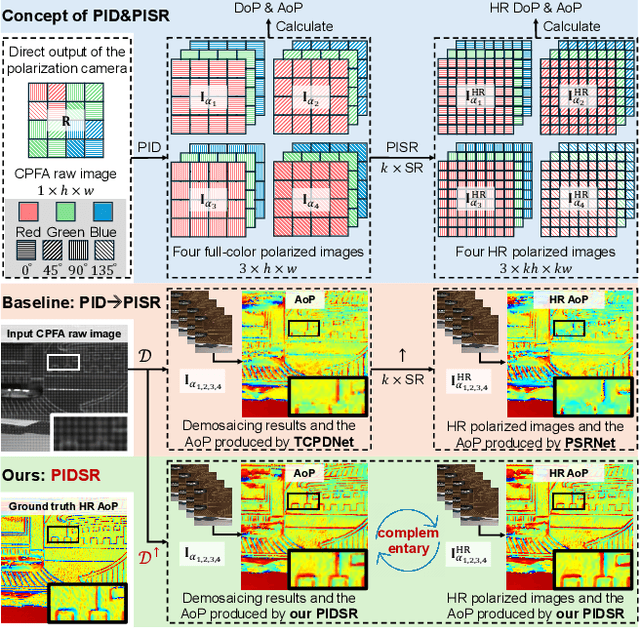
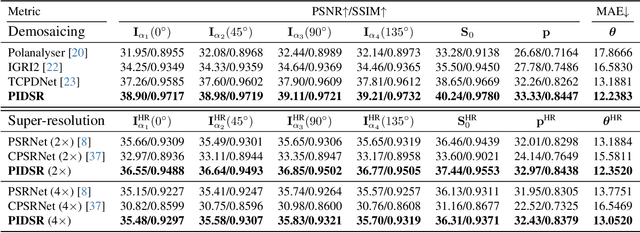
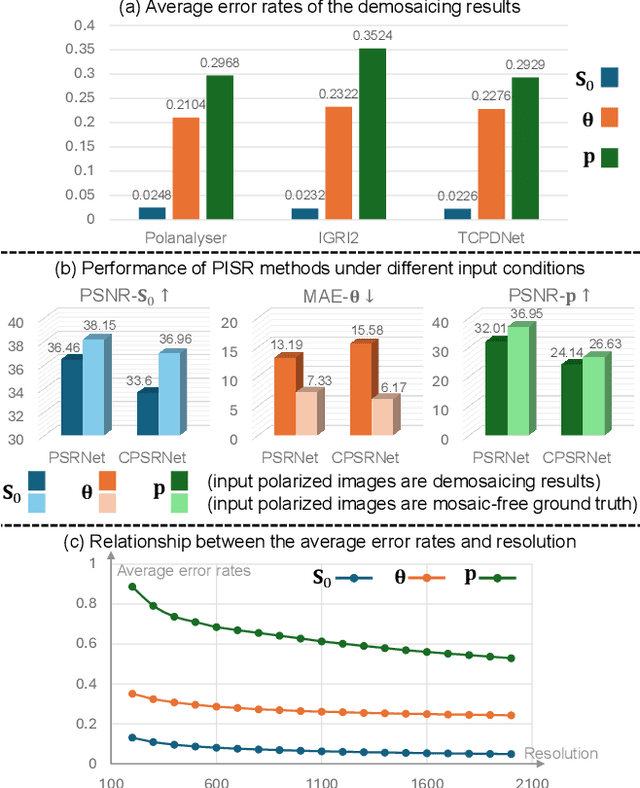
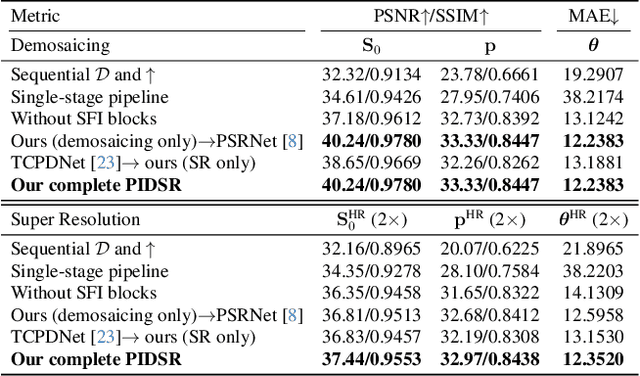
Polarization cameras can capture multiple polarized images with different polarizer angles in a single shot, bringing convenience to polarization-based downstream tasks. However, their direct outputs are color-polarization filter array (CPFA) raw images, requiring demosaicing to reconstruct full-resolution, full-color polarized images; unfortunately, this necessary step introduces artifacts that make polarization-related parameters such as the degree of polarization (DoP) and angle of polarization (AoP) prone to error. Besides, limited by the hardware design, the resolution of a polarization camera is often much lower than that of a conventional RGB camera. Existing polarized image demosaicing (PID) methods are limited in that they cannot enhance resolution, while polarized image super-resolution (PISR) methods, though designed to obtain high-resolution (HR) polarized images from the demosaicing results, tend to retain or even amplify errors in the DoP and AoP introduced by demosaicing artifacts. In this paper, we propose PIDSR, a joint framework that performs complementary Polarized Image Demosaicing and Super-Resolution, showing the ability to robustly obtain high-quality HR polarized images with more accurate DoP and AoP from a CPFA raw image in a direct manner. Experiments show our PIDSR not only achieves state-of-the-art performance on both synthetic and real data, but also facilitates downstream tasks.