 Add to Chrome
 Add to Firefox
 Add to Edge
Vision-Assisted Foundation Model for Solving Multi-Task Vehicle Routing Problems
Jun 09, 2026
Multi-task vehicle routing problems play a critical role in enhancing efficiency across various industries and service sectors. These problems consist of multiple variants that optimize routing costs while meeting diverse customer constraints. Existing multi-task VRP solvers solely utilize a graph-based modality, limiting their ability to address variants with multiple constraints. As a format to represent complex semantics, vision modality shows great potential for encoding diverse VRP constraints. This motivates us to learn patch-level semantics from the vision images, and then integrate them into a graph-based model to solve various VRP variants simultaneously. However, directly applying this approach to multi-task VRPs presents three challenges: 1) existing VRP images lack constraint representations, which are essential for multi-task VRPs, 2) the fixed receptive field of individual patches cannot effectively accommodate varying requirements across tasks, and 3) imbalanced pixel distribution among constraints may cause the model to overlook constraints with fewer pixels. In this paper, we propose a vision-assisted foundation model (VaFM) to address these challenges. In the vision modality, input images tailored to all constraints are encoded by a convolutional neural network. The obtained patch embeddings are fused with graph-based nodes to generate solutions, with an auxiliary task designed to address the pixel-imbalanced issue. The performance of VaFM is evaluated across 16 different VRP variants. The experimental results demonstrate the superiority of VaFM over state-of-the-art methods, especially for variants with complex constraints.

Chain-of-Context Learning: Dynamic Constraint Understanding for Multi-Task VRPs
Mar 02, 2026Multi-task Vehicle Routing Problems (VRPs) aim to minimize routing costs while satisfying diverse constraints. Existing solvers typically adopt a unified reinforcement learning (RL) framework to learn generalizable patterns across tasks. However, they often overlook the constraint and node dynamics during the decision process, making the model fail to accurately react to the current context. To address this limitation, we propose Chain-of-Context Learning (CCL), a novel framework that progressively captures the evolving context to guide fine-grained node adaptation. Specifically, CCL constructs step-wise contextual information via a Relevance-Guided Context Reformulation (RGCR) module, which adaptively prioritizes salient constraints. This context then guides node updates through a Trajectory-Shared Node Re-embedding (TSNR) module, which aggregates shared node features from all trajectories' contexts and uses them to update inputs for the next step. By modeling evolving preferences of the RL agent, CCL captures step-by-step dependencies in sequential decision-making. We evaluate CCL on 48 diverse VRP variants, including 16 in-distribution and 32 out-of-distribution (with unseen constraints) tasks. Experimental results show that CCL performs favorably against the state-of-the-art baselines, achieving the best performance on all in-distribution tasks and the majority of out-of-distribution tasks.
CholecTriplet2022: Show me a tool and tell me the triplet -- an endoscopic vision challenge for surgical action triplet detection
Feb 13, 2023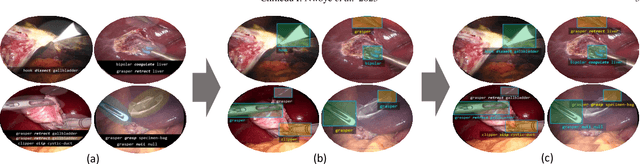


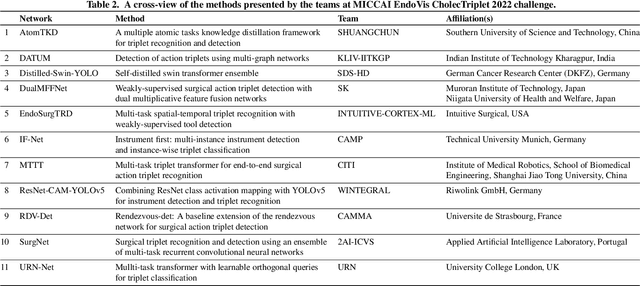
Formalizing surgical activities as triplets of the used instruments, actions performed, and target anatomies is becoming a gold standard approach for surgical activity modeling. The benefit is that this formalization helps to obtain a more detailed understanding of tool-tissue interaction which can be used to develop better Artificial Intelligence assistance for image-guided surgery. Earlier efforts and the CholecTriplet challenge introduced in 2021 have put together techniques aimed at recognizing these triplets from surgical footage. Estimating also the spatial locations of the triplets would offer a more precise intraoperative context-aware decision support for computer-assisted intervention. This paper presents the CholecTriplet2022 challenge, which extends surgical action triplet modeling from recognition to detection. It includes weakly-supervised bounding box localization of every visible surgical instrument (or tool), as the key actors, and the modeling of each tool-activity in the form of <instrument, verb, target> triplet. The paper describes a baseline method and 10 new deep learning algorithms presented at the challenge to solve the task. It also provides thorough methodological comparisons of the methods, an in-depth analysis of the obtained results, their significance, and useful insights for future research directions and applications in surgery.