 Add to Chrome
 Add to Firefox
 Add to Edge
Rectify Evaluation Preference: Improving LLMs' Critique on Math Reasoning via Perplexity-aware Reinforcement Learning
Nov 13, 2025
To improve Multi-step Mathematical Reasoning (MsMR) of Large Language Models (LLMs), it is crucial to obtain scalable supervision from the corpus by automatically critiquing mistakes in the reasoning process of MsMR and rendering a final verdict of the problem-solution. Most existing methods rely on crafting high-quality supervised fine-tuning demonstrations for critiquing capability enhancement and pay little attention to delving into the underlying reason for the poor critiquing performance of LLMs. In this paper, we orthogonally quantify and investigate the potential reason -- imbalanced evaluation preference, and conduct a statistical preference analysis. Motivated by the analysis of the reason, a novel perplexity-aware reinforcement learning algorithm is proposed to rectify the evaluation preference, elevating the critiquing capability. Specifically, to probe into LLMs' critiquing characteristics, a One-to-many Problem-Solution (OPS) benchmark is meticulously constructed to quantify the behavior difference of LLMs when evaluating the problem solutions generated by itself and others. Then, to investigate the behavior difference in depth, we conduct a statistical preference analysis oriented on perplexity and find an intriguing phenomenon -- ``LLMs incline to judge solutions with lower perplexity as correct'', which is dubbed as \textit{imbalanced evaluation preference}. To rectify this preference, we regard perplexity as the baton in the algorithm of Group Relative Policy Optimization, supporting the LLMs to explore trajectories that judge lower perplexity as wrong and higher perplexity as correct. Extensive experimental results on our built OPS and existing available critic benchmarks demonstrate the validity of our method.

Cardiac Digital Twins at Scale from MRI: Open Tools and Representative Models from ~55000 UK Biobank Participants
May 27, 2025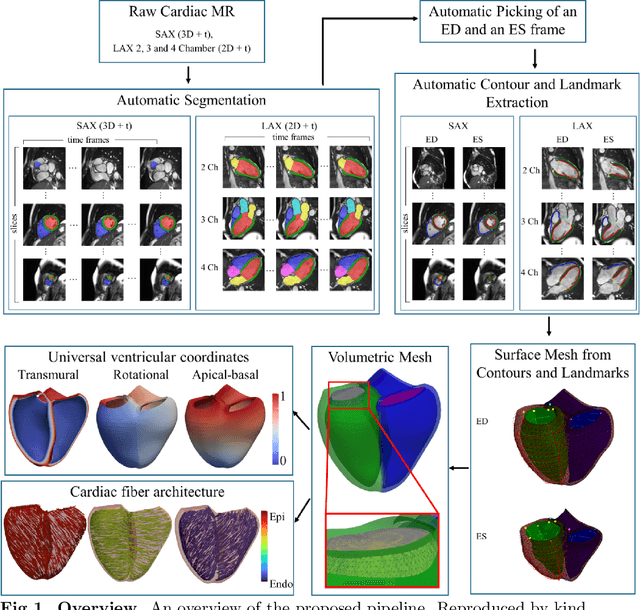
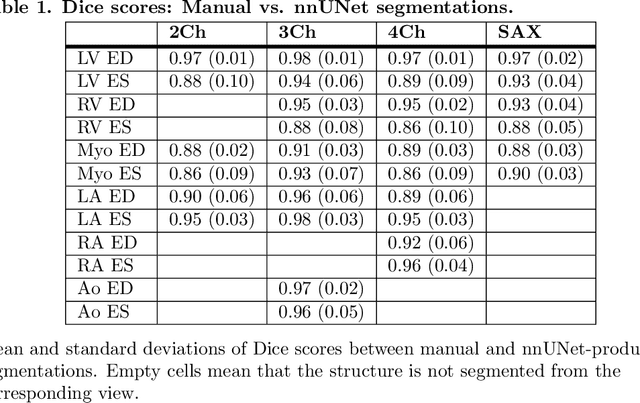
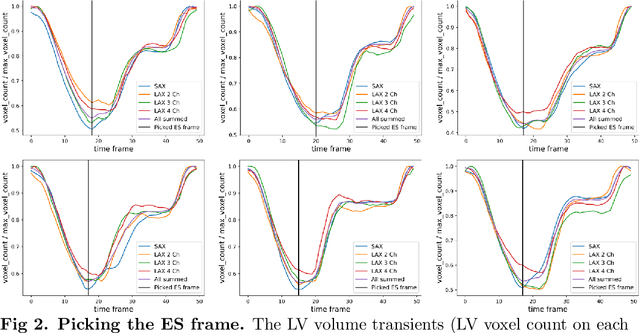
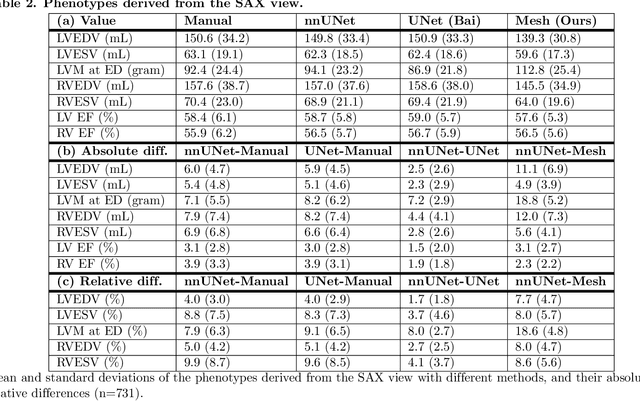
A cardiac digital twin is a virtual replica of a patient's heart for screening, diagnosis, prognosis, risk assessment, and treatment planning of cardiovascular diseases. This requires an anatomically accurate patient-specific 3D structural representation of the heart, suitable for electro-mechanical simulations or study of disease mechanisms. However, generation of cardiac digital twins at scale is demanding and there are no public repositories of models across demographic groups. We describe an automatic open-source pipeline for creating patient-specific left and right ventricular meshes from cardiovascular magnetic resonance images, its application to a large cohort of ~55000 participants from UK Biobank, and the construction of the most comprehensive cohort of adult heart models to date, comprising 1423 representative meshes across sex (male, female), body mass index (range: 16 - 42 kg/m$^2$) and age (range: 49 - 80 years). Our code is available at https://github.com/cdttk/biv-volumetric-meshing/tree/plos2025 , and pre-trained networks, representative volumetric meshes with fibers and UVCs will be made available soon.