 Add to Chrome
 Add to Firefox
 Add to Edge
Writer-R1: Enhancing Generative Writing in LLMs via Memory-augmented Replay Policy Optimization
Mar 16, 2026
As a typical open-ended generation task, creative writing lacks verifiable reference answers, which has long constrained reward modeling and automatic evaluation due to high human annotation costs, evaluative bias, and coarse feedback signals. To address these challenges, this paper first designs a multi-agent collaborative workflow based on Grounded Theory, performing dimensional decomposition and hierarchical induction of the problem to dynamically produce interpretable and reusable fine-grained criteria. Furthermore, we propose the Memory-augmented Replay Policy Optimization (MRPO) algorithm: on the one hand, without additional training, MRPO guides models to engage in self-reflection based on dynamic criteria, enabling controlled iterative improvement; on the other hand, we adopt the training paradigm that combines supervised fine-tuning with reinforcement learning to convert evaluation criteria into reward signals, achieving end-to-end optimization. Experimental results demonstrate that the automatically constructed criteria achieve performance gains comparable to human annotations. Writer-R1-4B models trained with this approach outperform baselines across multiple creative writing tasks and surpass some 100B+ parameter open-source models.

QChunker: Learning Question-Aware Text Chunking for Domain RAG via Multi-Agent Debate
Mar 12, 2026The effectiveness upper bound of retrieval-augmented generation (RAG) is fundamentally constrained by the semantic integrity and information granularity of text chunks in its knowledge base. To address these challenges, this paper proposes QChunker, which restructures the RAG paradigm from retrieval-augmentation to understanding-retrieval-augmentation. Firstly, QChunker models the text chunking as a composite task of text segmentation and knowledge completion to ensure the logical coherence and integrity of text chunks. Drawing inspiration from Hal Gregersen's "Questions Are the Answer" theory, we design a multi-agent debate framework comprising four specialized components: a question outline generator, text segmenter, integrity reviewer, and knowledge completer. This framework operates on the principle that questions serve as catalysts for profound insights. Through this pipeline, we successfully construct a high-quality dataset of 45K entries and transfer this capability to small language models. Additionally, to handle long evaluation chains and low efficiency in existing chunking evaluation methods, which overly rely on downstream QA tasks, we introduce a novel direct evaluation metric, ChunkScore. Both theoretical and experimental validations demonstrate that ChunkScore can directly and efficiently discriminate the quality of text chunks. Furthermore, during the text segmentation phase, we utilize document outlines for multi-path sampling to generate multiple candidate chunks and select the optimal solution employing ChunkScore. Extensive experimental results across four heterogeneous domains exhibit that QChunker effectively resolves aforementioned issues by providing RAG with more logically coherent and information-rich text chunks.
RouterKT: Mixture-of-Experts for Knowledge Tracing
Apr 11, 2025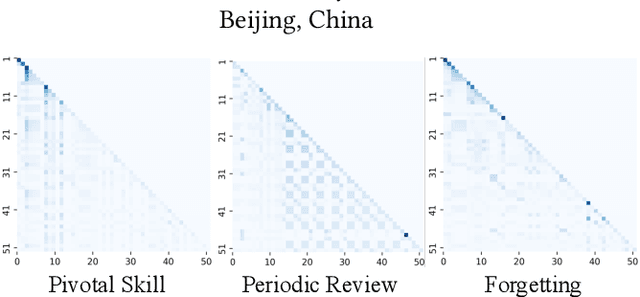
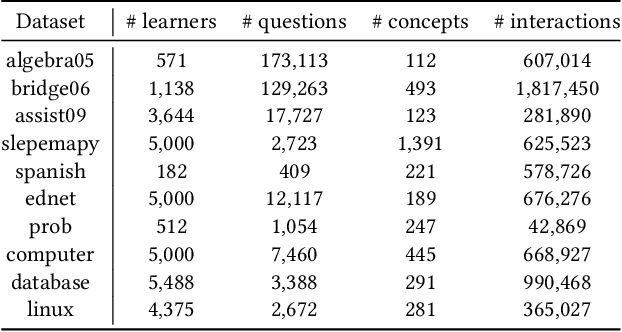
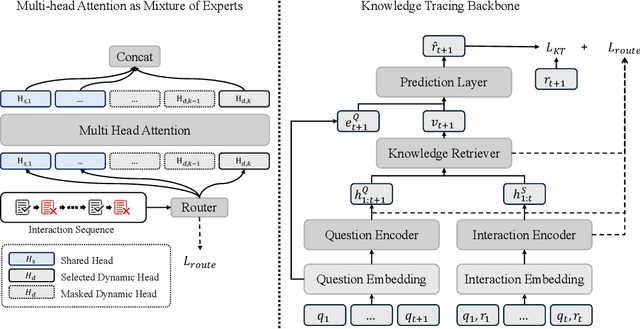
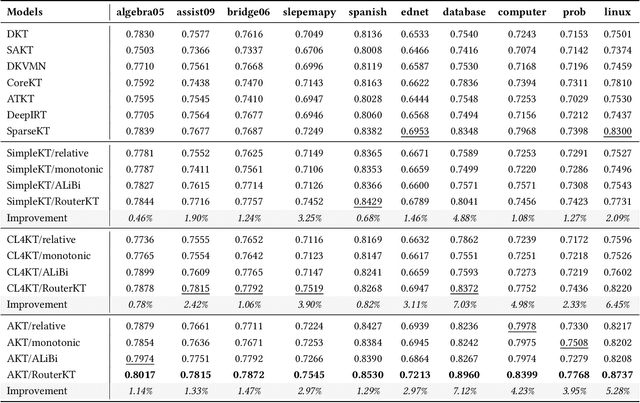
Knowledge Tracing (KT) is a fundamental task in Intelligent Tutoring Systems (ITS), which aims to model the dynamic knowledge states of students based on their interaction histories. However, existing KT models often rely on a global forgetting decay mechanism for capturing learning patterns, assuming that students' performance is predominantly influenced by their most recent interactions. Such approaches fail to account for the diverse and complex learning patterns arising from individual differences and varying learning stages. To address this limitation, we propose RouterKT, a novel Mixture-of-Experts (MoE) architecture designed to capture heterogeneous learning patterns by enabling experts to specialize in different patterns without any handcrafted learning pattern bias such as forgetting decay. Specifically, RouterKT introduces a \textbf{person-wise routing mechanism} to effectively model individual-specific learning behaviors and employs \textbf{multi-heads as experts} to enhance the modeling of complex and diverse patterns. Comprehensive experiments on ten benchmark datasets demonstrate that RouterKT exhibits significant flexibility and improves the performance of various KT backbone models, with a maximum average AUC improvement of 3.29\% across different backbones and datasets, outperforming other state-of-the-art models. Moreover, RouterKT demonstrates consistently superior inference efficiency compared to existing approaches based on handcrafted learning pattern bias, highlighting its usability for real-world educational applications. The source code is available at https://github.com/derek-liao/RouterKT.git.
Fair Knowledge Tracing in Second Language Acquisition
Dec 23, 2024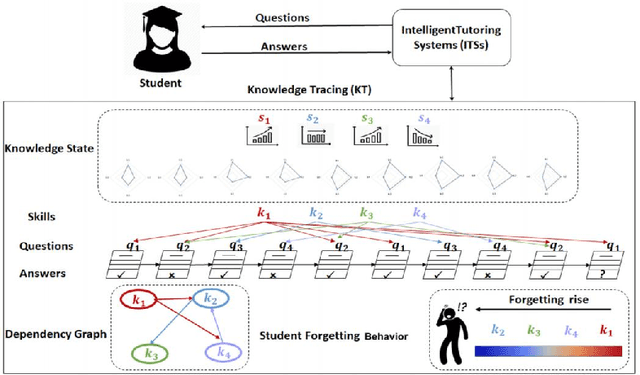
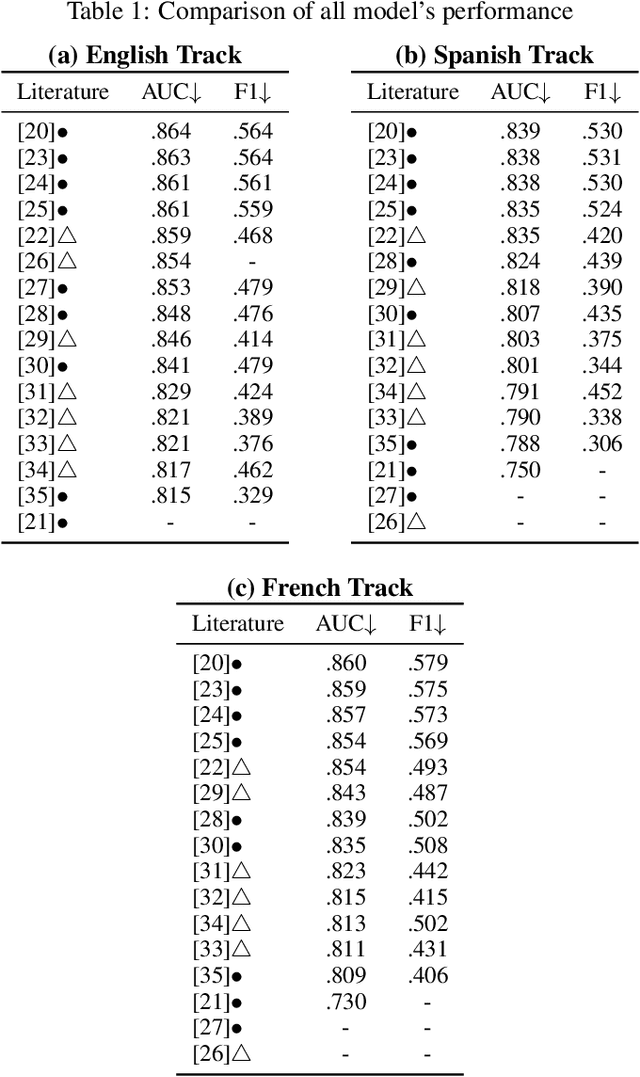
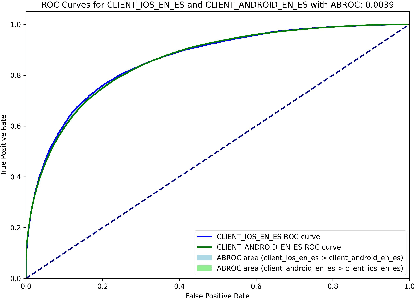
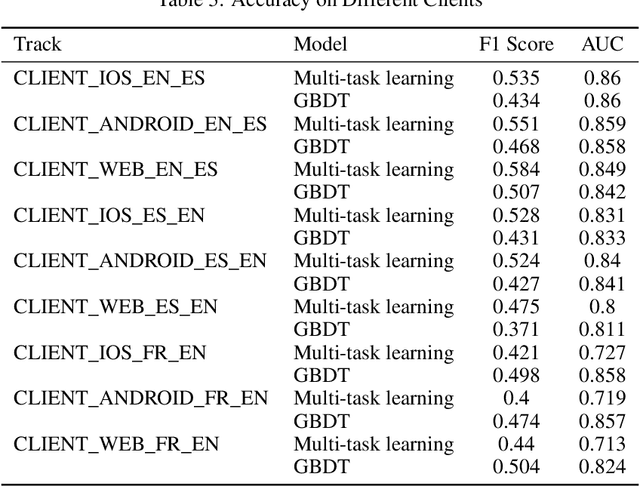
In second-language acquisition, predictive modeling aids educators in implementing diverse teaching strategies, attracting significant research attention. However, while model accuracy is widely explored, model fairness remains under-examined. Model fairness ensures equitable treatment of groups, preventing unintentional biases based on attributes such as gender, ethnicity, or economic background. A fair model should produce impartial outcomes that do not systematically disadvantage any group. This study evaluates the fairness of two predictive models using the Duolingo dataset's en\_es (English learners speaking Spanish), es\_en (Spanish learners speaking English), and fr\_en (French learners speaking English) tracks. We analyze: 1. Algorithmic fairness across platforms (iOS, Android, Web). 2. Algorithmic fairness between developed and developing countries. Key findings include: 1. Deep learning outperforms machine learning in second-language knowledge tracing due to improved accuracy and fairness. 2. Both models favor mobile users over non-mobile users. 3. Machine learning exhibits stronger bias against developing countries compared to deep learning. 4. Deep learning strikes a better balance of fairness and accuracy in the en\_es and es\_en tracks, while machine learning is more suitable for fr\_en. This study highlights the importance of addressing fairness in predictive models to ensure equitable educational strategies across platforms and regions.