 Add to Chrome
 Add to Firefox
 Add to Edge
Fully Rotation-Equivariant Spectral-Spatial Learning for Multispectral Object Detection
Jul 06, 2026
Existing multispectral detectors are limited by discrete spectral processing, a scale-dependent shift in the relative reliability of spectral and spatial cues across pyramid levels, and the lack of explicit rotation-equivariant geometric priors for arbitrarily oriented objects. To tackle these limitations, we propose FressDet, a fully rotation-equivariant spectral-spatial learning framework for multispectral object detection, capable of capturing the continuous, ordered nature of spectral structure and enabling reliable spectral-spatial fusion across pyramid levels under arbitrary in-plane rotations. FressDet integrates three complementary components. Spectral Implicit Warp (SpeIW) enables query-based spectral resampling via a coordinate-conditioned implicit field, yielding a monotone, order-preserving warp. Rotation-Equivariant Consistency Weighting (ReCoW) adaptively fuses spectral and spatial branches based on branch reliability, reinforcing informative cues while suppressing noise across pyramid levels. The oriented-aware head exploits group-indexed features to stably predict oriented objects without parameter replication. Taken together, FressDet learns more discriminative and robust spectral-spatial representations even under rotational perturbations. By achieving state-of-the-art performance with 93% fewer parameters on three public benchmarks, FressDet demonstrates its effectiveness and generalizability.

MODA: The First Challenging Benchmark for Multispectral Object Detection in Aerial Images
Dec 10, 2025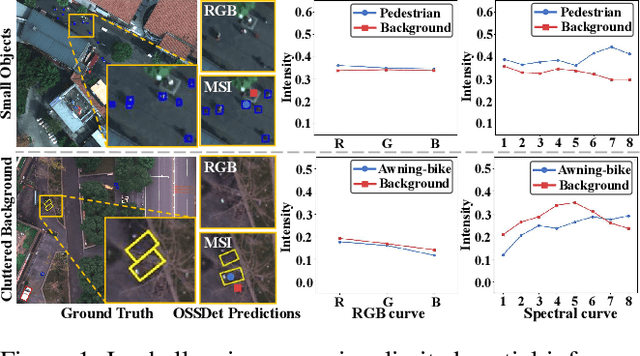

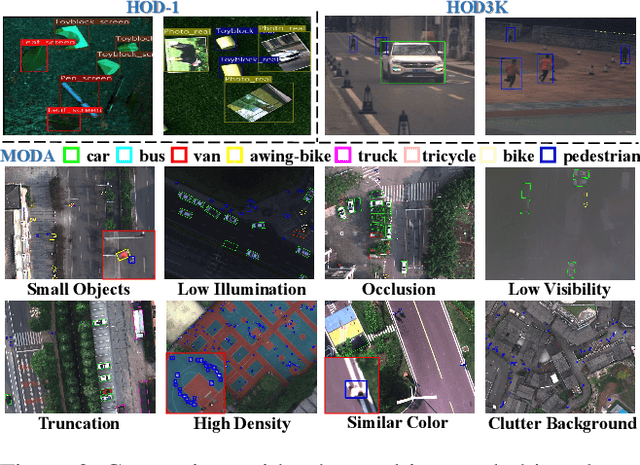
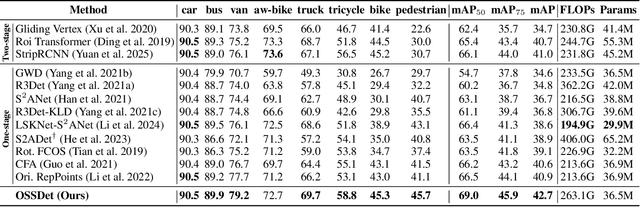
Aerial object detection faces significant challenges in real-world scenarios, such as small objects and extensive background interference, which limit the performance of RGB-based detectors with insufficient discriminative information. Multispectral images (MSIs) capture additional spectral cues across multiple bands, offering a promising alternative. However, the lack of training data has been the primary bottleneck to exploiting the potential of MSIs. To address this gap, we introduce the first large-scale dataset for Multispectral Object Detection in Aerial images (MODA), which comprises 14,041 MSIs and 330,191 annotations across diverse, challenging scenarios, providing a comprehensive data foundation for this field. Furthermore, to overcome challenges inherent to aerial object detection using MSIs, we propose OSSDet, a framework that integrates spectral and spatial information with object-aware cues. OSSDet employs a cascaded spectral-spatial modulation structure to optimize target perception, aggregates spectrally related features by exploiting spectral similarities to reinforce intra-object correlations, and suppresses irrelevant background via object-aware masking. Moreover, cross-spectral attention further refines object-related representations under explicit object-aware guidance. Extensive experiments demonstrate that OSSDet outperforms existing methods with comparable parameters and efficiency.