 Add to Chrome
 Add to Firefox
 Add to Edge
Beyond Isolated Tasks: A Framework for Evaluating Coding Agents on Sequential Software Evolution
Apr 03, 2026
Existing datasets for coding agents evaluate performance on isolated, single pull request (PR) tasks in a stateless manner, failing to capture the reality of real-world software development where code changes accumulate, technical debt accrues, and test suites grow over time. To bridge this gap, we introduce an automated coding task generation framework, which helps generate our dataset SWE-STEPS, that evaluates coding agents on long-horizon tasks through two realistic settings mirroring actual developer workflows: Conversational coding with iterative requests, and single-shot Project Requirement document (PRD)-based coding. Unlike existing datasets that evaluate agents on disjointed Pull Requests (PRs), our framework assesses performance across chains of dependent PRs, enabling evaluation of sequential execution, regression verification, and long-term repository health. We discover that widely used isolated PR evaluations yield inflated success rates, w.r.t. our settings - overshooting performance by as much as 20 percentage points - because they ignore the ``spillover'' effects of previous inefficient or buggy code. Furthermore, our analysis reveals that even when agents successfully resolve issues, they degrade repository health by generating code with higher cognitive complexity and technical debt compared to human developers, underscoring the necessity for multidimensional evaluation.

Fighting Fire with Fire: Adversarial Prompting to Generate a Misinformation Detection Dataset
Jan 09, 2024The recent success in language generation capabilities of large language models (LLMs), such as GPT, Bard, Llama etc., can potentially lead to concerns about their possible misuse in inducing mass agitation and communal hatred via generating fake news and spreading misinformation. Traditional means of developing a misinformation ground-truth dataset does not scale well because of the extensive manual effort required to annotate the data. In this paper, we propose an LLM-based approach of creating silver-standard ground-truth datasets for identifying misinformation. Specifically speaking, given a trusted news article, our proposed approach involves prompting LLMs to automatically generate a summarised version of the original article. The prompts in our proposed approach act as a controlling mechanism to generate specific types of factual incorrectness in the generated summaries, e.g., incorrect quantities, false attributions etc. To investigate the usefulness of this dataset, we conduct a set of experiments where we train a range of supervised models for the task of misinformation detection.
Overview of the HASOC Subtrack at FIRE 2021: Hate Speech and Offensive Content Identification in English and Indo-Aryan Languages
Dec 17, 2021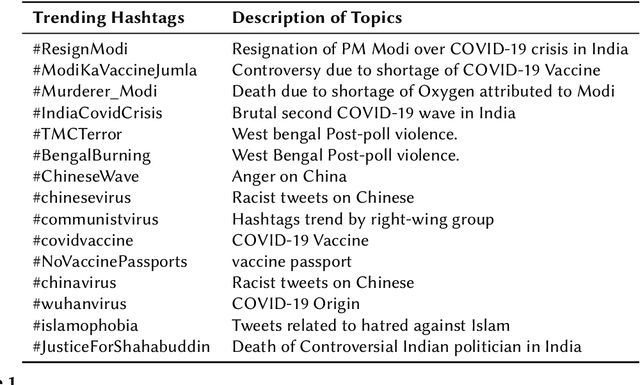
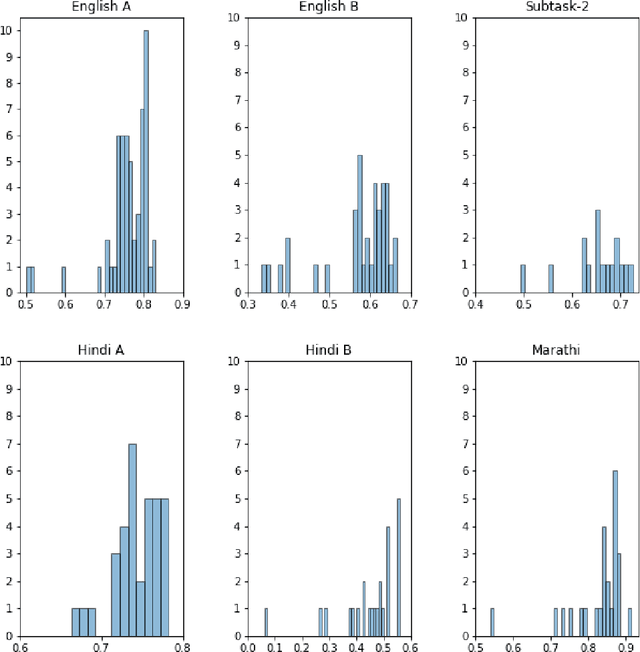
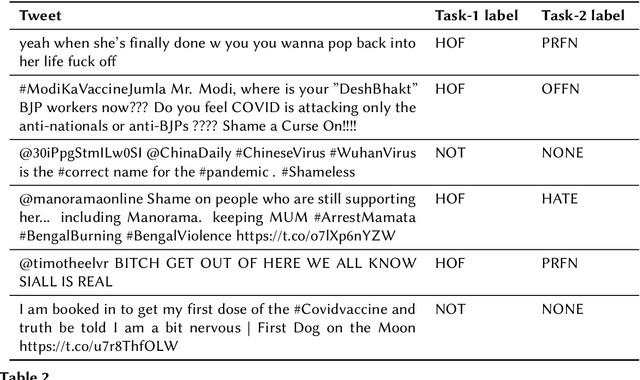
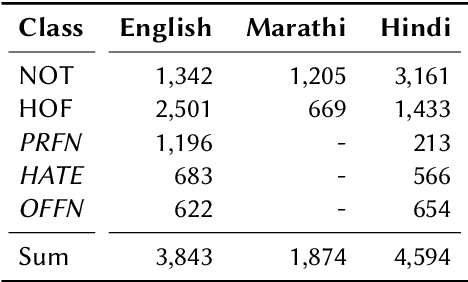
The widespread of offensive content online such as hate speech poses a growing societal problem. AI tools are necessary for supporting the moderation process at online platforms. For the evaluation of these identification tools, continuous experimentation with data sets in different languages are necessary. The HASOC track (Hate Speech and Offensive Content Identification) is dedicated to develop benchmark data for this purpose. This paper presents the HASOC subtrack for English, Hindi, and Marathi. The data set was assembled from Twitter. This subtrack has two sub-tasks. Task A is a binary classification problem (Hate and Not Offensive) offered for all three languages. Task B is a fine-grained classification problem for three classes (HATE) Hate speech, OFFENSIVE and PROFANITY offered for English and Hindi. Overall, 652 runs were submitted by 65 teams. The performance of the best classification algorithms for task A are F1 measures 0.91, 0.78 and 0.83 for Marathi, Hindi and English, respectively. This overview presents the tasks and the data development as well as the detailed results. The systems submitted to the competition applied a variety of technologies. The best performing algorithms were mainly variants of transformer architectures.