 Add to Chrome
 Add to Firefox
 Add to Edge
Annotating Topical Legal Insights from Case Proceedings
Jul 30, 2026
In this paper, we mainly concentrate on finding concepts or topics from the legal case proceedings, since adopting a structured representation for legal documents, as opposed to a mere bag-of-words flat text representation, can significantly enhance processing capabilities. To achieve this objective, we put forward a set of diverse concepts for legal case proceedings. With this motivation, we propose LeDA, a system for Legal Data Annotation. The system offers the generic functionality of annotating and adjudicating entities or concepts within documents via a web-based interface. A novel feature of our system is that it allows to dynamic create new tags for annotation, which is a particularly useful provision for situations where there exists no pre-defined ontology for the entities (concepts) that need to be annotated - these being rather discovered by annotators as they continue examining more documents. The system that we demonstrate is currently in use to annotate a set of concepts from legal documents to construct semantic representations of documents as bags of concepts that can then be used for several downstream tasks, such as prior case retrieval, judgment prediction, and so on. Along with the system features in general, we also describe how LeDA was used by 3 assessors to annotate and adjudicate legal concept names from Indian Supreme Court case proceedings.

Towards a Relevance Posterior in Neural Information Access
Jul 26, 2026Modern information retrieval systems typically operationalise relevance as a query-conditional score computed at inference time. This design choice has become dominant such that alternative decompositions of relevance are rarely discussed, despite the long history of document and query priors in probabilistic retrieval and large-scale search. As neural ranking models grow more computationally expensive and retrieval pipelines expand to include multi-stage ranking, recommendation, and retrieval-augmented generation, this monolithic view of query-time scoring becomes increasingly limiting. We argue that modern information access systems are more naturally understood as performing approximate posterior inference, in which relevance is refined through a staged combination of query-dependent likelihoods and query-independent priors. We extend classical probabilistic retrieval formalisms to contemporary learned systems and show how explicit likelihood-prior decomposition exposes new opportunities to shift computation offline while disentangling document-level and interaction-level beliefs. We present empirical evidence that incorporating query-independent document utility can complement existing rankers and improve effectiveness with minimal query-time computation (solely score fusion). Concretely, a learned prior improves first-stage retrieval through rank fusion (up to 0.046 nDCG@10 on TREC DL-2019 and 0.029 nDCG@10 on TREC DL-2020) and also improves downstream re-ranking, with the largest gains observed for the LLM re-ranker RankZephyr (up to 0.054 nDCG@10 on TREC DL-2020). Finally, we discuss how this decomposition connects to broader information access and outline research directions for designing retrieval systems that explicitly allocate modelling capacity between offline priors and online interaction.
A Theoretical Framework for Risk Analysis of Stochastic Rankers
Jun 15, 2026Different from deterministic rankers that seek to maximize relevance at top ranks, stochastic ranking policies instead estimate distributions over permutations, from which rankings are sampled, towards obtaining diversified or fair exposure. Such policies are commonly evaluated in terms of expected effectiveness postreranking. However, the randomness inherent in these policies gives rise to a fundamental but under-explored ex ante question: prior to applying stochastic reranking, how large can the induced variation in retrieval effectiveness be in the worst case? This paper presents a theoretical analysis of reranking risk, defined as the maximum absolute change in discounted cumulative gain (DCG) resulting from a permutation sampled from a stochastic reranking policy applied to a fixed retrieved list.We derive that this risk is governed by the distribution of the recall points in the initial retrieved list. We conduct experiments on submitted runs from the TREC Fairness 2022 track that employ stochastic reranking policies and empirically demonstrate that the effectiveness variations predicted by our theory closely approximate the observed changes in DCG.
Dynamic Ranked List Truncation for Reranking Pipelines via LLM-generated Reference-Documents
Apr 10, 2026Large Language Models (LLM) have been widely used in reranking. Computational overhead and large context lengths remain a challenging issue for LLM rerankers. Efficient reranking usually involves selecting a subset of the ranked list from the first stage, known as ranked list truncation (RLT). The truncated list is processed further by a reranker. For LLM rerankers, the ranked list is often partitioned and processed sequentially in batches to reduce the context length. Both these steps involve hyperparameters and topic-agnostic heuristics. Recently, LLMs have been shown to be effective for relevance judgment. Equivalently, we propose that LLMs can be used to generate reference documents that can act as a pivot between relevant and non-relevant documents in a ranked list. We propose methods to use these generated reference documents for RLT as well as for efficient listwise reranking. While reranking, we process the ranked list in either parallel batches of non-overlapping windows or overlapping windows with adaptive strides, improving the existing fixed stride setup. The generated reference documents are also shown to improve existing efficient listwise reranking frameworks. Experiments on TREC Deep Learning benchmarks show that our approach outperforms existing RLT-based approaches. In-domain and out-of-domain benchmarks demonstrate that our proposed methods accelerate LLM-based listwise reranking by up to 66\% compared to existing approaches. This work not only establishes a practical paradigm for efficient LLM-based reranking but also provides insight into the capability of LLMs to generate semantically controlled documents using relevance signals.
LURE-RAG: Lightweight Utility-driven Reranking for Efficient RAG
Jan 27, 2026Most conventional Retrieval-Augmented Generation (RAG) pipelines rely on relevance-based retrieval, which often misaligns with utility -- that is, whether the retrieved passages actually improve the quality of the generated text specific to a downstream task such as question answering or query-based summarization. The limitations of existing utility-driven retrieval approaches for RAG are that, firstly, they are resource-intensive typically requiring query encoding, and that secondly, they do not involve listwise ranking loss during training. The latter limitation is particularly critical, as the relative order between documents directly affects generation in RAG. To address this gap, we propose Lightweight Utility-driven Reranking for Efficient RAG (LURE-RAG), a framework that augments any black-box retriever with an efficient LambdaMART-based reranker. Unlike prior methods, LURE-RAG trains the reranker with a listwise ranking loss guided by LLM utility, thereby directly optimizing the ordering of retrieved documents. Experiments on two standard datasets demonstrate that LURE-RAG achieves competitive performance, reaching 97-98% of the state-of-the-art dense neural baseline, while remaining efficient in both training and inference. Moreover, its dense variant, UR-RAG, significantly outperforms the best existing baseline by up to 3%.
Beyond Correlations: A Downstream Evaluation Framework for Query Performance Prediction
Jan 24, 2026The standard practice of query performance prediction (QPP) evaluation is to measure a set-level correlation between the estimated retrieval qualities and the true ones. However, neither this correlation-based evaluation measure quantifies QPP effectiveness at the level of individual queries, nor does this connect to a downstream application, meaning that QPP methods yielding high correlation values may not find a practical application in query-specific decisions in an IR pipeline. In this paper, we propose a downstream-focussed evaluation framework where a distribution of QPP estimates across a list of top-documents retrieved with several rankers is used as priors for IR fusion. While on the one hand, a distribution of these estimates closely matching that of the true retrieval qualities indicates the quality of the predictor, their usage as priors on the other hand indicates a predictor's ability to make informed choices in an IR pipeline. Our experiments firstly establish the importance of QPP estimates in weighted IR fusion, yielding substantial improvements of over 4.5% over unweighted CombSUM and RRF fusion strategies, and secondly, reveal new insights that the downstream effectiveness of QPP does not correlate well with the standard correlation-based QPP evaluation.
Breaking Flat: A Generalised Query Performance Prediction Evaluation Framework
Jan 24, 2026The traditional use-case of query performance prediction (QPP) is to identify which queries perform well and which perform poorly for a given ranking model. A more fine-grained and arguably more challenging extension of this task is to determine which ranking models are most effective for a given query. In this work, we generalize the QPP task and its evaluation into three settings: (i) SingleRanker MultiQuery (SRMQ-PP), corresponding to the standard use case; (ii) MultiRanker SingleQuery (MRSQ-PP), which evaluates a QPP model's ability to select the most effective ranker for a query; and (iii) MultiRanker MultiQuery (MRMQ-PP), which considers predictions jointly across all query ranker pairs. Our results show that (a) the relative effectiveness of QPP models varies substantially across tasks (SRMQ-PP vs. MRSQ-PP), and (b) predicting the best ranker for a query is considerably more difficult than predicting the relative difficulty of queries for a given ranker.
Predicting Retrieval Utility and Answer Quality in Retrieval-Augmented Generation
Jan 20, 2026The quality of answers generated by large language models (LLMs) in retrieval-augmented generation (RAG) is largely influenced by the contextual information contained in the retrieved documents. A key challenge for improving RAG is to predict both the utility of retrieved documents -- quantified as the performance gain from using context over generation without context -- and the quality of the final answers in terms of correctness and relevance. In this paper, we define two prediction tasks within RAG. The first is retrieval performance prediction (RPP), which estimates the utility of retrieved documents. The second is generation performance prediction (GPP), which estimates the final answer quality. We hypothesise that in RAG, the topical relevance of retrieved documents correlates with their utility, suggesting that query performance prediction (QPP) approaches can be adapted for RPP and GPP. Beyond these retriever-centric signals, we argue that reader-centric features, such as the LLM's perplexity of the retrieved context conditioned on the input query, can further enhance prediction accuracy for both RPP and GPP. Finally, we propose that features reflecting query-agnostic document quality and readability can also provide useful signals to the predictions. We train linear regression models with the above categories of predictors for both RPP and GPP. Experiments on the Natural Questions (NQ) dataset show that combining predictors from multiple feature categories yields the most accurate estimates of RAG performance.
T-Retrievability: A Topic-Focused Approach to Measure Fair Document Exposure in Information Retrieval
Aug 29, 2025Retrievability of a document is a collection-based statistic that measures its expected (reciprocal) rank of being retrieved within a specific rank cut-off. A collection with uniformly distributed retrievability scores across documents is an indicator of fair document exposure. While retrievability scores have been used to quantify the fairness of exposure for a collection, in our work, we use the distribution of retrievability scores to measure the exposure bias of retrieval models. We hypothesise that an uneven distribution of retrievability scores across the entire collection may not accurately reflect exposure bias but rather indicate variations in topical relevance. As a solution, we propose a topic-focused localised retrievability measure, which we call \textit{T-Retrievability} (topic-retrievability), which first computes retrievability scores over multiple groups of topically-related documents, and then aggregates these localised values to obtain the collection-level statistics. Our analysis using this proposed T-Retrievability measure uncovers new insights into the exposure characteristics of various neural ranking models. The findings suggest that this localised measure provides a more nuanced understanding of exposure fairness, offering a more reliable approach for assessing document accessibility in IR systems.
Disentangling Locality and Entropy in Ranking Distillation
May 27, 2025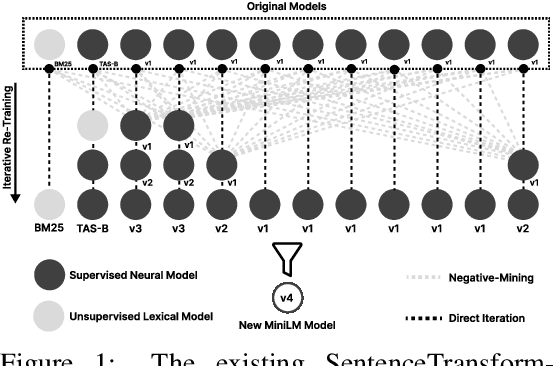
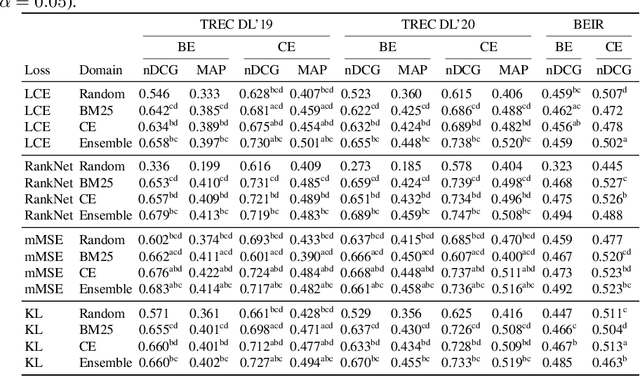
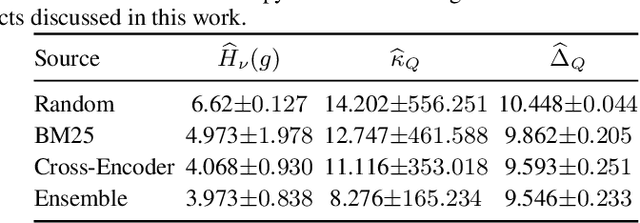
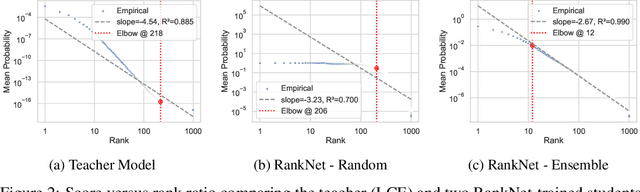
The training process of ranking models involves two key data selection decisions: a sampling strategy, and a labeling strategy. Modern ranking systems, especially those for performing semantic search, typically use a ``hard negative'' sampling strategy to identify challenging items using heuristics and a distillation labeling strategy to transfer ranking "knowledge" from a more capable model. In practice, these approaches have grown increasingly expensive and complex, for instance, popular pretrained rankers from SentenceTransformers involve 12 models in an ensemble with data provenance hampering reproducibility. Despite their complexity, modern sampling and labeling strategies have not been fully ablated, leaving the underlying source of effectiveness gains unclear. Thus, to better understand why models improve and potentially reduce the expense of training effective models, we conduct a broad ablation of sampling and distillation processes in neural ranking. We frame and theoretically derive the orthogonal nature of model geometry affected by example selection and the effect of teacher ranking entropy on ranking model optimization, establishing conditions in which data augmentation can effectively improve bias in a ranking model. Empirically, our investigation on established benchmarks and common architectures shows that sampling processes that were once highly effective in contrastive objectives may be spurious or harmful under distillation. We further investigate how data augmentation, in terms of inputs and targets, can affect effectiveness and the intrinsic behavior of models in ranking. Through this work, we aim to encourage more computationally efficient approaches that reduce focus on contrastive pairs and instead directly understand training dynamics under rankings, which better represent real-world settings.