 Add to Chrome
 Add to Firefox
 Add to Edge
ReCAPA: Hierarchical Predictive Correction to Mitigate Cascading Failures
Apr 23, 2026
Vision-Language-Action systems follow instructions to execute multi-step tasks in multimodal environments. Recent VLA approaches typically rely on post-hoc correction mechanisms or operate under fixed task decompositions and alignment schemes. However, once an intermediate step is mis-specified, local errors propagate through subsequent steps and eventually accumulate into cascading failures. To mitigate this compounding effect, we propose Predictive Alignment and Planning Architecture, a framework that uses prediction and contrast to adjust deviations across three levels: actions, subgoals, and trajectories. Semantic alignment is enforced at all levels using a Sinkhorn-based module and a Score-field module. The predictive correction and alignment jointly update the action generator during training, enabling it to adjust fine-grained steps to remain aligned with the overall intent. We further introduce two new metrics to quantify error propagation and recovery processes in tasks, capturing how mistakes spread and fade over long-horizon execution. Experiments show that ReCAPA achieves competitive results on embodied agent benchmarks such as VisualAgentBench, MineDojo, and AI2-THOR, outperforming strong proprietary and open-source Large Language Model baselines.

DGRC: An Effective Fine-tuning Framework for Distractor Generation in Chinese Multi-choice Reading Comprehension
May 29, 2024

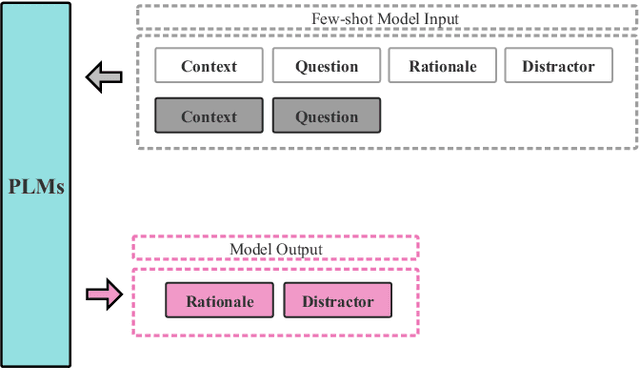
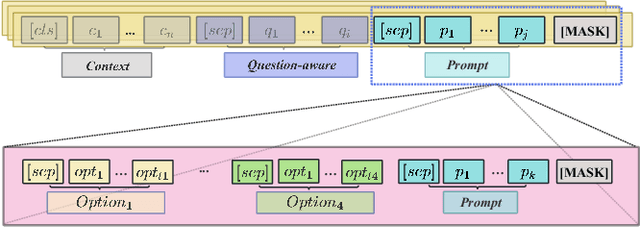
When evaluating a learner's knowledge proficiency, the multiple-choice question is an efficient and widely used format in standardized tests. Nevertheless, generating these questions, particularly plausible distractors (incorrect options), poses a considerable challenge. Generally, the distractor generation can be classified into cloze-style distractor generation (CDG) and natural questions distractor generation (NQDG). In contrast to the CDG, utilizing pre-trained language models (PLMs) for NQDG presents three primary challenges: (1) PLMs are typically trained to generate ``correct'' content, like answers, while rarely trained to generate ``plausible" content, like distractors; (2) PLMs often struggle to produce content that aligns well with specific knowledge and the style of exams; (3) NQDG necessitates the model to produce longer, context-sensitive, and question-relevant distractors. In this study, we introduce a fine-tuning framework named DGRC for NQDG in Chinese multi-choice reading comprehension from authentic examinations. DGRC comprises three major components: hard chain-of-thought, multi-task learning, and generation mask patterns. The experiment results demonstrate that DGRC significantly enhances generation performance, achieving a more than 2.5-fold improvement in BLEU scores.