 Add to Chrome
 Add to Firefox
 Add to Edge
Batch-wise Adaptive Pruning: Periodic Neuron Activation-Aware Weight Pruning for Language Reasoning Model
Aug 14, 2026
Large Reasoning Models (LRMs) achieve strong performance on complex tasks through extended chain-of-thought generation, but incur substantial computational costs during inference. In production settings, batched inference is essential for high throughput, yet the existing training-free adaptive pruning methods we evaluate severely degrade in this regime. Because a batch must share a single pruning mask, these methods aggregate activations across samples and then apply threshold-based selection; the threshold, calibrated offline on unaggregated activations, no longer matches the aggregated distribution, so the realized sparsity ratio drifts and accuracy on reasoning tasks collapses under batched inference. In this work, we propose a training-free adaptive pruning method designed specifically for batched inference in LRMs, built on two components. First, we replace threshold-based selection with periodic top-k selection over the aggregated importance scores, which is unaffected by the shift that aggregation induces in the activation distribution, and which runs selection once per update period rather than at every token, preserving the speedup. Second, based on the observation that important neurons re-fire periodically during long reasoning generation, we introduce an activation memory that accumulates importance across update phases so that recurring neurons are retained. Experiments on diverse reasoning benchmarks demonstrate that our method outperforms the previous state-of-the-art adaptive pruning method by 39.7 percentage points in average accuracy at batch size 4 with 50% target sparsity on DeepSeek-R1-Distill-Qwen-7B, and reaches 1.40x speedup over dense inference at 50% actual sparsity.

On Advantage Estimates for Max@K Policy Gradients
Jun 04, 2026Reinforcement learning with verifiable rewards is widely used for post-training reasoning models, but sparse outcome rewards make exploration difficult. A complementary approach is to optimize inference-time objectives such as pass@K and max@K directly, yet existing policy-gradient estimators for these objectives use different signals, baselines, and normalizations, making their relationships unclear. We study this issue through baseline design and advantage centering. Starting from the advantage estimator of a leading method in the field, we show that it is policy-gradient unbiased but yields a non-centered advantage. We then introduce a Leave-Two-Out baseline that preserves policy-gradient unbiasedness while making realized batch advantages exactly centered. The resulting method, MaxPO, has an efficient quadratic-time implementation and integrates naturally into group-based RL for LLM post-training. We further derive the canonical finite-batch advantage for max@K, providing a unified view of existing advantage estimators. Empirically, we verify that the L2O baseline reduces gradient variance and outperforms non-centered alternatives.
OrderGrad: Optimizing Beyond the Mean with Order-Statistic Policy Gradient Estimation
Jun 04, 2026Policy-gradient methods usually optimize expected return, but many real world applications care about distributional properties of returns: tail risk, outlier robustness, or best-of-K discovery. We introduce OrderGrad, a family of likelihood-ratio and reparameterization gradient estimators for order-statistic objectives. OrderGrad optimizes finite-sample L-statistics, i.e., weighted averages of sorted rewards or costs, recovering objectives such as VaR, CVaR, trimmed means, medians, and top-m/best-of-K criteria by changing only the rank weights. For any fixed sample size and rank-weight vector, OrderGrad provides an unbiased gradient estimator for the corresponding order-statistic objective. The method is implemented as a simple reward transformation that can then be used in an otherwise standard policy-gradient or reparameterized update. We study the resulting estimator's variance behavior and evaluate it on tasks where mean optimization is mismatched to the deployment objective, including LLM math post-training and other tasks. OrderGrad provides a unified, plug-and-play route to risk-averse, robust, and exploratory learning. Code: https://github.com/paavo5/ordergrad
Thinking While Listening: Fast-Slow Recurrence for Long-Horizon Sequential Modeling
Apr 02, 2026We extend the recent latent recurrent modeling to sequential input streams. By interleaving fast, recurrent latent updates with self-organizational ability between slow observation updates, our method facilitates the learning of stable internal structures that evolve alongside the input. This mechanism allows the model to maintain coherent and clustered representations over long horizons, improving out-of-distribution generalization in reinforcement learning and algorithmic tasks compared to sequential baselines such as LSTM, state space models, and Transformer variants.
$\infty$-MoE: Generalizing Mixture of Experts to Infinite Experts
Jan 25, 2026The Mixture of Experts (MoE) selects a few feed-forward networks (FFNs) per token, achieving an effective trade-off between computational cost and performance. In conventional MoE, each expert is treated as entirely independent, and experts are combined in a discrete space. As a result, when the number of experts increases, it becomes difficult to train each expert effectively. To stabilize training while increasing the number of experts, we propose $\infty$-MoE that selects a portion of the parameters of large FFNs based on continuous values sampled for each token. By considering experts in a continuous space, this approach allows for an infinite number of experts while maintaining computational efficiency. Experiments show that a GPT-2 Small-based $\infty$-MoE model, with 129M active and 186M total parameters, achieves comparable performance to a dense GPT-2 Medium with 350M parameters. Adjusting the number of sampled experts at inference time allows for a flexible trade-off between accuracy and speed, with an improvement of up to 2.5\% in accuracy over conventional MoE.
Answer When Needed, Forget When Not: Language Models Pretend to Forget via In-Context Knowledge Unlearning
Oct 01, 2024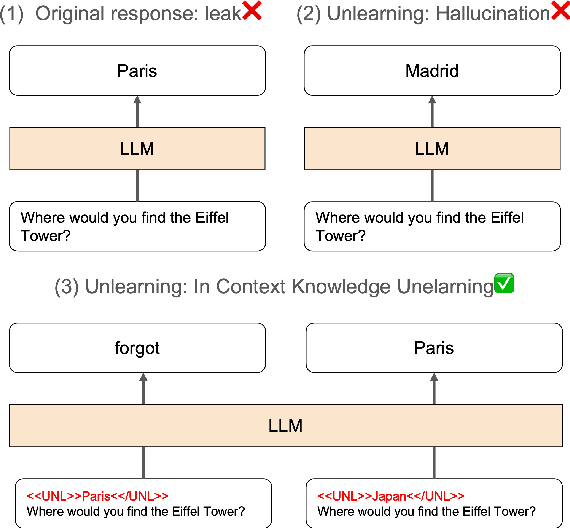


As large language models (LLMs) are applied across diverse domains, the ability to selectively unlearn specific information has become increasingly essential. For instance, LLMs are expected to provide confidential information to authorized internal users, such as employees or trusted partners, while withholding it from external users, including the general public and unauthorized entities. In response to this challenge, we propose a novel method termed ``in-context knowledge unlearning'', which enables the model to selectively forget information in test-time based on the context of the query. Our method fine-tunes pre-trained LLMs to enable prompt unlearning of target knowledge within the context, while preserving other knowledge. Experiments on the TOFU and AGE datasets using Llama2-7B/13B and Mistral-7B models show our method achieves up to 95% forgetting accuracy while retaining 80% of unrelated knowledge, significantly outperforming baselines in both in-domain and out-of-domain scenarios. Further investigation into the model's internal behavior revealed that while fine-tuned LLMs generate correct predictions in the middle layers and maintain them up to the final layer, they make the decision to forget at the last layer, i.e., ``LLMs pretend to forget''. Our findings offer valuable insights into enhancing the robustness of unlearning mechanisms in LLMs, setting a foundation for future research in the field.