 Add to Chrome
 Add to Firefox
 Add to Edge
From Sparse Decisions to Dense Reasoning: A Multi-attribute Trajectory Paradigm for Multimodal Moderation
Jan 28, 2026
Safety moderation is pivotal for identifying harmful content. Despite the success of textual safety moderation, its multimodal counterparts remain hindered by a dual sparsity of data and supervision. Conventional reliance on binary labels lead to shortcut learning, which obscures the intrinsic classification boundaries necessary for effective multimodal discrimination. Hence, we propose a novel learning paradigm (UniMod) that transitions from sparse decision-making to dense reasoning traces. By constructing structured trajectories encompassing evidence grounding, modality assessment, risk mapping, policy decision, and response generation, we reformulate monolithic decision tasks into a multi-dimensional boundary learning process. This approach forces the model to ground its decision in explicit safety semantics, preventing the model from converging on superficial shortcuts. To facilitate this paradigm, we develop a multi-head scalar reward model (UniRM). UniRM provides multi-dimensional supervision by assigning attribute-level scores to the response generation stage. Furthermore, we introduce specialized optimization strategies to decouple task-specific parameters and rebalance training dynamics, effectively resolving interference between diverse objectives in multi-task learning. Empirical results show UniMod achieves competitive textual moderation performance and sets a new multimodal benchmark using less than 40\% of the training data used by leading baselines. Ablations further validate our multi-attribute trajectory reasoning, offering an effective and efficient framework for multimodal moderation. Supplementary materials are available at \href{https://trustworthylab.github.io/UniMod/}{project website}.

SafeWork-R1: Coevolving Safety and Intelligence under the AI-45$^{\circ}$ Law
Jul 24, 2025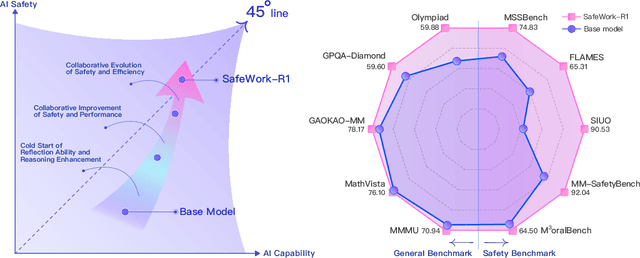
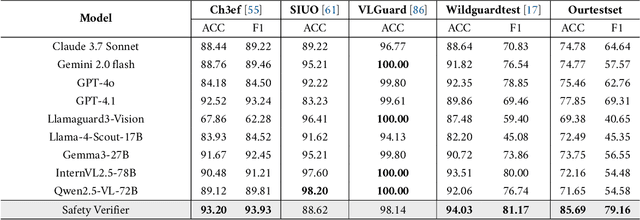
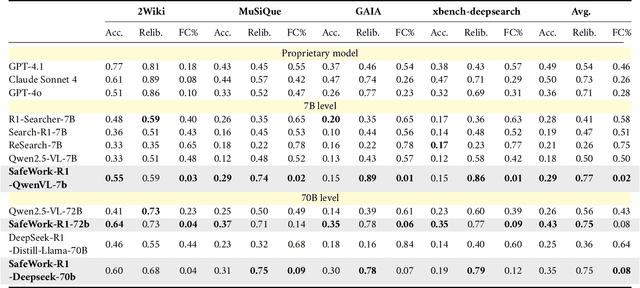
We introduce SafeWork-R1, a cutting-edge multimodal reasoning model that demonstrates the coevolution of capabilities and safety. It is developed by our proposed SafeLadder framework, which incorporates large-scale, progressive, safety-oriented reinforcement learning post-training, supported by a suite of multi-principled verifiers. Unlike previous alignment methods such as RLHF that simply learn human preferences, SafeLadder enables SafeWork-R1 to develop intrinsic safety reasoning and self-reflection abilities, giving rise to safety `aha' moments. Notably, SafeWork-R1 achieves an average improvement of $46.54\%$ over its base model Qwen2.5-VL-72B on safety-related benchmarks without compromising general capabilities, and delivers state-of-the-art safety performance compared to leading proprietary models such as GPT-4.1 and Claude Opus 4. To further bolster its reliability, we implement two distinct inference-time intervention methods and a deliberative search mechanism, enforcing step-level verification. Finally, we further develop SafeWork-R1-InternVL3-78B, SafeWork-R1-DeepSeek-70B, and SafeWork-R1-Qwen2.5VL-7B. All resulting models demonstrate that safety and capability can co-evolve synergistically, highlighting the generalizability of our framework in building robust, reliable, and trustworthy general-purpose AI.