 Add to Chrome
 Add to Firefox
 Add to Edge
Neural Operator-Based Surrogate Model for CFD:Helical Coil Steam Generator in Small Modular Reactor
May 28, 2026
Real-time thermal-hydraulic simulation is essential for digital twin (DT) technology that supports the safe and efficient operation of small modular reactors (SMRs). Computational fluid dynamics (CFD) provides high-fidelity flow analysis, but its computational cost prevents direct use in DT applications. AI-based surrogate modeling has been actively investigated to address this limitation, yet neural operator--based surrogates for CFD-level transient analysis of SMR-specific geometries have not been reported. This study presents an integrated framework that combines a reduced-order model (ROM) with neural operators, applied to the helical coil steam generator (HCSG) of the System-integrated Modular Advanced Reactor (SMART). Two ROM strategies tailored to each CFD data type were compared, an MLP-based autoencoder (AE) for unstructured mesh data and a convolutional autoencoder (CAE) for structured mesh data, and each was coupled with the deep operator network (DeepONet) to construct the latent DeepONet (L-DeepONet). The Fourier neural operator (FNO) was additionally adopted for comparison. A multi-scale technique was incorporated into both frameworks to mitigate spectral bias and improve the prediction of Kármán vortex streets developing inside the HCSG. The multi-scale L-DeepONet captured the instantaneous periodic vortex dynamics in both velocity and pressure fields, while the FNO and its multi-scale variant predicted the time-averaged mean flow and provided reliable pressure drop estimates. These complementary characteristics provide a practical model-selection guideline that links each architecture to specific DT objectives based on CFD data type and the required level of flow resolution.

Advanced deep-reinforcement-learning methods for flow control: group-invariant and positional-encoding networks improve learning speed and quality
Jul 25, 2024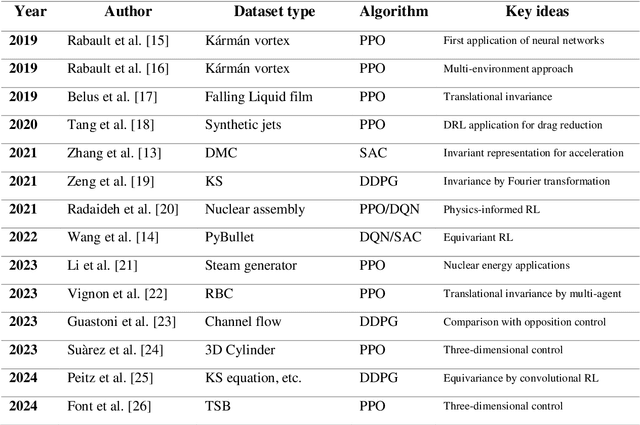
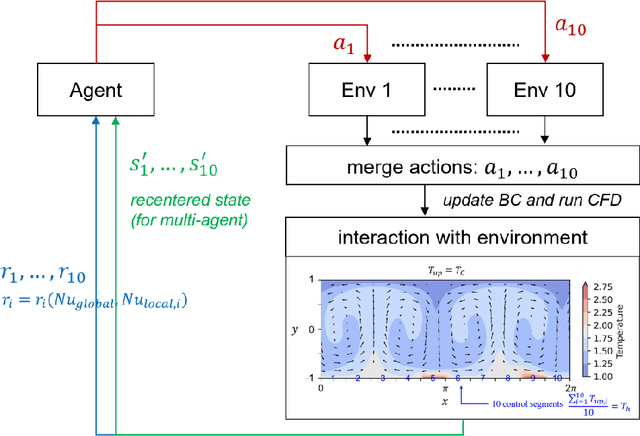
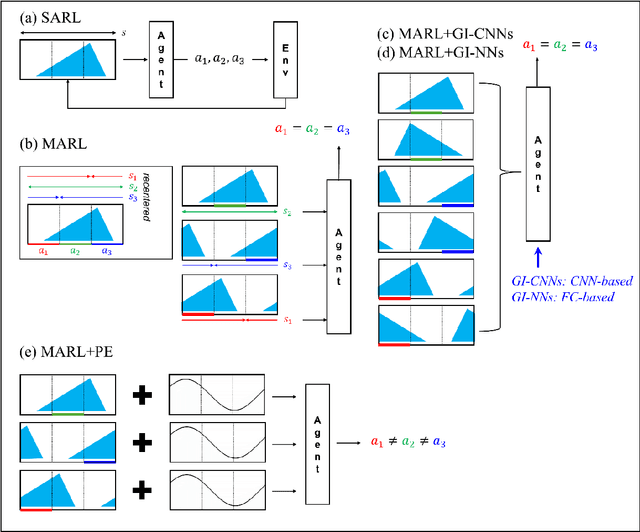

Flow control is key to maximize energy efficiency in a wide range of applications. However, traditional flow-control methods face significant challenges in addressing non-linear systems and high-dimensional data, limiting their application in realistic energy systems. This study advances deep-reinforcement-learning (DRL) methods for flow control, particularly focusing on integrating group-invariant networks and positional encoding into DRL architectures. Our methods leverage multi-agent reinforcement learning (MARL) to exploit policy invariance in space, in combination with group-invariant networks to ensure local symmetry invariance. Additionally, a positional encoding inspired by the transformer architecture is incorporated to provide location information to the agents, mitigating action constraints from strict invariance. The proposed methods are verified using a case study of Rayleigh-B\'enard convection, where the goal is to minimize the Nusselt number Nu. The group-invariant neural networks (GI-NNs) show faster convergence compared to the base MARL, achieving better average policy performance. The GI-NNs not only cut DRL training time in half but also notably enhance learning reproducibility. Positional encoding further enhances these results, effectively reducing the minimum Nu and stabilizing convergence. Interestingly, group invariant networks specialize in improving learning speed and positional encoding specializes in improving learning quality. These results demonstrate that choosing a suitable feature-representation method according to the purpose as well as the characteristics of each control problem is essential. We believe that the results of this study will not only inspire novel DRL methods with invariant and unique representations, but also provide useful insights for industrial applications.