 Add to Chrome
 Add to Firefox
 Add to Edge
Human-AI Collaboration Reconfigures Group Regulation from Socially Shared to Hybrid Co-Regulation
Apr 09, 2026
Generative AI (GenAI) is increasingly used in collaborative learning, yet its effects on how groups regulate collaboration remain unclear. Effective collaboration depends not only on what groups discuss, but on how they jointly manage goals, participation, strategy use, monitoring, and repair through co-regulation and socially shared regulation. We compared collaborative regulation between Human-AI and Human-Human groups in a parallel-group randomised experiment with 71 university students completing the same collaborative tasks with GenAI either available or unavailable. Focusing on human discourse, we used statistical analyses to examine differences in the distribution of collaborative regulation across regulatory modes, regulatory processes, and participatory focuses. Results showed that GenAI availability shifted regulation away from predominantly socially shared forms towards more hybrid co-regulatory forms, with selective increases in directive, obstacle-oriented, and affective regulatory processes. Participatory-focus distributions, however, were broadly similar across conditions. These findings suggest that GenAI reshapes the distribution of regulatory responsibility in collaboration and offer implications for the human-centred design of AI-supported collaborative learning.

Single-agent vs. Multi-agents for Automated Video Analysis of On-Screen Collaborative Learning Behaviors
Apr 04, 2026On-screen learning behavior provides valuable insights into how students seek, use, and create information during learning. Analyzing on-screen behavioral engagement is essential for capturing students' cognitive and collaborative processes. The recent development of Vision Language Models (VLMs) offers new opportunities to automate the labor-intensive manual coding often required for multimodal video data analysis. In this study, we compared the performance of both leading closed-source VLMs (Claude-3.7-Sonnet, GPT-4.1) and open-source VLM (Qwen2.5-VL-72B) in single- and multi-agent settings for automated coding of screen recordings in collaborative learning contexts based on the ICAP framework. In particular, we proposed and compared two multi-agent frameworks: 1) a three-agent workflow multi-agent system (MAS) that segments screen videos by scene and detects on-screen behaviors using cursor-informed VLM prompting with evidence-based verification; 2) an autonomous-decision MAS inspired by ReAct that iteratively interleaves reasoning, tool-like operations (segmentation/ classification/ validation), and observation-driven self-correction to produce interpretable on-screen behavior labels. Experimental results demonstrated that the two proposed MAS frameworks achieved viable performance, outperforming the single VLMs in scene and action detection tasks. It is worth noting that the workflow-based agent achieved best on scene detection, and the autonomous-decision MAS achieved best on action detection. This study demonstrates the effectiveness of VLM-based Multi-agent System for video analysis and contributes a scalable framework for multimodal data analytics.
Comparing the Impact of Pedagogy-Informed Custom and General-Purpose GAI Chatbots on Students' Science Problem-Solving Processes and Performance Using Heterogeneous Interaction Network Analysis
Apr 03, 2026Problem solving plays an essential role in science education, and generative AI (GAI) chatbots have emerged as a promising tool for supporting students' science problem solving. However, general-purpose chatbots (e.g., ChatGPT), which often provide direct, ready-made answers, may lead to students' cognitive offloading. Prior research has rarely focused on custom chatbots for facilitating students' science problem solving, nor has it examined how they differently influence problem-solving processes and performance compared to general-purpose chatbots. To address this gap, we developed a pedagogy-informed custom GAI chatbot grounded in the Socratic questioning method, which supports students by prompting them with guiding questions. This study employed a within-subjects counterbalanced design in which 48 secondary school students used both custom and general-purpose chatbot to complete two science problem-solving tasks. 3297 student-chatbot dialogues were collected and analyzed using Heterogeneous Interaction Network Analysis (HINA). The results showed that: (1) students demonstrated significantly higher interaction intensity and cognitive interaction diversity when using custom chatbot than using general-purpose chatbot; (2) students were more likely to follow custom chatbot's guidance to think and reflect, whereas they tended to request general-purpose chatbot to execute specific commands; and (3) no statistically significant difference was observed in students' problem-solving performance evaluated by solution quality between two chatbot conditions. This study provides novel theoretical insights and empirical evidence that custom chatbots are less likely to induce cognitive offloading and instead foster greater cognitive engagement compared to general-purpose chatbots. This study also offers insights into the design and integration of GAI chatbots in science education.
LLM-Assisted Automated Deductive Coding of Dialogue Data: Leveraging Dialogue-Specific Characteristics to Enhance Contextual Understanding
Apr 28, 2025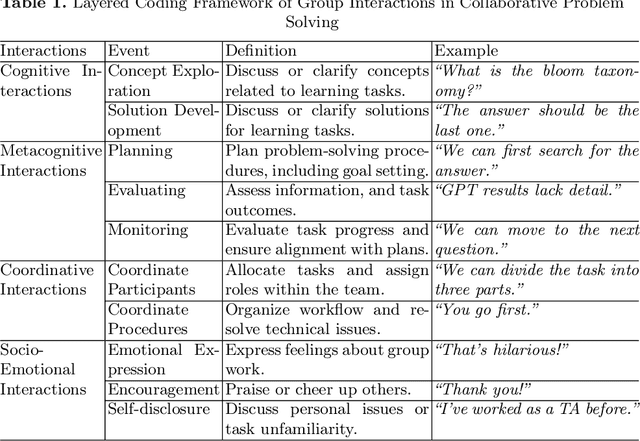
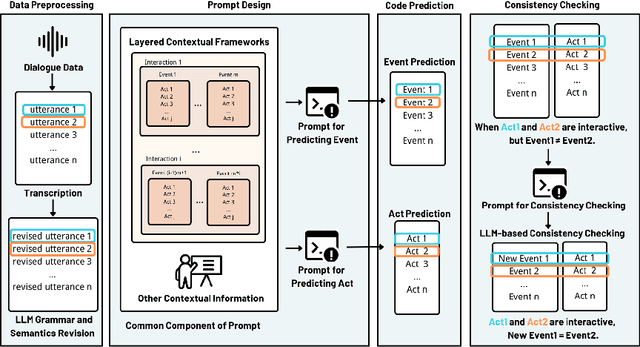

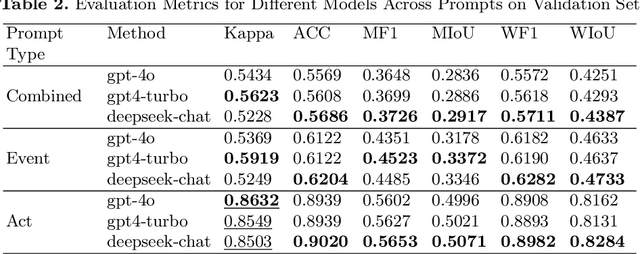
Dialogue data has been a key source for understanding learning processes, offering critical insights into how students engage in collaborative discussions and how these interactions shape their knowledge construction. The advent of Large Language Models (LLMs) has introduced promising opportunities for advancing qualitative research, particularly in the automated coding of dialogue data. However, the inherent contextual complexity of dialogue presents unique challenges for these models, especially in understanding and interpreting complex contextual information. This study addresses these challenges by developing a novel LLM-assisted automated coding approach for dialogue data. The novelty of our proposed framework is threefold: 1) We predict the code for an utterance based on dialogue-specific characteristics -- communicative acts and communicative events -- using separate prompts following the role prompts and chain-of-thoughts methods; 2) We engaged multiple LLMs including GPT-4-turbo, GPT-4o, DeepSeek in collaborative code prediction; 3) We leveraged the interrelation between events and acts to implement consistency checking using GPT-4o. In particular, our contextual consistency checking provided a substantial accuracy improvement. We also found the accuracy of act predictions was consistently higher than that of event predictions. This study contributes a new methodological framework for enhancing the precision of automated coding of dialogue data as well as offers a scalable solution for addressing the contextual challenges inherent in dialogue analysis.