 Add to Chrome
 Add to Firefox
 Add to Edge
Comparing the Impact of Pedagogy-Informed Custom and General-Purpose GAI Chatbots on Students' Science Problem-Solving Processes and Performance Using Heterogeneous Interaction Network Analysis
Apr 03, 2026
Problem solving plays an essential role in science education, and generative AI (GAI) chatbots have emerged as a promising tool for supporting students' science problem solving. However, general-purpose chatbots (e.g., ChatGPT), which often provide direct, ready-made answers, may lead to students' cognitive offloading. Prior research has rarely focused on custom chatbots for facilitating students' science problem solving, nor has it examined how they differently influence problem-solving processes and performance compared to general-purpose chatbots. To address this gap, we developed a pedagogy-informed custom GAI chatbot grounded in the Socratic questioning method, which supports students by prompting them with guiding questions. This study employed a within-subjects counterbalanced design in which 48 secondary school students used both custom and general-purpose chatbot to complete two science problem-solving tasks. 3297 student-chatbot dialogues were collected and analyzed using Heterogeneous Interaction Network Analysis (HINA). The results showed that: (1) students demonstrated significantly higher interaction intensity and cognitive interaction diversity when using custom chatbot than using general-purpose chatbot; (2) students were more likely to follow custom chatbot's guidance to think and reflect, whereas they tended to request general-purpose chatbot to execute specific commands; and (3) no statistically significant difference was observed in students' problem-solving performance evaluated by solution quality between two chatbot conditions. This study provides novel theoretical insights and empirical evidence that custom chatbots are less likely to induce cognitive offloading and instead foster greater cognitive engagement compared to general-purpose chatbots. This study also offers insights into the design and integration of GAI chatbots in science education.

Towards Top-Down Stereoscopic Image Quality Assessment via Stereo Attention
Aug 26, 2023
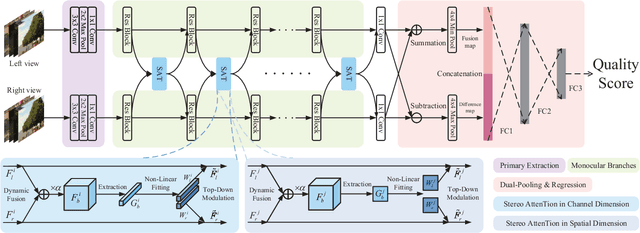


Stereoscopic image quality assessment (SIQA) plays a crucial role in evaluating and improving the visual experience of 3D content. Existing binocular properties and attention-based methods for SIQA have achieved promising performance. However, these bottom-up approaches are inadequate in exploiting the inherent characteristics of the human visual system (HVS). This paper presents a novel network for SIQA via stereo attention, employing a top-down perspective to guide the quality assessment process. Our proposed method realizes the guidance from high-level binocular signals down to low-level monocular signals, while the binocular and monocular information can be calibrated progressively throughout the processing pipeline. We design a generalized Stereo AttenTion (SAT) block to implement the top-down philosophy in stereo perception. This block utilizes the fusion-generated attention map as a high-level binocular modulator, influencing the representation of two low-level monocular features. Additionally, we introduce an Energy Coefficient (EC) to account for recent findings indicating that binocular responses in the primate primary visual cortex are less than the sum of monocular responses. The adaptive EC can tune the magnitude of binocular response flexibly, thus enhancing the formation of robust binocular features within our framework. To extract the most discriminative quality information from the summation and subtraction of the two branches of monocular features, we utilize a dual-pooling strategy that applies min-pooling and max-pooling operations to the respective branches. Experimental results highlight the superiority of our top-down method in simulating the property of visual perception and advancing the state-of-the-art in the SIQA field. The code of this work is available at https://github.com/Fanning-Zhang/SATNet.